
search
The MBR process uses an aeration tank similar to those used in conventional activated sludge processes, combined with membrane filtration as a replacement for secondary sedimentation.
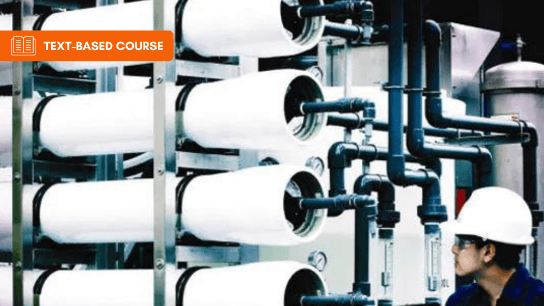
The MBR (membrane bioreactor) process uses an aeration tank similar to those used in conventional activated sludge processes, combined with membrane filtration as a replacement for secondary sedimentation. This combination can produce a very high-quality effluent, typically with a more compact reactor than conventional activated sludge, but requires a higher rate of aeration than conventional activated sludge in order to keep the membranes from fouling. The current typical MBR process configuration uses a membrane module submerged in the aeration tank. This course includes a discussion of process design calculations for the membrane module used in an MBR system, for an MBR aeration tank designed to provide BOD removal and nitrification, and for a pre-anoxic tank to go with an MBR BOD removal and nitrification system.
Topics: At the conclusion of this course, the student will: Be familiar with the components of and general configuration of an MBR wastewater treatment process Know the advantages and disadvantages of an MBR wastewater treatment process in comparison with a conventional activated sludge process Know the type of pretreatment typically required for an MBR wastewater treatment process Be able to carry out process design calculations to determine the required membrane area, membrane module volume and scouring air flow rate for an MBR wastewater treatment system Be able to carry out process design calculations for a BOD removal/nitrification MBR process in order to determine the required aeration tank volume, sludge wasting rate, air flow rate, and alkalinity addition Be able to carry out process design calculations for a Pre-Anoxic Denitrification MBR process in order to determine the required pre-anoxic tank volume, the reduced oxygen/air requirement, the reduced alkalinity requirement, the anoxic tank mixing power needed, and the sludge wasting rate.
Intended Audience: This course is intended for civil engineers, environmental engineers, and chemical engineers. After completing this course you will be familiar with the general components and configuration of an MBR wastewater treatment process and be able to make typical process design calculations for an MBR process.
Publication Source: Based on original courseware, written by Harlan Bengtson, PhD, PE

Dr. Harlan Bengtson is an online PDH course provider of continuing education courses for professional engineers. Dr. Bengtson is a graduate of Iowa State University with B.S. and M.S. degrees and of the University of Colorado with a PhD. He is a licensed Professional Engineer in Missouri. Dr. Bengtson has spent 30 years in engineering education in teaching and administrative positions, including six years as Dean of Engineering at Southern Illinois University Edwardsville. Dr. Harlan H. Bengtson, PE 33 Grainey Drive Glen Carbon, IL 62034 Phone: (618) 406-6892 E-mail: hnkbengtson@yahoo.com PROFESSIONAL PROFILE Dr. Bengtson is a graduate of Iowa State University with B.S. and M.S. degrees and of the University of Colorado with a PhD. He is a licensed Professional Engineer in Missouri. He has spent 30 years in engineering education in teaching and administrative positions, including six years as Dean of Engineering at Southern Illinois University Edwardsville. His areas of expertise are environmental engineering, hydrology and hydraulics, engineering science and renewable energy systems. He has done regular consulting work while holding the academic positions. Prior to entering academia, Dr. Bengtson worked for Minnesota Mining & Manufacturing as a Product Development Engineer and for E. I. duPont deNemours as a Process Development Engineer. Dr. Bengtson has authored numerous publications, presentations and technical reports. He is currently active as a freelance technical writer, author of continuing education courses for Professional Engineers, and is the founder of www.engineeringexceltemplates.com and www.EngineeringExcelSpreadsheets.com, sites with the objective of providing inexpensive, easy to use Excel spreadsheets for a variety of engineering calculations.