Recognize critical bridge defects, understand why bridges fail, and apply real-world lessons to improve inspection, maintenance, and structural safety.
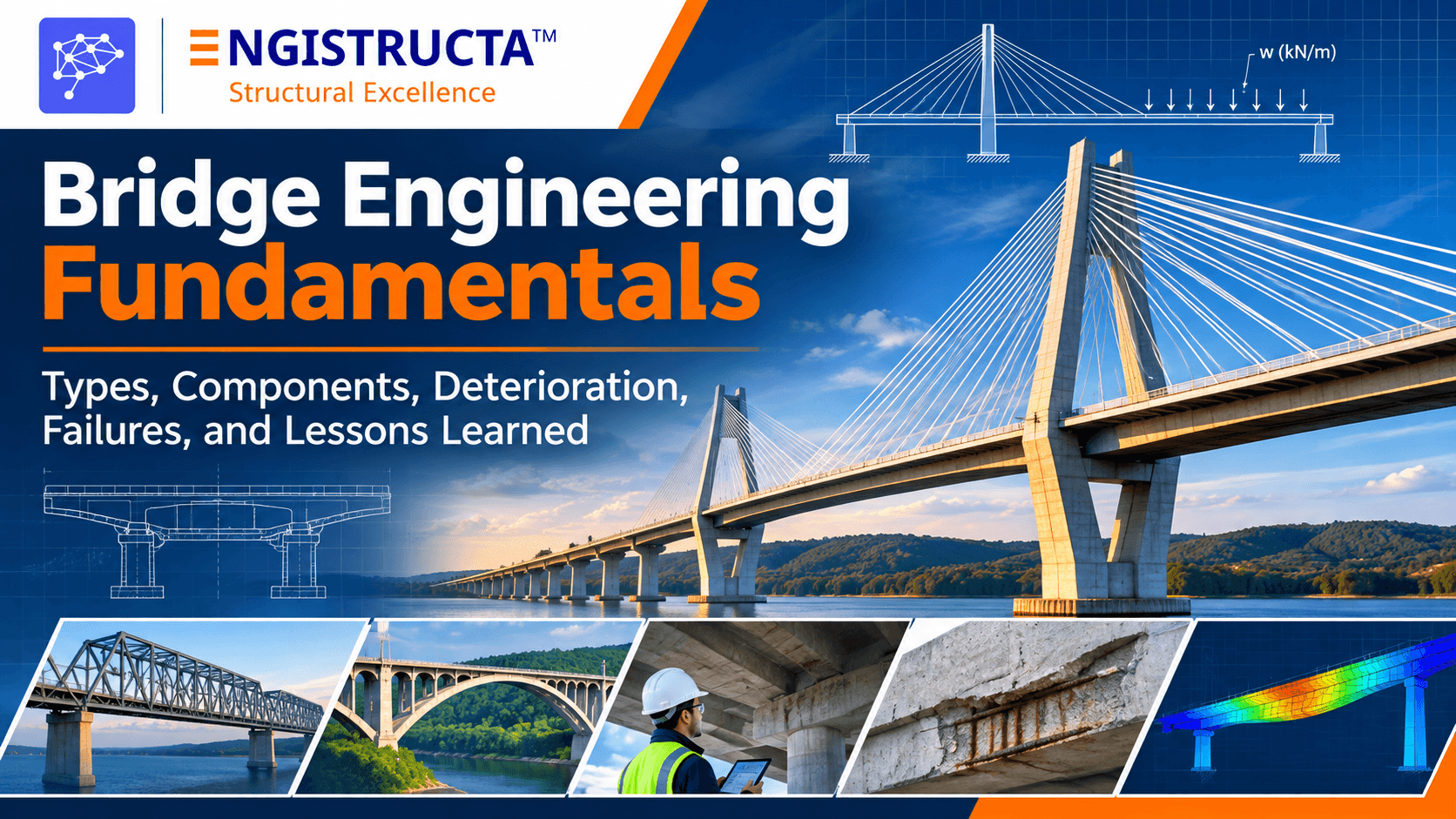
Bridge failures rarely occur without warning; they are usually the result of progressive deterioration, overlooked deficiencies, inadequate inspection, or delayed maintenance decisions. Understanding how bridge systems behave, deteriorate, and fail is essential for engineers responsible for safe and reliable transportation infrastructure.
This course provides a practical engineering perspective on bridge performance by examining major bridge types, structural components, deterioration mechanisms, and lessons learned from documented bridge failures. Participants will explore how foundations, substructures, and superstructures contribute to overall bridge behavior, and how reinforced concrete and steel bridges are affected by corrosion, chloride exposure, fatigue, overloading, environmental conditions, and operational demands.
Through real-world failure examples and engineering evaluations, this course highlights the relationship between design decisions, construction quality, inspection practices, and maintenance strategies. The course provides valuable guidance for engineers involved in bridge assessment, rehabilitation, inspection, and infrastructure management.
By completing this course, participants will be better prepared to identify critical bridge components, evaluate common deterioration mechanisms, recognize potential warning signs of structural deficiencies, interpret failure investigation findings, and apply improved inspection and maintenance practices to enhance bridge safety and service life.
2 activities • 1 chapters • duration: 2 hours

Professor of Reinforced Concrete Structures | Structural & Forensic Engineering Consultant | Wyoming-Licensed P.E. | CPD Course Author
Dr. Ibrahim M. Metwally, Ph.D., P.E., is a Wyoming-licensed Professional Engineer specializing in civil and structural engineering, structural and forensic engineering consultancy, and continuing professional education. He serves as Professor of Reinforced Concrete Structures at the Housing and Building National Research Center (HBRC) in Cairo, Egypt. He is the Founder and Principal Consultant of ENGISTRUCTA™ | Structural Excellence, a structural and forensic engineering consulting practice registered in Wyoming. He is also registered as an independent structural engineering consultant with the Wyoming Department of Transportation (WYDOT) and as a structural consulting engineer with Egypt’s Ministry of Housing, Utilities and Urban Communities. With more than 30 years of academic, research, and professional experience, Dr. Metwally specializes in structural analysis and design, forensic investigation, structural assessment, rehabilitation and strengthening, seismic and wind engineering, performance-based evaluation, and advanced nonlinear finite element analysis. His technical expertise encompasses reinforced concrete, structural steel, prestressed and post-tensioned concrete, deep foundations, structural masonry, bridges, buildings, and infrastructure systems. His professional experience includes the design, review, evaluation, rehabilitation, and failure investigation of major structures across Egypt and the Arabian Gulf region, including projects involving deterioration, structural distress, complex loading conditions, and extreme environmental effects. His academic and research interests include ultra-high-performance concrete (UHPC), fiber-reinforced polymer (FRP) structural systems, large-scale experimental testing, seismic performance, and the behavior of concrete structures under extreme loading. As an author and technical reviewer of continuing professional development (CPD) courses for professional engineers, Dr. Metwally integrates current codes and standards, advanced technical knowledge, worked examples, and practical engineering judgment. His educational materials help practicing engineers strengthen their capabilities in structural design, assessment, rehabilitation, forensic engineering, and code compliance.
