
search
In this online engineering PDH course, some characteristics of successful roundabout projects are identified.
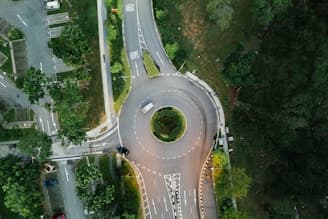
Roundabouts, which are simply modern versions of their primitive ancestors— traffic circles and rotaries—have safety, environmental, and cost-saving features superior to those of traditional intersections.
But implementing roundabout projects sometimes proves difficult, and it would be useful to know what makes for a successful roundabout project. Of course, all successful construction projects share some obvious characteristics: designers, contractors, tradespeople, suppliers and a host of other people must execute their jobs well if success is to be achieved.
But the present course focuses on identifying characteristics that are especially important for achieving successful roundabout projects. The process of identification will include a detailed discussion of the advantages roundabouts offer over traditional intersections and a review of roundabout projects that the U.S. Department of Transportation considered worthy of mention.
This course is intended for civil and transportation engineers interested in promoting the use of roundabouts.
This course is based on documents from the U.S. Department of Transportation Roundabout website, selected and organized into a single course document, with commentary added, by Mark Rossow.
Civil Engneering faculty member for 27 years
Dr. Rossow is a graduate of the University of Michigan with B.S., M.S., and Ph.D. degrees. He is a licensed Professional Engineer in the State of Illinois. He taught civil engineering for over 35 years, including six years at Washington University in St. Louis and 29 years at Southern Illinois University Edwardsville, where he was the Chair of the Civil Engineering Department for ten years. His areas of expertise are in civil engineering and mechanics. He has consulted for various organizations, including government agencies and an international offshore drilling company. He has published numerous technical journal articles and technical reports for a variety of governmental agencies and private sector organizations. Mark P. Rossow, PE, PhD Licensed Professional Engineer in State of Illinois License No. 062.040560 Dr. Rossow is a graduate of the University of Michigan with B.S., M.S., and Ph.D. degrees. He taught civil engineering for over 35 years, including six years at Washington University in St. Louis and 29 years at Southern Illinois University Edwardsville, where he was the Chair of the Civil Engineering Department for ten years. His areas of expertise are in civil engineering and mechanics. He has consulted for various organizations, including government agencies and an international offshore drilling company. He has published many journal articles and technical reports.