by learnformula
Explore courses
search
For Business
Team license & compliance management
For Higher Education
Academic partnerships
For Government Agencies
Government training solutions
For Instructors & Course Creators
Teach on our marketplace
Become a Sponsor
Reach professionals where they learn
Log inStart 7-Day Free TrialStart Free TrialStart Free Trial
search
Explore courses
  1. Courses
  2. /Engineering
  3. /Electrical Engineering Basics

Engineering Calculus Made Simple (Derivatives)

A look at derivatives...the short version.
Created byGraham Van Brunt
BeginnerUpdated Dec 16, 2021
Engineering Calculus Made Simple (Derivatives)

What You'll Learn

  • check_circleStudents will learn mathematical derivatives as they apply to electrical functions
  • check_circleStudents will learn useful Trig Identities
  • check_circleStudents will learn about limits
  • check_circleStudents will learn the Squeeze Theorem

About This Course

In mathematics, the derivative of a function of a real variable measures the sensitivity to change of the function value (output value) with respect to a change in its argument (input value). Derivatives are a fundamental tool of calculus. For example, the derivative of the position of a moving object with respect to time is the object's velocity: this measures how quickly the position of the object changes when time advances.

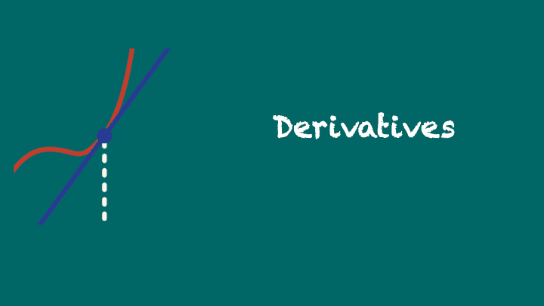
The derivative of a function of a single variable at a chosen input value, when it exists, is the slope of the tangent line to the graph of the function at that point. The tangent line is the best linear approximation of the function near that input value. For this reason, the derivative is often described as the "instantaneous rate of change", the ratio of the instantaneous change in the dependent variable to that of the independent variable.

This course is designed as the basics review of derivatives as they apply to electrical functions. It is designed for the student of electrical engineering who comes across theoretical formulas that reference derivatives. A detailed understanding of derivatives is not required in order to continue the electrical topic and this course will provide the basic amount required. During this course, the student will learn useful trig identities and approach derivatives with the help of limits and theorems such as the squeeze theorem.

Who this course is for: Electrical Engineers, Technologists, Technicians & Electrical Students

Course Content

1 activity • 9 videos • duration: 3h 35m

  • videocam00 Introduction to Engineering Calculus Made Simple (Derivatives) course
    Duration 8:21
  • videocam01 Functions
    Duration 24:03
  • videocam02 Limits
    Duration 42:17
  • videocam03 The Derivative
    Duration 40:04
  • videocam04 Trig Identities
    Duration 21:59
  • videocam05 The Squeeze Theorem
    Duration 31:14
  • videocam06 The Derivative of Sin(x)
    Duration 8:26
  • videocam07 The Derivative of Cos(x)
    Duration 10:11
  • videocam08 Other Derivatives
    Duration 28:59
  • quizCourse Quiz

Your Instructor

Graham Van Brunt

menu_book23 courses
star245 reviews

An entire career in the power sector of engineering, Graham graduated from Queen's university coupled with subsequent studies with Wilfrid Laurier University to travel the globe and apply his skills and garner his protection and control experience internationally. His passion for staying in touch with his profession and his kinship for mentoring has kept him in front of an audience of learners.

Credit Information

What Students Are Saying

5.0 out of 5
Student's Choice
3 reviews
  • FT
    Fulton T.
    starstarstarstarstar

    Great course! However, the exponents shown in the quiz are not displayed properly. No issue, as long as you realize it's an exponent.

Frequently Asked Questions

We are a registered provider with 300+ associations and regulatory bodies worldwide. We operate across 28 global markets including Canada, the US, Australia, and the UK. Every course page clearly displays its specific accreditations. Upon completion, you receive a professional certificate that can be validated online. Our certificates include all necessary accreditation details, credit hours, and completion dates, and are formatted specifically to meet the submission requirements of most global regulatory bodies.

You May Also Like

  • Engineering: Laws & Rules

    Florida Laws and Rules for Professional Engineers - Biennium Cycle 2025-2027

    starRated5.0out of 5,(26 reviews)
    1 CPD hr
  • Engineering: Engineering Ethics

    Ethics-Standards of Conduct

    starRated4.9out of 5,(107 reviews)
    1 CPD hr
  • Engineering: Engineering Management

    AI Management Systems for Engineering Organisations

    starRated5.0out of 5,(21 reviews)
    1 CPD hr