
search
The purpose of this course is to describe these environmental concerns and identify mitigation strategies that might be implemented.
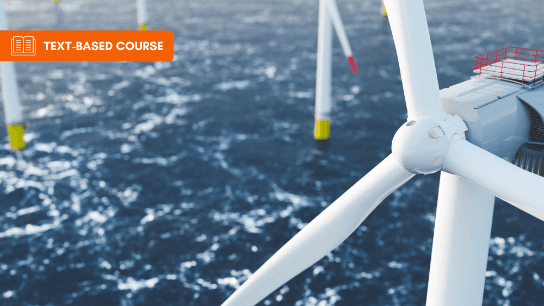
Energy can be extracted from the motion of waves, tides, rivers, ocean currents, and the temperature differences between water at the ocean surface and water far below. In the search for sustainable energy sources, these marine and “hydrokinetic” (concerned with kinetic energy of the motion of water) technologies are attracting increasing attention.
As these technologies are studied more, however, many potential environmental concerns have arisen. The list is lengthy: plant and animal habitats will be altered when wave heights or velocities are changed. Bottom-dwelling organisms will be affected by sediment transport and deposition. Marine construction activities will generate underwater sounds sufficiently loud to drive away or actually kill some species of animals. Electromagnetic fields associated with generating devices and cables may interfere with species that depend on sensing electric fields for identifying prey or on sensing magnetic fields for navigation. Anti-biofouling coatings applied to structures may be toxic to some species. Moving turbine blades may strike and kill fish just as wind turbines kill birds. The transfer of large volumes of water between the ocean surface and depth will affect water temperatures, proportions of dissolved solids, nutrient content, and gas concentrations.
The purpose of this course is to describe these environmental concerns and identify mitigation strategies that might be implemented.
Intended Audience: This course is intended for civil, mechanical, and electrical engineers concerned with the design and construction of marine and hydrokinetic energy technologies.
Publication Source: This course is based on the U. S. Department of Energy document, “Report to Congress on the Potential Environmental Effects of Marine and Hydrokinetic Energy Technologies,” December, 2009.

Civil Engneering faculty member for 27 years
Dr. Rossow is a graduate of the University of Michigan with B.S., M.S., and Ph.D. degrees. He is a licensed Professional Engineer in the State of Illinois. He taught civil engineering for over 35 years, including six years at Washington University in St. Louis and 29 years at Southern Illinois University Edwardsville, where he was the Chair of the Civil Engineering Department for ten years. His areas of expertise are in civil engineering and mechanics. He has consulted for various organizations, including government agencies and an international offshore drilling company. He has published numerous technical journal articles and technical reports for a variety of governmental agencies and private sector organizations. Mark P. Rossow, PE, PhD Licensed Professional Engineer in State of Illinois License No. 062.040560 Dr. Rossow is a graduate of the University of Michigan with B.S., M.S., and Ph.D. degrees. He taught civil engineering for over 35 years, including six years at Washington University in St. Louis and 29 years at Southern Illinois University Edwardsville, where he was the Chair of the Civil Engineering Department for ten years. His areas of expertise are in civil engineering and mechanics. He has consulted for various organizations, including government agencies and an international offshore drilling company. He has published many journal articles and technical reports.