
search
Bottomless (or three-sided) culverts use the natural channel bed and are environmentally attractive alternatives to traditional closed culverts.
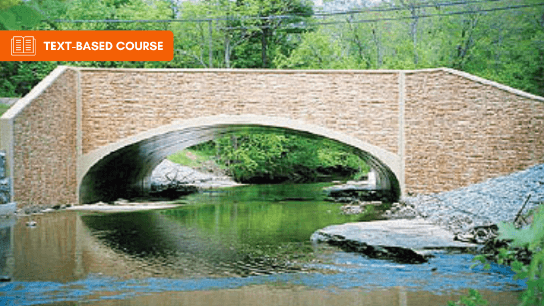
Bottomless (or three-sided) culverts use the natural channel bed and are environmentally attractive alternatives to traditional closed culverts. They are often promoted as alternatives for replacing short bridges. This report describes a two-phase study conducted at the FHWA Hydraulic Laboratory: Phase I: a preliminary investigation focused on measuring maximum scour depths at the culvert entrance and developing equations for estimating inlet scour. Phase II: a follow-up investigation to include scour measurements at the outlet, submerged entrance scour measurements, detailed velocity and depth measurements with a prescour fixed bed to refine the equations, and evaluation of various potential scour countermeasures to reduce scour at the culvert inlet and outlet.
Topics: Introduction to Bottomless Culverts Test Facilities and Instrumentation Model Bottomless Culvert Shapes Experimental Parameters Scour protection: Riprap Analysis Theoretical Background Clear Water Scour Experiments Riprap Stability Design Coefficients Use of Cross Vanes for Inlet Scour Control Scour Calculation Examples.
Intended Audience: This course is intended for Hydraulic, Civil, Transportation, Water Resources, and other engineers whose job description may require a general knowledge of the scouring effects of streams and rivers on culvert and bridge structures.
Publication Source: US DOT (Federal Highway Administration)
Civil Engneering faculty member for 27 years
Dr. Rossow is a graduate of the University of Michigan with B.S., M.S., and Ph.D. degrees. He is a licensed Professional Engineer in the State of Illinois. He taught civil engineering for over 35 years, including six years at Washington University in St. Louis and 29 years at Southern Illinois University Edwardsville, where he was the Chair of the Civil Engineering Department for ten years. His areas of expertise are in civil engineering and mechanics. He has consulted for various organizations, including government agencies and an international offshore drilling company. He has published numerous technical journal articles and technical reports for a variety of governmental agencies and private sector organizations. Mark P. Rossow, PE, PhD Licensed Professional Engineer in State of Illinois License No. 062.040560 Dr. Rossow is a graduate of the University of Michigan with B.S., M.S., and Ph.D. degrees. He taught civil engineering for over 35 years, including six years at Washington University in St. Louis and 29 years at Southern Illinois University Edwardsville, where he was the Chair of the Civil Engineering Department for ten years. His areas of expertise are in civil engineering and mechanics. He has consulted for various organizations, including government agencies and an international offshore drilling company. He has published many journal articles and technical reports.