
search
New Approaches to Electrocatalysis.
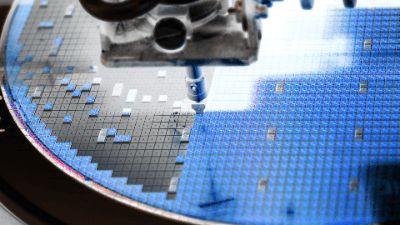
The electrochemistry of semiconductors is central to the development of photoelectrochemical conversion systems and to understanding the geophotochemistry of light-absorbing minerals in water, for example. The recent advent of ultrathin two dimensional (2D) semiconductor materials prepared either by exfoliation or thin film growth methods opens up new opportunities to examine the role of dimensionality in semiconductor electrochemistry.
A particularly intriguing possibility is to exploit the transverse field effect—so central to silicon CMOS technology—to modulate the carrier density in the valence (VB) and conduction bands (CB) of a 2D semiconductor that simultaneously serves as the working electrode in an electrochemical cell. This can be accomplished by placing the (grounded) 2D material on a metal gate/dielectric stack, where application of voltage on the gate shifts the VB and CB edges with respect to the Fermi-level; this phenomenon is the transverse field effect. The potential significance of such a field effect modulated 2D working electrode architecture is two-fold: (1) because of the extreme thinness of the 2D material, the charge induced in the semiconductor by the back gate is accessible to an electrolyte solution on the opposite (front) face; (2) this charge is separate from, but in addition to, double-layer charge induced by the independently controlled working electrode potential with respect to the reference.
This talk will show how field effect modulation can control both outer-sphere and inner-sphere (electrocatalytic) electron transfer at 2D semiconductor electrodes. For electrocatalysis, the specific example will be H2 evolution at 2D MoS2 back-gated electrodes. Gated electrodes provide a new platform for fundamental investigation of electronic effects in electrocatalysis; these architectures may also be scalable for practical applications in water splitting, for example.

The Global Home of Chemical Engineers
At every stage of your career, AIChE Academy is the definitive resource engineers use to sharpen their professional skills. We offer up-to-date courses and webinars in chemical engineering, process and hydrogen safety, bioengineering, sustainability, professional development, and many more.

McKnight University Professor and Head of Chemical Engineering and Materials Science at the University of Minnesota
C. Daniel Frisbie is Distinguished McKnight University Professor and Head of Chemical Engineering and Materials Science at the University of Minnesota. He obtained a PhD in physical chemistry at MIT in 1993 and was an NSF Postdoctoral Fellow at Harvard. His research focuses on materials for printed electronics, including organic semiconductors and their applications in devices such as transistors and electrochromic displays. Research themes include the synthesis of novel organic semiconductors, structure-property relationships, organic device physics, and the application of scanning probe techniques. Recent efforts also include new manufacturing approaches for flexible electronics and new strategies for electrocatalysis. From 2002-2014, Frisbie led a multi-investigator effort in Organic Semiconductors at the University of Minnesota, sponsored by the Materials Research Science and Engineering Center (MRSEC) program of the NSF. He was the lead investigator on a Multi-University Research Initiative (MURI) grant funded by the Office of Naval Research from 2011-2017 for development of a roll-to-roll printed electronics manufacturing platform.