
search
Optimizing High-Particle-Loading Materials for 3D Printing & Electrospinning.
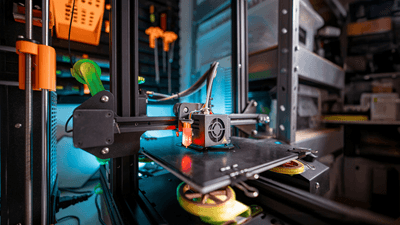
Materials with high particle loadings are important for several applications: in many cases the particles provide the desired functionality and the polymer acts to bind them together into a shape, so maximizing particle content is required. As new processing technologies become more prevalent, such as 3D printing and electrospinning, low binder content has introduced challenges, particularly due to the high viscosities encountered in highly loaded systems. Understanding the rheology and the effect of chemistry and molecular interactions on the processability is of great importance to the field.
We have focused primarily on two processing technologies: additive manufacturing (AM, direct ink writing 3D printing) and electrospinning. We focus on direct ink write additive manufacturing and examine the rheology and processability of high particle loading suspensions (>60 vol% particles) and show how the nature of the polymer binder, the particle size distributions and the processing parameters influence the consistency of the print and the distribution of particles and voids in the final solid part. This work will allow us to understand how to design high solids suspensions for direct ink write additive manufacturing to result in homogenous, predictable solid parts for applications ranging from pharmaceuticals to concrete to ceramics.
In a parallel project for preparing highly functional ultrafine fiber mats, we have developed the electrospinning process to prepare fibers containing high loadings of particles, again, with particular attention to rheology and molecular level behavior.

The Global Home of Chemical Engineers
At every stage of your career, AIChE Academy is the definitive resource engineers use to sharpen their professional skills. We offer up-to-date courses and webinars in chemical engineering, process and hydrogen safety, bioengineering, sustainability, professional development, and many more.

Assistant Professor in Chemical and Biomolecular Engineering and Materials Science and Engineering
Blair Brettmann received her B.S. in Chemical Engineering at the University of Texas at Austin and her Ph.D. in Chemical Engineering at MIT. Following her Ph.D., Dr. Brettmann was a Senior Research Engineer at Saint-Gobain and a postdoctoral researcher in the Institute for Molecular Engineering at the University of Chicago. She was the recipient of the NSF CAREER Award in 2020, the ACS PMSE Young Investigator award in 2020, and the Ralph E. Powe Award in 2018 and an IUPAC Young Observer in 2019. Her research focuses on linking molecular to micron scale phenomena to processing and multicomponent complex mixtures to enable rapid and science-driven formulation and product development.