
search
Master the complete "water-to-wire" energy cycle by bridging essential hydraulic principles with electrical engineering for efficient hydro system design and operation.
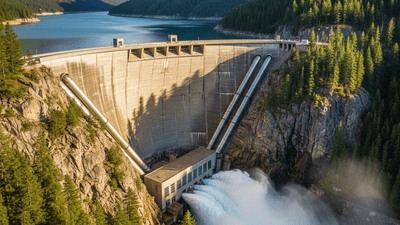
This course is intended to serve as an introduction to fluid statics, hydrodynamics, hydraulic machines, and electrical engineering principles and practice for non-electrical engineers. This course is designed for participants with little or no background in those fields. We begin with the basics. Participants will have the opportunity to ask questions, interact with the instructor and other attendees, and engage in discussions.
This course transitions from hydraulics concepts to laws, mathematical equations, sample problems, and practical hydraulics case study examples. For those attendees or participants who possess prior fluids knowledge and experience, this course is intended to serve as a refresher on the basics and intermediate-level knowledge related to the subject of hydrostatics and hydrodynamics. The course then segues into the principles and practice of electrical engineering. However, during the hydrostatics and hydrodynamics segments, the participants are reminded of common denominators and similarities between the realms of hydrostatics, hydrodynamics, and electricity.
The fluids and the principles of electricity are presented in a simple, easy-to-understand format. The electrical portion of the course is themed after a book published by the instructor, titled: Electrical Engineering for Non-Electrical Engineers. In the book, as well as this course, Rauf uses simple analogies and practical, day-to-day examples to illustrate the otherwise abstract concepts of electrical engineering.
Upon attending this course, participants will be familiar with and be able to perform straightforward and common calculations associated with gage pressure, volumetric flow rate, maximum head, friction head loss, water horsepower, turbines, flow of power and energy from water to electric grid, hydroelectric dams, hydroelectric power, voltage, current, single-phase AC, three-phase AC, power, power factor, and much more. Practical examples of electrical equipment applications in hydroelectric power plants are covered. Design and specifications of a few of the world’s most notable dams are reviewed. Discussions on electrical equipment, components, devices, sensing, controls, and test instrumentation involved in most common hydroelectric power plants are included. Hydroelectric power plant governor purpose and operation are explained through examples.
This course is designed for engineers, professional engineers, chartered engineers, energy professionals, engineering managers, technical professionals, facilities managers, technicians, and other professionals who are not intimately familiar with hydrostatics, hydrodynamics, electrical engineering principles and practices, and hydroelectric power systems.

PDH, CPC & CEU Engineering, Energy, Safety, Code, and Finance Courses For Engineers & Other Industry Professionals
Semtrain is an authorized provider of Engineering, Energy, Code, Safety, and Engineering Project Management courses designed to meet your annual, biennial, and triennial Professional Engineering and Certification renewal needs. What differentiates us from other course providers is that we offer courses that earnestly deliver and develop skills and knowledge, and not just the PDH’s or Credits. Our instructors engage participants through live, Q &A’s, classwork, and discussion. Our courses require no prerequisites and are designed for engineers and professional of all disciplines. Earn PDH / CPC credits with information that is exciting, fresh, accurate, and affordable. Our Money Mack Guarantee: If you are not satisfied with our course content, reach out to us immediately after conclusion of the course – before issuance of certificate – for a 90% refund. Our Board Acceptance Guarantee: If our course is rejected by any board, reach out to us for a 100% refund.

President, Chief Consultant and a Senior Instructor at Sem-Train, LLC
Bobby has over 25 years of experience in teaching undergraduate and postgraduate engineering, math, business administration, and MBA courses, seminars, and workshops. Professor Rauf is a registered Professional Engineer (PE) in the states of Virginia, North Carolina, and Wyoming and is a Certified Energy Manager (CEM) and a Certified Ergonomist (CE). Mr. Rauf was inducted as a “Legend in Energy” by the AEE in 2014. He is a published author of multiple engineering and energy books and professional development courses. He holds a patent in process controls technology. Professor Rauf is certified to instruct various engineering, ergonomics, and industrial safety courses. He has conducted certification training and trained engineers for Professional Engineering licensure exams in the United Kingdom, the Kingdom of Saudi Arabia, the Netherlands, and Ukraine over the past ten years. Mr. Rauf develops and instructs PDH (Professional Development Hour) and continuing education engineering skill-building courses. He conducts these courses in the form of webinars, live on-site presentations, workshops, pre-recorded audio, and self-study texts. He has also served as an Adjunct Professor at Gardner-Webb University. Professor Rauf has also developed and published several self-study books that cater to the continuous professional development needs of engineers, technicians, and technical managers. Mr. Rauf’s last full-time engineering employment in the corporate world was at PPG Industries, Inc., where he served as a Senior Staff Engineer. During his long career at PPG, his responsibilities included the development and management of energy and ergonomics programs for multiple manufacturing plants in the U.S. and overseas. He also provided consultation and training services in energy, electrical engineering, industrial safety, ergonomics, and the arc flash arena. His extensive engineering experience includes power design, control system design, project management, process management, energy and utilities management, energy audits/assessments, plant maintenance, robotics, manufacturing automation, HVAC audits, and the design of ergonomic equipment.