
search
Pumps are widely used in industry for uses such as providing lubrication and cooling service and to transferring process fluids.
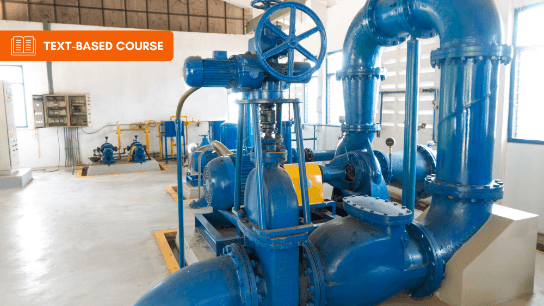
Pumps are widely used in industry for uses such as providing lubrication and cooling service and to transferring process fluids. In the commercial sector pumps see widespread use for HVAC systems. Municipalities depend upon pumps in water and wastewater treatment plants. Pumps consume 27% of the electricity used by industrial systems in the manufacturing sector. In view of this widespread use of pumps, any steps taken to improve the efficiency of performance can have a significant effect. Methods of analyzing pumping systems and improving their efficiency are the subject matter of this course.
Topics: Following the completion of this course, the student will: Be familiar with typical pumping system components Know the types of centrifugal pumps and the typical applications for which centrifugal pumps are used. Know the types of positive displacement pumps and the typical applications for which positive displacement pumps are used. Know the opportune times in the life cycle of a pumping system for assessing pumping system needs to improve performance Be familiar with common pumping system problems Know the common indicators of an oversized pump in a pumping system Know how to analyze piping configurations to improve pumping system efficiency Be familiar with basic pump maintenance Be familiar with typical multiple pump arrangements and the use of pony pumps Be able to predict the effect of impeller trimming on pump flow rate, head and brake horsepower Be able to estimate annual cost of electricity for a pump for several types of input information
Intended Audience: for hydraulic, mechanical, civil, and construction engineers. An attendee of this course will gain knowledge about methods for analyzing pumping systems and steps for improving their efficiency. Publication Source: Dept. of Energy

Dr. Harlan Bengtson is an online PDH course provider of continuing education courses for professional engineers. Dr. Bengtson is a graduate of Iowa State University with B.S. and M.S. degrees and of the University of Colorado with a PhD. He is a licensed Professional Engineer in Missouri. Dr. Bengtson has spent 30 years in engineering education in teaching and administrative positions, including six years as Dean of Engineering at Southern Illinois University Edwardsville. Dr. Harlan H. Bengtson, PE 33 Grainey Drive Glen Carbon, IL 62034 Phone: (618) 406-6892 E-mail: hnkbengtson@yahoo.com PROFESSIONAL PROFILE Dr. Bengtson is a graduate of Iowa State University with B.S. and M.S. degrees and of the University of Colorado with a PhD. He is a licensed Professional Engineer in Missouri. He has spent 30 years in engineering education in teaching and administrative positions, including six years as Dean of Engineering at Southern Illinois University Edwardsville. His areas of expertise are environmental engineering, hydrology and hydraulics, engineering science and renewable energy systems. He has done regular consulting work while holding the academic positions. Prior to entering academia, Dr. Bengtson worked for Minnesota Mining & Manufacturing as a Product Development Engineer and for E. I. duPont deNemours as a Process Development Engineer. Dr. Bengtson has authored numerous publications, presentations and technical reports. He is currently active as a freelance technical writer, author of continuing education courses for Professional Engineers, and is the founder of www.engineeringexceltemplates.com and www.EngineeringExcelSpreadsheets.com, sites with the objective of providing inexpensive, easy to use Excel spreadsheets for a variety of engineering calculations.