
search
Introductory Course (the first in a series of progressively more complex courses on LNG)
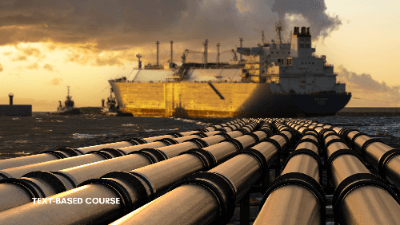
This course is the first in a series of Liquefied Natural Gas (LNG) courses. It is designed for engineers entering the specialty of LNG or those who want to understand the basics of LNG production, storage, transportation, safety measures, and vaporization.
Learners taking this course are expected to have a basic understanding of thermodynamics and heat transfer (boiling, condensation, pressure-temperature relationships, etc.). The learner will understand the origins of natural gas and the required pre-treatment before natural gas is converted to LNG. The reasons for, and methods of, reducing the concentration of acid gases, mercury, water vapor, and heavy hydrocarbons before liquefaction will be covered.
The course will cover many unique characteristics of LNG. Emphasis will also be given to the need for relief valves and special LNG phenomena, such as Rapid Phase Transformation, LNG spill behavior, LNG storage tank inventory rollover, the effects of nitrogen in LNG, and re-condenser use. The importance of proper design (spring hangers, expansion joints, etc.) and maintenance will be presented. Importantly, the learner will appreciate the need to maintain safe and reliable plant operations through proper training of plant personnel.
The course will also highlight the importance of strictly following procedures, recognizing anomalies, understanding the technologies, and using the Management of Change process. The need for auxiliary and backup auxiliary systems will also be presented.
The course will aim to develop a culture of preemptive thinking, continuous learning, continuous improvement, and ethical behavior to avoid accidents and unreasonable risks. The most important intention of this course is to give the learner the basic technical knowledge, at an introductory level, needed to begin their study on how to continue making the Liquefied Natural Gas industry “Safe and Reliable.”

** Mechanical Engineering and Process Engineering ** Dr. Vitale is a graduate of NYU Tandon School of Engineering (formerly NY Polytechnic University) with a B.S., M.S., and Ph.D. in Mechanical Engineering and an M.S. in Civil Engineering. He has been licensed as a P.E. in 6 states and keeps his P.E. licenses active in New York, Pennsylvania, and New Mexico. Dr. Vitale has worked in the natural gas and LNG industry for over 50 years. In 2004 he retired as Vice President and Chief Engineer over Gas Engineering and 28 Production facilities for KeySpan Energy across New York City, Long Island, Rhode Island, Massachusetts, and New Hampshire. During his employment with KeySpan, he often taught Thermodynamics, Heat Transfer, Fluid Dynamics, and other energy courses at NY Polytechnic University. From 2004 to the present, Dr. Vitale has focused on consulting for the Gas Industry with a specialty in training the industry’s human resources on how to make safety and reliability their major focus through understanding the technologies. More than half of Dr. Vitale’s consulting has been focused on training Liquefied Natural Gas (LNG) Operating personnel on generic and site-specific operations of their plants. Dr. Vitale has generated and delivered training materials for import terminals, export terminals, peak shavers, and portable LNG facilities. His courses have been both open-enrollment and plant-specific. He has trained clients in the U.S., Canada, Mexico, South America, Europe, Mid-East, and China. Dr. Vitale has also provided expert testimony for justifying asset (pipeline and service) replacement programs and new facilities (LNG or pipeline or compressors) for system reinforcements to meet the peak-day demands of the industry’s customers. Dr. Vitale’s passion is to train Gas Operators on their gas systems' safe, reliable, and efficient operation and develop a continuous learning culture.