
search
Master nature-based stormwater strategies to create cost-effective, sustainable site designs that mimic natural hydrology and protect water resources.
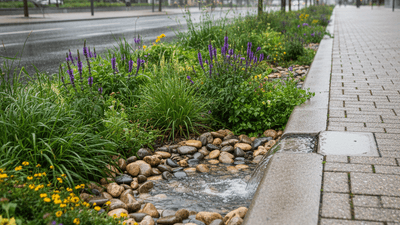
This course examines the principles of stormwater low-impact development, hydrology considerations for low-impact development, site planning, structural Best Management Practices, low-impact development economics, construction, and maintenance.
A significant portion of the training focuses on Environmental Site Design (ESD) and specific Best Management Practices (BMPs). You will examine techniques to reduce impervious cover, protect sensitive resources like woodlands and wetlands, and implement site fingerprinting. The course provides detailed technical guidance on designing vegetative systems such as bioretention cells (rain gardens) and grass swales, as well as hardscape solutions like permeable pavements, porous concrete, and green roofs. Through a blend of design theory, regulatory insights, and real-world case studies of both successes and failures, this course provides a practical roadmap for creating hydrologically functional landscapes.
Key Learning Outcomes:

Online Courses for Engineers
HalfMoon Education is a nonprofit continuing education provider offering live webinars and on-demand courses for engineers, architects, landscape architects, land surveyors, attorneys, paralegals, accountants and others. Since 1996, we’ve helped thousands of professionals nationwide stay current with industry standards and codes, earn CE hours, and advance their expertise through practical, expert-led learning experiences. Learn more about us at: www.halfmoonseminars.org

Principal at Trinkaus Engineering, LLC
Mr. Trinkaus is an internationally recognized expert in the field of Low Impact Development (LID), having presented at many American Society of Civil Engineers/Environmental & Water Resources Institute (ASCE/EWRI) international conferences and many other regional conferences and workshops on LID and water quality issues. He was invited by the Water Resources Agency in Taichung, Taiwan, to present a 12-hour workshop on LID in December 2011. Mr. Trinkaus has been an invited presenter and consultant multiple times on stormwater and LID in China and South Korea since 2013. He has designed LID retrofits in Zhenjiang, China. Mr. Trinkaus has reviewed and edited LID reports by Pusan National University and the Land & Housing Institute in South Korea. Mr. Trinkaus has written LID design manuals for the towns of Tolland, Plainville, Harwinton, Morris, and East Granby, Connecticut. He has designed many types of LID treatment systems for a variety of residential and commercial applications. Mr. Trinkaus is the primary author for the EWRI Filter Strip/Bioswales Task Committee. Mr. Trinkaus is a licensed professional engineer in Connecticut and Maryland. He received a Bachelor of Science degree in Forest Management in 1980 from the University of New Hampshire. Mr. Trinkaus has more than 39 years of experience in the land development field, more than 19 years of experience designing Low Impact Development treatment systems, and 10 years of experience writing LID regulations and design manuals.