
search
Stop struggling with complex loops—learn the systematic method to solve any DC or AC circuit with ease.
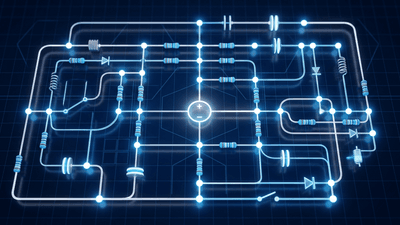
Are you tired of getting lost in a maze of loops, meshes, and endless equations when trying to solve electrical circuits? What if there was one systematic, foolproof method to analyze almost any circuit you encounter?
Welcome to Mastering Node Analysis: Circuit Solving Simplified.
Node analysis (or nodal analysis) is arguably the most powerful and widely used technique in electrical engineering. In this course, we strip away the heavy academic jargon and confusing textbook explanations. Instead, we provide a clear, intuitive, and highly visual approach to mastering circuit analysis. Whether you are dealing with basic resistor networks or complex circuits featuring supernodes and dependent sources, this course will give you the framework to solve them quickly and accurately.
Through step-by-step video tutorials, practical examples, and guided practice problems, you will transition from a beginner to a confident circuit-solver. By the end of this course, you will look at a complex circuit diagram and instantly know exactly how to break it down.
What You Will Learn:
Why Take This Course?
Who This Course is For:
Requirements:
Ready to simplify your circuits? Enroll today and master Node Analysis once and for all!

Professional Engineer with over 40 years of experience
Mr. Foad Alvandi is an online PDH course provider of continuing education for LearnFormula Mr. Alvandi holds a Bachelor of Science degree in Electrical Engineering and a Master of Science degree in Electrical and Computer Engineering from George Mason University. He is a registered Professional Engineer in the State of Maryland. Mr. Alvandi is a seasoned engineer with over 40 years of experience in the electrical and solar power industries, as well as a number of years of teaching experience. He is an adjunct professor with Johns Hopkins University and presently teaches the graduate-level “Introduction to Electrical Power Systems” course in their online EP (Engineering for Professionals) program. He has retired in recent years from full-time work in the industry, but continues to teach and keeps updated on the latest developments in the solar and electrical power industries in general.