
search
Understanding the Parallel Resistance Formulas, Parallel Circuit Rules and Parallel Circuit Math
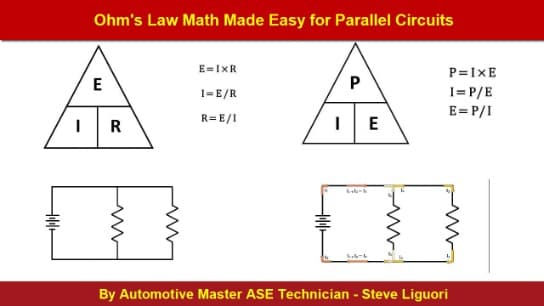
Welcome to Ohm’s Law Made Easy for Parallel Circuits!
By the end of this course, students will gain confidence in understanding the rules of parallel circuits and mastering the calculations for voltage, current, resistance, and power in these circuits. Detailed explanations of both parallel resistance formulas are provided, along with shortcuts to expedite calculations once the formulas are understood.
Ohm’s Law defines the relationship between voltage, current, and resistance in an electrical or electronic circuit. With knowledge of any two values—voltage and current, voltage and resistance, or current and resistance—the third value can be calculated mathematically. Understanding the mathematical principles behind these relationships significantly enhances your comprehension and diagnostic thinking.
Parallel circuits are employed when each device needs to receive the full source voltage. In automotive circuits, the majority are parallel, as it is preferred that each component receives the full battery or source voltage.
This course is tailored for automotive students, beginners in electronics, and DIY enthusiasts seeking a solid foundation and comprehension of parallel circuits and Ohm’s Law. It doesn't just present formulas or concepts, but guides you through the thought process, steps, and reasoning behind them.
The course offers practice examples and detailed explanations of how the answers are calculated. Understanding Ohm's Law math in conjunction with basic electrical fundamentals helps students identify incorrect voltage measurements and improves their troubleshooting and electrical diagnostic skills.
Let’s begin!

A Tale of Two Careers… Steve is a Stock and Options Trader for over 21 years and an Instructor, Coach and Mentor for most of his life. He is the Founder and Options Coach/Mentor at Blue Chip Trader Development and is available to answer your questions as well as provide One-on-One Online Personal Coaching Sessions. Steve's mission is to assist new and experienced Stock and Options Traders in realizing their own potential. He focuses on the mental aspect of trading, as well as strategies and skills and has an intuitive way of connecting with students to pinpoint the factors that are preventing them from succeeding. Steve brings to the table an unprecedented passion for teaching. Years of Coaching new and experienced Traders has given Steve the understanding of what struggling traders need most; Clear explanations of the Processes that will lead them to the Success they are looking for in their Trading. Steve is also an ASE Certified Master Automotive Technician for over 36 Years. Back in the Day, He was the “go to” guy for vehicles that no one else could fix, as well as a Shop Foreman and Instructor of fellow technicians. After 26 years specializing in Diagnosing Electrical and Electronics Systems, Steve made the move to Automotive Instructor and spent the next 10 years at a Technical School in NY. There he received a Recognition Award as Top Instructor. Steve teaches in a way that lets the students realize “they can do this”, not how hard it is. He is passionate about teaching and takes pride in every light bulb he can turn on.