Applying ASCE 7-22 & ASCE 49-21 to Tall Buildings, Façades, and Bridges, with Occupant Comfort and Performance-Based Wind Design.
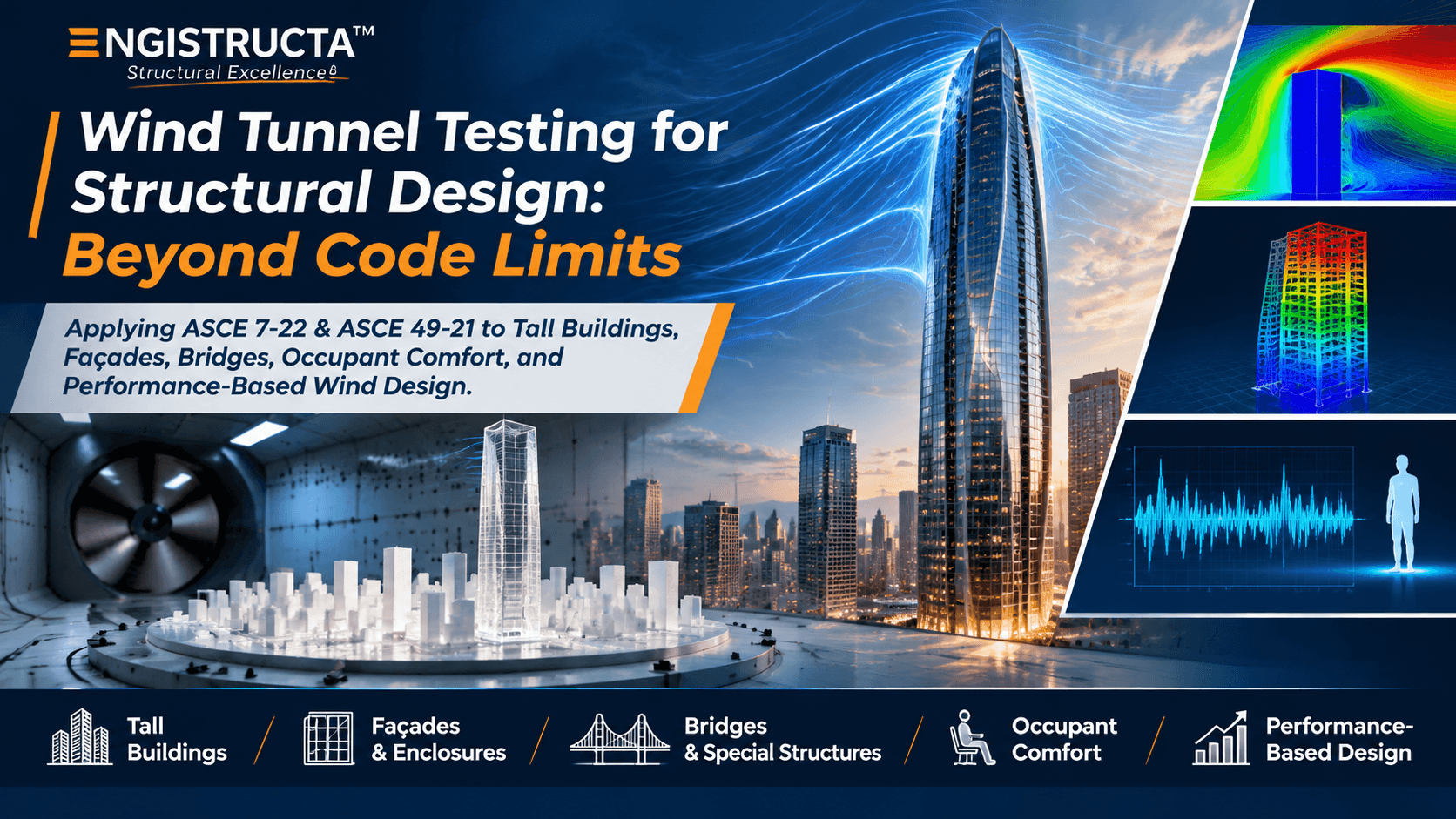
For tall, slender, irregular, and aerodynamically sensitive structures, code-based wind procedures may not capture every effect that governs design. Localized façade pressures, cross-wind excitation, torsional response, dynamic amplification, occupant acceleration, and interference from nearby buildings can influence structural safety, serviceability, and enclosure performance. Wind tunnel testing provides project-specific aerodynamic data, but its value depends on properly defining the study, reviewing data quality, interpreting results, and translating findings into engineering decisions.
This practice-focused course explains how wind tunnel testing is used with ASCE/SEI 7-22 and ASCE/SEI 49-21. Participants examine when prescriptive code procedures are appropriate and when building geometry, flexibility, exposure, serviceability requirements, or unusual structural behavior warrant further investigation. Topics include atmospheric boundary-layer simulation, model scaling and similitude, rigid and aeroelastic models, instrumentation, pressure and force measurements, data-quality review, and directional wind effects. The course then connects measured aerodynamic behavior to base shear, overturning, torsion, member demands, foundation response, and performance-based wind design.
The course addresses practical design decisions involving wind-induced serviceability and occupant comfort, using acceleration-based criteria and guidance from ISO 10137, ISO 2631-1, and CTBUH. It examines localized cladding and roof pressures and their implications for glazing, anchors, fasteners, and building-envelope systems. Applications include tall towers, long-span roofs, stadiums, and bridges. Participants also consider how wind tunnel results are incorporated into structural-analysis workflows using tools such as ETABS, SAP2000, Robot Structural Analysis, and related finite-element platforms, with attention to load mapping, directionality, correlation, and the risks of combining peak responses incorrectly.
Beyond conventional testing, the course considers how CFD, hybrid CFD–wind tunnel workflows, reduced-order and AI-assisted models, structural monitoring, and digital twins can support—but not replace—engineering judgment. It also covers the project-delivery process: defining study objectives, selecting a testing strategy, planning schedules and budgets, coordinating deliverables, and establishing contractual and quality-control requirements before testing begins.
Upon completion, participants will be better prepared to determine when wind tunnel testing is warranted, critically review study methods and results, translate aerodynamic data into structural and enclosure design actions, assess serviceability and occupant comfort, integrate directional wind loads into analytical models, and make informed technical and project-planning decisions when code procedures alone do not fully represent the expected structural response.
Why Take This Course?
This is a structured, practice-driven program covering the wind-engineering decision process from study planning and aerodynamic testing through structural response and design application. Participants will:
Understand wind–structure interaction, from atmospheric flow and aerodynamic loading to structural response, serviceability, and façade performance.
Follow the wind tunnel design workflow, including test planning, model scaling, data-quality checks, result interpretation, and integration with structural-analysis models.
Examine complex effects often requiring specialist attention, including torsion, cross-wind excitation, directional sensitivity, localized peak pressures, and occupant comfort.
Understand the interfaces between structural systems, cladding design, vibration control, and occupant perception.
Review project case histories connecting testing, analysis, and engineering decisions.
Explore emerging applications of CFD, reduced-order models, AI-assisted methods, structural monitoring, and digital twins.
The course is intended for engineers seeking a rigorous, connected methodology—not a series of disconnected lectures or a superficial overview.
2 activities • 1 chapters • duration: 5 hours

Professor of Reinforced Concrete Structures | Structural & Forensic Engineering Consultant | Wyoming-Licensed P.E. | CPD Course Author
Dr. Ibrahim M. Metwally, Ph.D., P.E., is a Wyoming-licensed Professional Engineer specializing in civil and structural engineering, structural and forensic engineering consultancy, and continuing professional education. He serves as Professor of Reinforced Concrete Structures at the Housing and Building National Research Center (HBRC) in Cairo, Egypt. He is the Founder and Principal Consultant of ENGISTRUCTA™ | Structural Excellence, a structural and forensic engineering consulting practice registered in Wyoming. He is also registered as an independent structural engineering consultant with the Wyoming Department of Transportation (WYDOT) and as a structural consulting engineer with Egypt’s Ministry of Housing, Utilities and Urban Communities. With more than 30 years of academic, research, and professional experience, Dr. Metwally specializes in structural analysis and design, forensic investigation, structural assessment, rehabilitation and strengthening, seismic and wind engineering, performance-based evaluation, and advanced nonlinear finite element analysis. His technical expertise encompasses reinforced concrete, structural steel, prestressed and post-tensioned concrete, deep foundations, structural masonry, bridges, buildings, and infrastructure systems. His professional experience includes the design, review, evaluation, rehabilitation, and failure investigation of major structures across Egypt and the Arabian Gulf region, including projects involving deterioration, structural distress, complex loading conditions, and extreme environmental effects. His academic and research interests include ultra-high-performance concrete (UHPC), fiber-reinforced polymer (FRP) structural systems, large-scale experimental testing, seismic performance, and the behavior of concrete structures under extreme loading. As an author and technical reviewer of continuing professional development (CPD) courses for professional engineers, Dr. Metwally integrates current codes and standards, advanced technical knowledge, worked examples, and practical engineering judgment. His educational materials help practicing engineers strengthen their capabilities in structural design, assessment, rehabilitation, forensic engineering, and code compliance.
