
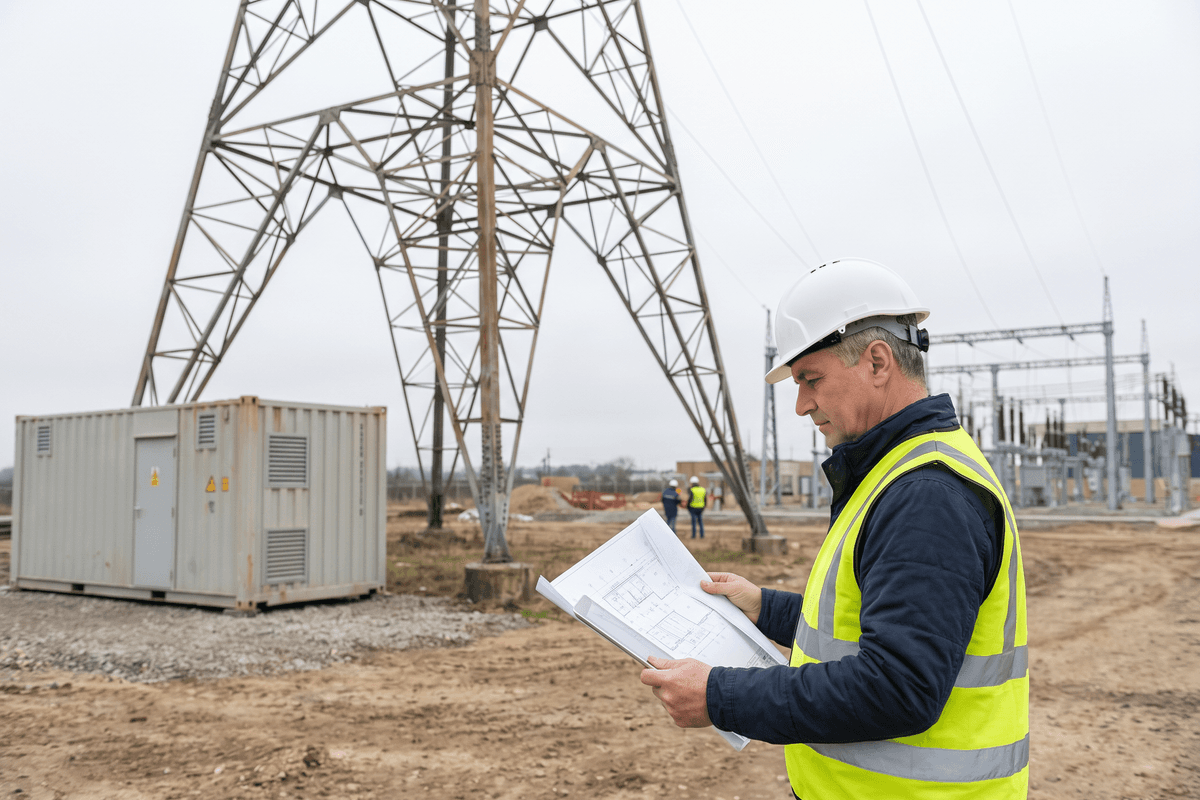



Across the United States, the grand ambitions of artificial intelligence megaprojects, domestic semiconductor fabrication, and aerospace modernization are colliding with a singular, unyielding physical constraint: the bulk electric system. For the past three years, power system engineers and utility procurement teams have faced unprecedented lead times for extra-high-voltage (EHV) power transformers, in some cases waiting anywhere from 120 to 210 weeks for step-up units critical to interconnecting generation assets and massive industrial loads. That bottleneck is finally forcing a domestic manufacturing response. Energy infrastructure developer GameChange Energy has broken ground on a 300,000-square-foot manufacturing facility engineered specifically to produce extra-high-voltage transformers for U.S. utility and grid projects.
This expansion comes at a pivotal moment. While broader commercial construction markets grapple with rising input costs and compressing backlogs, the engineering sector is seeing a structural reallocation of capital toward heavy industrial, defense, and high-voltage electrical infrastructure. From advanced packaging fabs in the Midwest to tactical nuclear power on military installations, the engineering mandate for late 2026 is defined by high-spec, power-dense execution.
The Extra-High-Voltage Bottleneck and Domestic Capacity
Extra-high-voltage transformers—typically rated at 230 kV, 345 kV, 500 kV, and 765 kV—are custom-engineered assets that require specialized grain-oriented electrical steel (GOES), intricate conductor winding, vacuum drying, and rigorous dielectric testing. Prior to the recent manufacturing pivot, domestic production accounted for less than 20% of total U.S. high-voltage transformer demand, leaving utility interconnects vulnerable to volatile global shipping, raw material shortages, and foreign factory backlogs.
GameChange Energy’s 300,000-square-foot facility is designed to inject critical domestic manufacturing volume into this constrained supply chain. For electrical design firms, substation engineers, and transmission planners, additional domestic capacity provides a pathway to compress project development schedules that have drifted out past five-year horizons.
"You cannot commission a multi-gigawatt compute campus, a high-rate defense plant, or utility-scale clean generation without the physical iron and copper to step up and step down bulk voltage. Domestic transformer manufacturing is not just an industrial supply play; it is the cornerstone of U.S. grid reliability."
The manufacturing complexity of EHV units requires high-precision factory engineering, including climate-controlled winding cleanrooms, multi-ton bridge cranes, and high-capacity impulse test bays capable of simulating lightning strikes and transient overvoltages exceeding 1,000 kV. Expanding this domestic capability reduces single-point failure risks across North America's bulk power systems.
Decentralized Baseload: The $2.2B Army Janus Program
While utility-scale grid infrastructure struggles to keep pace with demand, the U.S. military is taking a parallel, decentralized path to ensure energy sovereignty. The U.S. Army selected five developers under its Janus Program for a $2.2 billion initiative to construct privately operated nuclear microreactors across domestic military installations.
The Janus Program marks a definitive operational shift: transitioning modular nuclear reactor engineering from pilot demonstrations and university laboratories to commercial, field-deployed power plants. These microreactors—generally ranging from 1 to 20 MW electrical output—are designed to operate independently of the commercial grid, providing uninterruptible, zero-emission baseload power for strategic defense installations.
Engineering Challenges in Microreactor Deployment
- Factory-Fabricated Modularity: Moving the primary containment, core vessel, and balance-of-plant assemblies to standardized offsite manufacturing environments to bypass field construction delays.
- Passive Safety Systems: Integrating passive decay heat removal mechanisms that require zero operator action and zero external electrical power during emergency shutdown sequences.
- Advanced Microgrid Interfacing: Engineering high-speed switchgear, synchronization controls, and power conditioning systems capable of islanding critical military operations without sub-cycle voltage drops.
For civil and nuclear engineering practitioners, the Janus awards establish the first true procurement framework for commercial-military microreactors, creating standard design envelopes that commercial data center operators are already analyzing for private behind-the-meter generation.
Industrial Capital Concentration: High-Spec Packaging and Aerospace
The urgency to secure reliable, high-density power is driven by an unprecedented concentration of capital in specialized advanced manufacturing facilities. In West Lafayette, Indiana, SK hynix broke ground on a $4 billion advanced packaging and R&D facility for high-bandwidth AI memory (HBM) at Purdue Research Park. Concurrently, Rolls-Royce concluded a decade-long $1 billion modernization of its Indiana engineering and advanced manufacturing operations dedicated to military and civil propulsion systems.
| Project / Facility | Capital Scope | Primary Engineering Focus | Grid / Infrastructure Implication |
|---|---|---|---|
| GameChange Energy Plant | 300k sq ft footprint | EHV transformer manufacturing & high-voltage testing | Relieves utility interconnect and substation hardware lead times |
| Army Janus Program | $2.2 Billion | Modular nuclear microreactor deployment | Establishes behind-the-meter islanded baseload for critical sites |
| SK hynix Purdue Facility | $4.0 Billion | Advanced 2.5D/3D HBM semiconductor packaging & cleanrooms | Demands high-reliability, clean power feeds and ultra-pure water MEP |
| Rolls-Royce Indianapolis | $1.0 Billion Modernization | Advanced aerospace engine test cells & precision digital machining | Requires dedicated high-power dynamic testing and thermal handling |
These megaprojects place extreme technical demands on industrial engineering teams. Advanced semiconductor packaging facilities require Class 1 and Class 10 cleanroom environments, vibration mitigation down to micro-inch tolerances, and redundant uninterruptible power systems (UPS). Similarly, modern aerospace engine development requires high-capacity thermal dissipation, dynamic test cell telemetry, and advanced multi-axis machining cells that place massive cyclical loads on local distribution networks.
Macro Divergence: Data Center Demand vs. Backlog Compression
The heavy industrial push is taking place against an increasingly bifurcated macroeconomic backdrop. According to the Associated Builders and Contractors August 2026 economic report, nonresidential engineering and trade hiring maintained steady growth through July—bolstered overwhelmingly by data center, energy, and advanced manufacturing demand. However, contractor backlog indicators contracted across the majority of U.S. regions as persistent input price escalation and financing costs constrained standard commercial and light-industrial starts.
This dynamic creates a clear operational mandate for multidisciplinary engineering firms:
- Pivot to Mission-Critical and Industrial Sectors: Firms heavily weighted in speculative commercial office or generic retail spaces must reposition design capabilities toward high-density compute, defense manufacturing, and utility interconnect engineering.
- Integrate Early Procurement Models: With physical equipment such as switchgear, chillers, and transformers still dictating project schedules, engineering-led procurement (EPC) and progressive design-build frameworks are displacing traditional design-bid-build workflows.
- Deepen Grid Interconnect Expertise: Site selection for advanced packaging and aerospace depends entirely on sub-transmission capacity and substation access. Engineering teams that can perform high-level interconnect studies and power flow modeling provide decisive value during early feasibility phases.
The Forward-Looking Engineering Frontier
The U.S. engineering landscape is undergoing a structural transformation. The historical assumption that electrical power would be readily available at the site boundary is no longer valid. Instead, the design of next-generation infrastructure—whether an AI packaging line in Indiana, a tactical microreactor at a military base, or an aerospace modernization hub—must be engineered from the power source outward.
Initiatives like GameChange Energy's transformer manufacturing expansion and the Army’s Janus microreactor program demonstrate that physical infrastructure reshoring is actively accelerating. For engineering leaders and project developers, the years ahead will reward those who master power systems integration, navigate supply chain realities, and deliver the high-voltage backbone required to power the nation’s advanced industrial economy.