
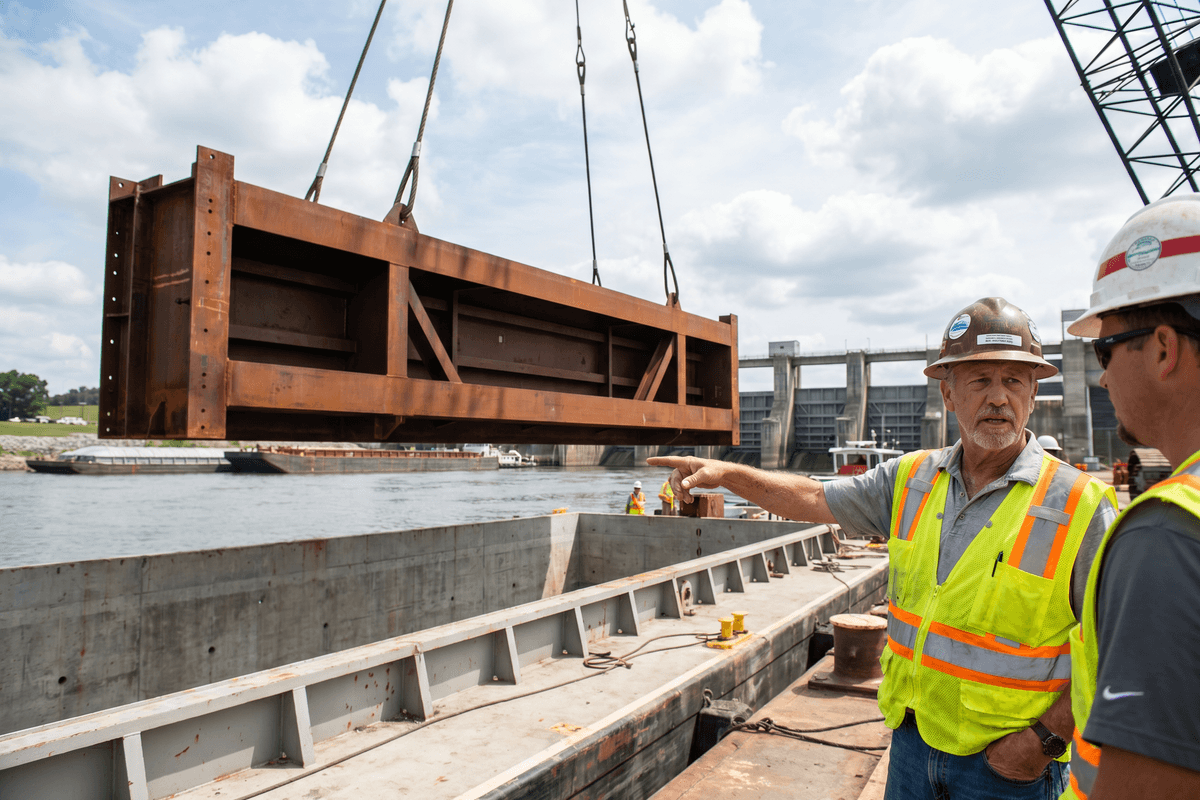



In the high-stakes theater of heavy civil marine construction, there is little room for error. When you are maneuvering structural elements that weigh as much as a fully loaded Boeing 747 over an active river system, the margin between a historic engineering triumph and a catastrophic failure is measured in millimeters. The U.S. Army Corps of Engineers (USACE) recently achieved a critical milestone at the Chickamauga Lock Replacement Project in Tennessee by successfully placing massive 420-ton concrete beams for the new lock's upstream approach wall. This feat is more than just a regional project update; it is a masterclass in modern constructability, risk transfer, and heavy-lift logistics.
For engineering professionals across the United States, the Chickamauga Lock project serves as a vital blueprint. As the nation grapples with a multi-billion-dollar backlog of aging inland waterway infrastructure, the methodologies deployed in Tennessee highlight a strategic shift in how we approach marine megaprojects: moving away from risky over-water concrete pours in favor of massive, land-cured precast elements.
The Catalyst: Battling 'Concrete Cancer'
To understand the engineering significance of the new lock, one must first understand the fatal flaw of the old one. Completed in 1940, the original Chickamauga Lock has been battling a relentless, microscopic enemy for decades: Alkali-Aggregate Reaction (AAR), often referred to in the industry as "concrete cancer."
AAR occurs when the alkaline cement paste reacts with non-crystalline silica found in certain aggregates. In the presence of moisture—a guarantee for a river lock—this reaction forms a gel that expands, creating internal stress that eventually cracks and degrades the concrete. At Chickamauga, this expansion has caused the concrete structure to physically grow, warping the lock chamber and threatening the mechanical integrity of the miter gates.
"You cannot negotiate with structural expansion caused by alkali-aggregate reaction in legacy infrastructure. Once the chemical process accelerates in a marine environment, replacement is no longer an option; it becomes a strict timeline dictated by structural physics."
The new lock, positioned adjacent to the existing structure, is designed to accommodate modern barge configurations, allowing up to nine jumbo barges to pass through in a single lockage, compared to the single barge capacity of the 1940 lock. But building this massive new chamber while keeping the old, degrading lock operational requires surgical precision.
The Upstream Approach Wall: A Lesson in Constructability
The recent milestone involved the construction of the upstream approach wall—a critical guideway that safely funnels thousands of tons of river traffic into the lock chamber. Traditionally, constructing such a wall might involve extensive cofferdamming, dewatering, and cast-in-place concrete operations. However, the USACE and its contracting partners opted for a heavy-precast methodology.
Why Massive Precast Wins in Marine Environments
By precasting the 420-ton beams on land, the engineering team fundamentally altered the project's risk profile. This approach yields several compounding advantages for heavy civil execution:
- Quality Assurance: Concrete curing is highly sensitive to temperature and humidity. Land-based fabrication allows for strict environmental controls, ensuring the mix design achieves its maximum compressive strength without the variables of river microclimates.
- Safety Parity: Every hour spent working over or under water exponentially increases life-safety risks. Precasting shifts thousands of man-hours to a controlled, dry environment.
- Schedule Compression: While the heavy-lift logistics require intense planning, the actual placement of a precast beam is significantly faster than the cycle of formwork, pouring, curing, and stripping required for cast-in-place alternatives.
However, this methodology trades one set of risks for another. The environmental risks of cast-in-place are swapped for the extreme logistical risks of heavy lifting.
| Methodology | Primary Engineering Advantage | Primary Execution Risk |
|---|---|---|
| Traditional Cast-in-Place | Lower transport and rigging logistics; continuous structural integration. | Environmental variables; extended over-water safety exposure; curing delays. |
| Massive Precast (420-ton) | Controlled fabrication; rapid installation; minimized over-water man-hours. | Extreme heavy-lift rigging; dynamic loads on floating cranes; millimeter tolerances. |
The Mechanics of a 420-Ton Lift
Moving a 420-ton concrete beam from a land-based casting yard to its final resting place on drilled riverbed shafts is a ballet of applied physics. The engineering calculations extend far beyond the static weight of the beam itself.
Dynamic Loading and Barge Stability
When dealing with floating cranes, the load is never truly static. River currents, wind loads, and the shifting center of gravity as the crane swings all introduce dynamic forces. Marine engineers must calculate the metacentric height of the crane barge to ensure that lifting a 420-ton load over the side does not induce a catastrophic list or capsize the vessel. The ballast systems of the barge must be actively managed to counter the weight of the beam as it is lifted, swung, and lowered.
Rigging and Tolerance
The rigging itself is a specialized engineering sub-discipline. Custom lifting frames and spreader bars are required to ensure the compressive forces of the lift do not crack the concrete beam before it is even installed. Furthermore, the placement tolerances are incredibly tight. These beams must align perfectly with the submerged foundational elements to ensure the structural continuity of the approach wall. A misalignment of a few inches could compromise the load paths designed to withstand the impact of a rogue barge.
The Broader Mandate: Securing the U.S. Supply Chain
While the technical achievements at Chickamauga are impressive, they serve a much larger economic mandate. The U.S. inland waterway system is the hidden backbone of American industrial and agricultural logistics. A single 15-barge tow moves the equivalent cargo of 1,050 semi-trucks, doing so with a fraction of the carbon emissions and without contributing to highway congestion.
Yet, the majority of the lock and dam systems on the Tennessee, Ohio, and Mississippi rivers were built during the New Deal era. They are operating decades past their design lives. The successful execution of the Chickamauga Lock Replacement is proving that the U.S. engineering sector has the capability to execute these critical modernizations safely and effectively.
For civil engineering firms, heavy contractors, and logistics planners, the writing is on the wall. The federal government, through the Bipartisan Infrastructure Law and ongoing USACE appropriations, is injecting unprecedented capital into waterway modernization. The firms that will dominate this space over the next decade are those that can master the exact skills demonstrated in Tennessee: modularizing massive structural components, engineering flawless heavy lifts, and executing with absolute precision in unforgiving marine environments.
The 420-ton beams now resting in the Tennessee River are more than just concrete and rebar. They are a testament to the evolving sophistication of U.S. civil engineering—a necessary evolution if we are to rebuild the arteries of American commerce for the century ahead.