



The U.S. civil and environmental engineering sectors are currently navigating a dual mandate: overhaul aging municipal water systems to handle increasingly complex contaminants, and rapidly scale marine infrastructure to support the offshore energy boom. Meeting these simultaneous demands requires a technological leap that most engineering, procurement, and construction (EPC) firms cannot fund entirely in-house. Enter the "Blue Tech Nexus"—a growing reliance on specialized academic research hubs to pilot, validate, and de-risk next-generation technologies before they hit the commercial market.
Recent developments out of the Northeast highlight exactly how this academic-to-industry pipeline is maturing. This month, the spotlight is on the University of Rhode Island (URI), where breakthroughs in both municipal water treatment and autonomous ocean robotics are offering U.S. engineering firms a blueprint for integrating advanced technologies into their upcoming project backlogs.
The Electrochemical Shift in Municipal Water
For decades, municipal water treatment has relied heavily on bulk chemical dosing, physical filtration, and energy-intensive pump-and-treat systems. However, as the EPA tightens regulations on emerging contaminants like PFAS (per- and polyfluoroalkyl substances) and heavy metals, traditional methods are reaching their physical and economic limits.
This paradigm shift was recently underscored when a URI engineering graduate was honored with the 2026 Academic Achievement Award from the American Water Works Association (AWWA). The award recognized her master's thesis focusing on public water supply and electrochemical regeneration—a technology that is rapidly moving from the lab bench to pilot-scale deployment.
Why Electrochemical Regeneration Matters to EPCs
Electrochemical water treatment utilizes electrical currents to drive chemical reactions, offering a highly precise method for neutralizing contaminants. For engineering firms designing municipal upgrades, electrochemical regeneration solves several critical logistical and operational hurdles:
- Reduced Chemical Supply Chains: Rather than trucking in tons of reactive chemicals—a supply chain vulnerability exposed repeatedly over the last five years—electrochemical systems generate necessary oxidants on-site or regenerate sorbent materials in-situ.
- Targeted Contaminant Destruction: Unlike traditional carbon filtration, which merely captures contaminants and requires expensive, hazardous off-site disposal, advanced electrochemical cells can break the strong carbon-fluorine bonds in "forever chemicals," offering a true destruction pathway.
- Scalable Modularity: Electrochemical units can be designed as modular skids, allowing engineering firms to retrofit existing treatment plants without requiring massive expansions of the facility's physical footprint.
"The recognition of electrochemical regeneration by the AWWA signals a critical inflection point. We are moving past the theoretical phase; municipal utility clients are now actively asking engineering partners to evaluate electrochemical alternatives in their feasibility studies to lower long-term OPEX and liability."
The $300M Marine Proving Ground
While water treatment engineers look to electrochemistry, coastal and structural engineers are eyeing a revolution in marine robotics. The rapid expansion of U.S. offshore wind, combined with the need to monitor aging subsea pipelines and bridges, has created a massive demand for underwater structural health monitoring.
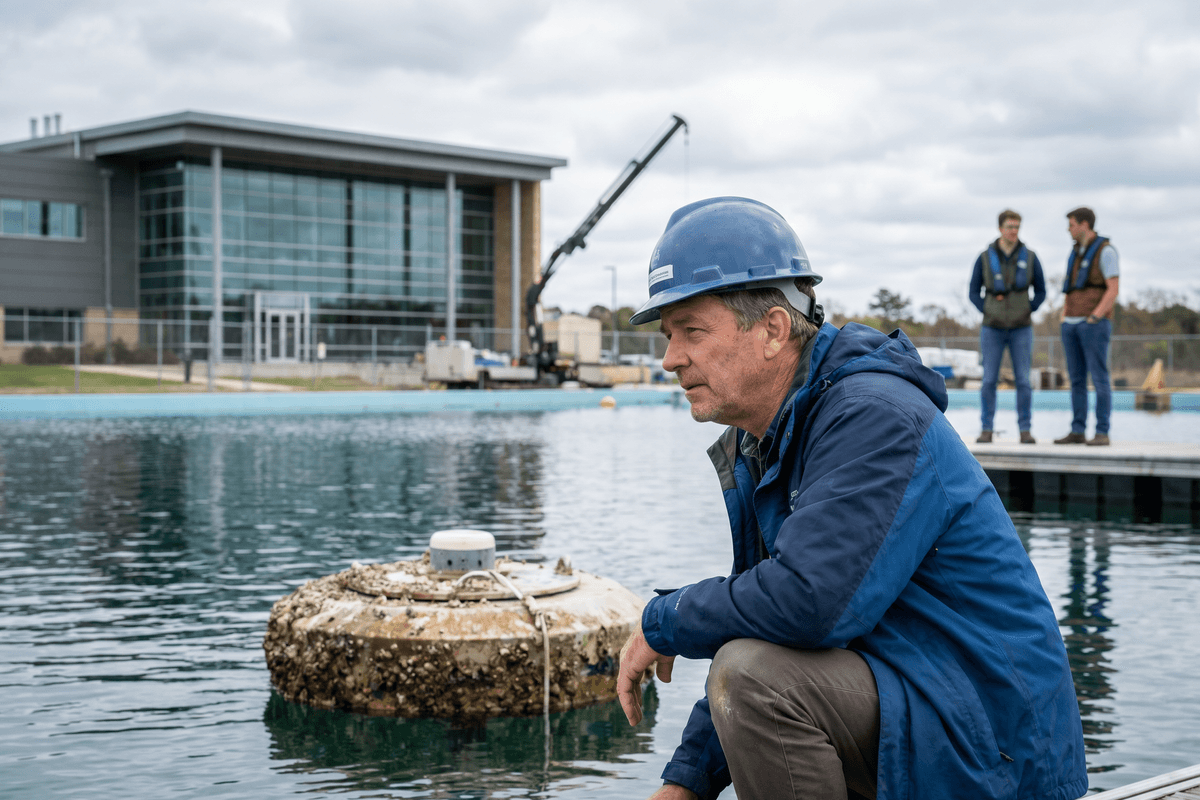
Addressing this demand, URI recently celebrated an underwater ribbon cutting to usher in its new Ocean Robotics Laboratory. This facility is a cornerstone of the university's $300 million revitalization of its Narragansett Bay Campus, effectively creating one of the most advanced marine engineering proving grounds on the East Coast.
Redefining Subsea Asset Management
For engineering firms tasked with offshore asset management, the traditional reliance on human commercial divers and tethered Remotely Operated Vehicles (ROVs) is becoming financially and logistically prohibitive. The new wave of Autonomous Underwater Vehicles (AUVs) and robotic swarms—developed and tested in facilities like URI's new lab—changes the calculus of marine engineering.
These advanced robotic platforms are equipped with high-resolution sonar, LiDAR, and AI-driven defect recognition software. They can autonomously map scour around bridge piers, inspect the integrity of subsea transmission cables, and monitor the ecological impact of offshore construction with minimal surface-vessel support.
Bridging the Technology Transfer Gap
The core challenge for mid-to-large engineering firms is not recognizing the value of these technologies, but navigating the "Technology Transfer Gap." Integrating novel electrochemical skids or autonomous marine drones into a $500 million public infrastructure project carries inherent risk. To mitigate this, forward-thinking firms are fundamentally changing how they interact with academic institutions.
Strategic Integration for U.S. Engineering Firms
- Co-Piloting and Demonstration Projects: Rather than waiting for technologies to be fully commercialized by third-party vendors, engineering firms are co-sponsoring pilot projects at university labs. This provides the firm with proprietary performance data, giving them a competitive edge in public bidding processes.
- Targeted Talent Acquisition: The AWWA award highlights another critical asset: specialized human capital. Firms are increasingly bypassing general recruitment in favor of directly hiring graduates who have spent years operating these specific next-gen systems, effectively importing the R&D expertise directly into their practice groups.
- Leveraging Federal Grants: The Bipartisan Infrastructure Law (BIL) and subsequent federal mandates heavily favor projects that incorporate innovative, resilient technologies. Joint bids featuring an established EPC firm and an academic research partner (for monitoring and validation) are proving highly successful in securing federal funding.
Comparing Operational Methodologies
To understand the scale of this shift, it is helpful to compare traditional engineering methodologies with the next-generation applications currently being validated in these academic hubs.
| Infrastructure Domain | Traditional Methodology | Next-Generation Application (2026+) | Primary Engineering Benefit |
|---|---|---|---|
| Municipal Water Treatment | Bulk chemical dosing & off-site disposal | Electrochemical regeneration & in-situ destruction | Reduced supply chain reliance, lower lifecycle OPEX, mitigated liability |
| Subsea Asset Inspection | Tethered ROVs & commercial dive teams | Autonomous underwater vehicle (AUV) swarms | Continuous monitoring, enhanced safety in high-sea states, lower day-rates |
| Coastal Resilience Planning | Historical tidal data & static modeling | Real-time robotic sensor networks & digital twins | Predictive maintenance, dynamic load forecasting for extreme weather events |
Looking Ahead: The 2030 Baseline
The investments we are seeing today—whether it is the rigorous academic work recognized by the AWWA or massive capital deployments like URI's $300 million campus revitalization—are not isolated academic exercises. They are the leading indicators of the U.S. civil engineering baseline for 2030.
As the complexity of environmental regulations increases alongside the physical scale of offshore infrastructure, the traditional silos separating academic research and commercial engineering are collapsing. For engineering leaders, the mandate is clear: the firms that actively engage with these academic proving grounds today will be the ones writing the design standards for tomorrow's most critical infrastructure.