
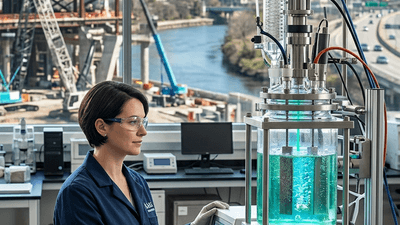



Cement is the literal and metaphorical foundation of modern American infrastructure. It is also one of our most stubborn environmental liabilities. For decades, the structural engineering community has operated under a difficult compromise: the material we rely on to build bridges, highways, and high-rises is responsible for approximately 8% of global carbon dioxide emissions. But a paradigm-shifting breakthrough in materials science is poised to flip the script, offering a pathway to zero-carbon concrete that could fundamentally alter U.S. construction and procurement strategies.
According to recent research highlighted by the American Chemical Society (ACS), scientists have successfully manufactured cement using a novel electrochemical method. The headline metrics are nothing short of revolutionary: a 70% reduction in input energy demand and a staggering 98% reduction in CO2 emissions compared to traditional production methods. For U.S. engineering firms navigating an increasingly stringent regulatory environment and the federal push for "Buy Clean" infrastructure, this isn't just an environmental victory—it is a competitive mandate.
The Carbon Conundrum of Traditional Portland Cement
To understand the magnitude of this electrochemical breakthrough, we must first examine the entrenched inefficiencies of traditional Ordinary Portland Cement (OPC) production. The standard manufacturing process relies heavily on calcination, where limestone (calcium carbonate) and clay are heated in massive rotary kilns to temperatures exceeding 1,400°C (2,500°F).
This traditional method creates a bimodal carbon problem:
- Thermal Emissions: Achieving these extreme temperatures typically requires burning fossil fuels, primarily coal or natural gas, generating massive amounts of greenhouse gases.
- Chemical Emissions: Even if the kilns were powered by 100% renewable energy, the chemical reaction itself—breaking down calcium carbonate into calcium oxide and carbon dioxide—releases roughly 50% of the total CO2 associated with cement production directly into the atmosphere.
For years, engineers and materials scientists have attempted to mitigate this footprint through supplementary cementitious materials (SCMs) like fly ash or slag, or via expensive carbon capture and storage (CCS) technologies at the kiln stack. However, these are largely incremental improvements or economically prohibitive retrofits. The ACS-highlighted research represents a fundamental redesign of the process itself.
The Electrochemical Breakthrough: How It Works
Rather than relying on extreme heat to drive the chemical separation of limestone, the new approach utilizes electrochemistry. By dissolving calcium carbonate in a specialized liquid solution and applying an electrical current, researchers can induce a reaction that extracts the necessary calcium compounds at ambient or near-ambient temperatures.
"By replacing thermal energy with electrical energy, we decouple cement production from its inherent carbon penalty. When powered by renewable energy grids, this electrochemical process effectively zeroes out the carbon footprint of the world's most critical building material."
This method yields two distinct advantages that are highly relevant to U.S. industrial scaling:
- 70% Lower Energy Demand: Because the process operates without the need for extreme heat, the total energy required per ton of cement drops precipitously. This significantly lowers the operational expenditure (OpEx) of production, insulating manufacturers from volatile fossil fuel markets.
- Grid Integration: Unlike continuous-fire kilns, electrochemical reactors can potentially be ramped up or down based on grid demand, allowing cement plants to act as flexible loads that utilize excess solar or wind power during peak production hours.
Strategic Implications for U.S. Engineering Firms
For civil, structural, and materials engineers across the United States, the transition from thermal to electrochemical cement will not happen overnight. However, the trajectory is clear, and proactive firms are already beginning to adjust their long-term strategies. The implications span across procurement, structural design, and project lifecycle analysis.
Redefining Procurement and "Buy Clean" Compliance
The U.S. federal government, through initiatives like the Federal Buy Clean Initiative and funding from the Inflation Reduction Act (IRA), is aggressively prioritizing low-carbon materials for public infrastructure projects. Projects requiring federal funding are increasingly subject to strict Environmental Product Declaration (EPD) limits on global warming potential (GWP).
Electrochemical cement, with its 98% reduction in CO2, will easily clear these regulatory hurdles, likely moving to the top of preferred materials lists for Department of Transportation (DOT) and Department of Defense (DoD) contracts. Engineering firms that establish early supply chain relationships with early adopters of this technology will secure a distinct bidding advantage.
Structural Performance and Mix Design
From a structural engineering perspective, the chemical composition of the final product is what dictates safety, durability, and performance. The electrochemical process aims to produce the exact same calcium silicate hydrates that give traditional concrete its compressive strength. However, engineers must prepare for a rigorous period of validation.
| Metric / Attribute | Traditional Portland Cement (OPC) | Electrochemical Cement |
|---|---|---|
| Energy Source | Fossil Fuels (Coal/Gas) | Electricity (Renewables/Grid) |
| Process Temperature | > 1,400°C | Ambient / Low Heat |
| CO2 Reduction | Baseline (High) | Up to 98% Reduction |
| Energy Demand | Baseline (High) | 70% Reduction |
| Primary Engineering Hurdle | Emissions Mitigation / Carbon Capture | ASTM Certification & Scale-up |
The Path to ASTM Certification and Site Deployment
Before this electrochemical cement can be poured into the formwork of a U.S. highway bridge or a commercial high-rise, it must run the gauntlet of standardizations, primarily governed by the American Society for Testing and Materials (ASTM) and the American Concrete Institute (ACI).
Testing for Equivalency: Engineers will need comprehensive data proving that electrochemical cement matches or exceeds OPC in several critical areas:
- Compressive and Tensile Strength: Ensuring the 28-day strength curves align with existing structural models.
- Hydration Kinetics: Understanding how the material cures, the heat of hydration it generates, and how it interacts with standard admixtures (retarders, accelerators, plasticizers).
- Long-Term Durability: Evaluating resistance to chloride ingress, sulfate attack, and freeze-thaw cycles, which are critical for infrastructure in the Northeast and Midwest.
Firms with in-house materials testing laboratories or strong university partnerships will be the first to validate these new mix designs. As the technology scales from the laboratory to pilot plants, we can expect a transitional period where electrochemical cement is first utilized in non-structural applications—such as sidewalks, architectural precast panels, and retaining walls—before graduating to critical load-bearing infrastructure.
Looking Ahead: The Decarbonized Baseline
The leap from a laboratory breakthrough to ubiquitous commercial availability is historically fraught with scaling challenges. Capital expenditure for new electrochemical plants will be substantial, and incumbent producers may resist transitioning away from their heavily capitalized thermal kilns. However, the sheer economic efficiency of a 70% energy reduction, combined with the unavoidable regulatory pressure to decarbonize, creates a compelling, unavoidable business case.
For U.S. engineering professionals, the message is clear: the era of accepting massive carbon penalties as a necessary evil of concrete construction is drawing to a close. The electrochemical shift represents more than just an environmental win; it is a fundamental evolution in materials science. By staying ahead of this technological curve, engineering firms can ensure they remain not just compliant with the infrastructure mandates of tomorrow, but are actively leading the charge toward a fully decarbonized built environment.