
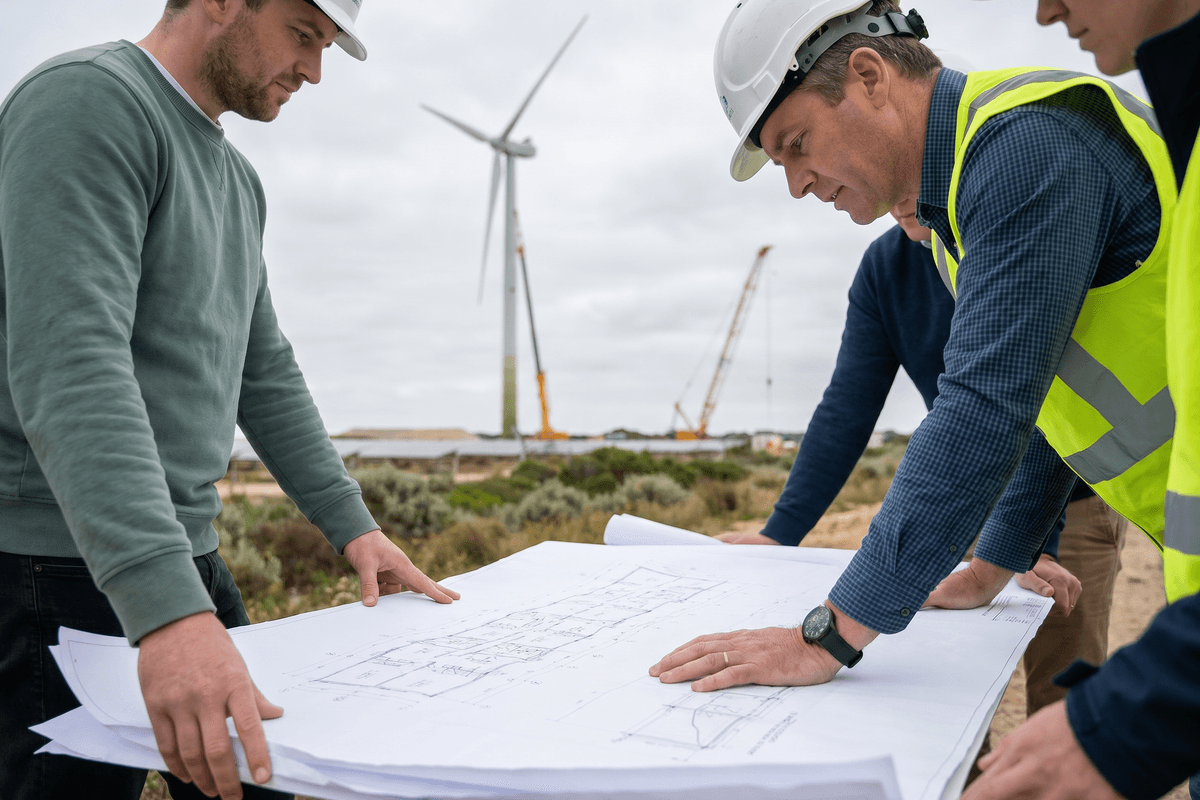



The second quarter of 2026 has officially set a new high-water mark for the U.S. engineering and architecture sector. After years of strategic planning, backlog accumulation, and navigating complex federal funding mechanisms, top design firms have reported record-breaking revenues for the second quarter. This financial surge signals a critical transition for the industry: the historic influx of federal infrastructure capital and green energy investments has decisively moved from the legislative whiteboard to active, billable project execution.
For engineering professionals and firm leadership, these Q2 financials are more than just a momentary economic boom. They represent a fundamental restructuring of the American engineering portfolio. The revenue is not being driven by a simple replication of legacy projects; rather, it is fueled by a complex convergence of traditional heavy civil engineering, advanced ecological resilience, and a massive domestic green energy buildout.
The Dual Engines of Q2 Growth: Infrastructure and Energy
The Q2 earnings reports from the nation's leading design firms reveal a bifurcated, yet complementary, growth engine. On one side, federal infrastructure spending—catalyzed by the long-tail effects of the Infrastructure Investment and Jobs Act (IIJA)—is finally hitting the ground. Projects that spent 2023 and 2024 in environmental review and early conceptual design are now generating substantial design-build and detailed engineering fees.
On the other side, a surge in domestic green energy projects is compounding this growth. The push to onshore renewable energy manufacturing, coupled with the urgent need to modernize the grid to handle new generation capacity, has created a parallel boom. Engineering firms are suddenly tasked with designing vast utility-scale solar and wind interconnects, next-generation battery storage facilities, and the advanced manufacturing plants required to build them.
"We are no longer waiting on the sidelines for federal funds to trickle down. Q2 2026 is the quarter where the floodgates opened. The challenge has shifted entirely from winning work to executing it at an unprecedented scale, requiring a seamless blend of civil, electrical, and environmental engineering disciplines."
The "Green and Gray" Convergence: The Everglades Blueprint
Perhaps the most illustrative example of how these federal funds are transforming engineering practices is the integration of "green" (ecological) and "gray" (traditional civil) infrastructure. The days of pouring concrete without regard for systemic ecological impact are effectively over. Today's megaprojects require a holistic approach to resilience.
This paradigm shift was perfectly encapsulated recently when the U.S. Army Corps of Engineers (USACE) awarded a major new engineering and design contract for the Southern Everglades Restoration Project. This initiative is not a standard water diversion project; it is a massive undertaking focused on sustainable water management and ecological resilience.
Engineering the Everglades
The Southern Everglades Restoration Project highlights the immense technical complexity driving today's record engineering revenues. The project demands a multidisciplinary approach that pushes the boundaries of traditional hydrology and civil engineering:
- Advanced Hydrological Modeling: Engineers must utilize real-time, AI-driven fluid dynamics models to simulate water flow across millions of acres, predicting how subtle changes in elevation and pump rates will affect delicate micro-ecosystems.
- Adaptive Infrastructure Design: The physical infrastructure—pump stations, levees, and flow equalization basins—must be designed to operate dynamically. Unlike static legacy systems, these structures must adapt to seasonal variations, extreme weather events, and long-term climate shifts.
- Ecological Baselines and Bioremediation: Traditional civil engineers are working side-by-side with ecologists to ensure that water treatment areas naturally filter phosphorus and other agricultural runoffs before the water reaches the protected wetlands.
By securing this contract, the engineering firms involved are not just generating revenue; they are establishing a blueprint for how large-scale ecological restoration will be engineered for the next fifty years.
The Domestic Green Energy Multiplier
While ecological megaprojects like the Everglades restoration anchor the civil side of the ledger, the domestic green energy buildout is supercharging the industrial and electrical engineering sectors. The Q2 revenue reports heavily feature the financial impact of this sector.
Grid Modernization and Interconnectivity: The U.S. power grid is undergoing its most significant overhaul in a century. Engineering firms are tasked with designing high-voltage direct current (HVDC) transmission lines to move renewable energy from remote generation sites to urban load centers. This requires complex right-of-way engineering, geotechnical analysis for transmission towers, and advanced substation design.
Advanced Manufacturing Facilities: The push to onshore the green energy supply chain has resulted in a boom of "gigafactories" for battery production and solar panel manufacturing. These facilities require ultra-precise environmental controls, massive power loads, and specialized structural engineering to support heavy, automated manufacturing equipment.
Strategic Imperatives for Engineering Leaders
The record revenues of Q2 2026 present a unique set of challenges for engineering leadership. The industry is currently operating at maximum capacity, and sustaining this momentum requires strategic evolution.
1. Talent Density over Headcount
As project complexity increases, simply hiring more junior engineers is insufficient. Firms must focus on "talent density"—building highly skilled, multidisciplinary teams capable of cross-pollinating ideas. An engineer working on the Everglades project, for example, must understand both structural load-bearing principles and ecological impact metrics.
2. The Joint Venture Standard
The sheer scale of these federal and green energy projects has made the Joint Venture (JV) the standard operating model. No single firm, regardless of size, holds all the specialized expertise required for a multi-billion-dollar ecological restoration or a massive grid overhaul. Navigating the legal, operational, and cultural integration of JVs is now a core competency for top-tier firms.
3. Redefining Project Delivery
The traditional Design-Bid-Build model is increasingly inadequate for these fast-moving, highly complex initiatives. Firms must adapt to Progressive Design-Build and Integrated Project Delivery (IPD) models, which require earlier collaboration with contractors and stakeholders to mitigate risk and control costs.
Comparing the Eras: Engineering Project Models
| Project Metric | Legacy Infrastructure Models (Pre-2020) | 2026 Integrated Project Models |
|---|---|---|
| Primary Driver | Capacity expansion (more lanes, larger pipes) | Ecological resilience & decarbonization |
| Core Disciplines | Structural, Civil, Geotechnical | Systems Engineering, Hydrology, Ecology, Data Science |
| Delivery Method | Design-Bid-Build (Siloed) | Progressive Design-Build / IPD (Collaborative) |
| Success Metric | On-time, on-budget completion | Lifecycle sustainability, adaptive capacity, carbon footprint |
Looking Ahead: Sustaining the Boom
The record-breaking Q2 2026 revenues are a testament to the U.S. engineering sector's ability to adapt, scale, and execute. However, this is not the peak; it is the establishment of a new baseline. As federal funds continue to flow and the green energy transition accelerates, the demand for sophisticated, integrated design services will only grow.
The firms that will dominate the remainder of the decade are those that view projects like the Everglades restoration not as anomalies, but as the new standard. By mastering the convergence of gray infrastructure and green resilience, and by successfully navigating the complex delivery mechanisms of modern megaprojects, the U.S. engineering industry is not just generating record profits—it is actively redesigning the future of the nation's built environment.