
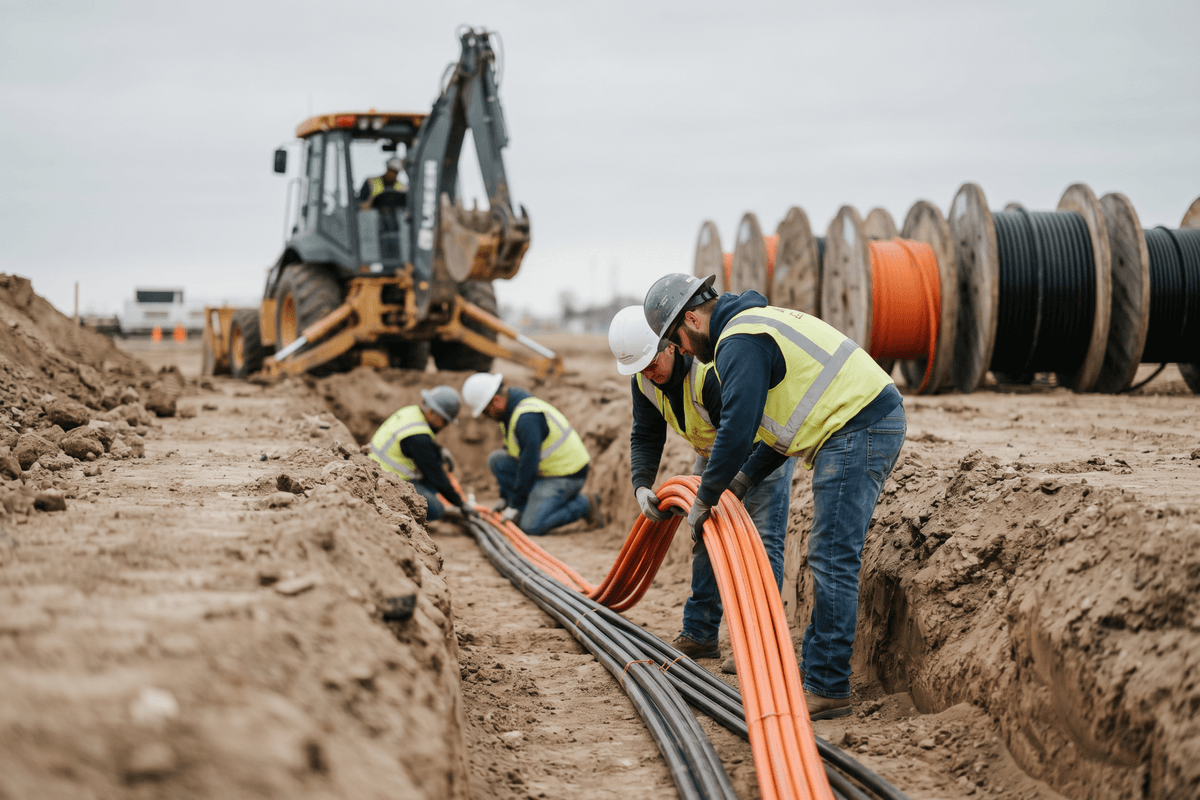



In the lifecycle of American infrastructure, there is a distinct pivot point where federal mandates transition from theoretical spreadsheets to heavy machinery. For the multi-billion-dollar broadband expansion currently sweeping the United States, that pivot point has officially arrived. As internet service providers race to deploy capital and meet stringent deployment milestones, civil engineering firms are finding themselves on the front lines of a hyper-accelerated procurement environment. The traditional, sequential rhythm of infrastructure planning is being replaced by parallel execution, demanding unprecedented agility from site preparation and utility engineering teams.
This dynamic was brought into sharp focus recently when a major internet provider hosted a groundbreaking ceremony for its Urbana project. While groundbreakings are standard industry fanfare, the underlying mechanics of this specific project reveal a critical trend for 2026: a yearend construction timeline that necessitates immediate, almost aggressive mobilization for site preparation. For civil engineering firms looking to secure early-phase contracts, the Urbana project serves as a masterclass in the new rules of broadband infrastructure delivery.
The Urbana Catalyst: Why Timelines are Compressing
The Urbana project is emblematic of a broader national push. Driven by a combination of remaining Broadband Equity, Access, and Deployment (BEAD) program funds and aggressive private capital deployment, internet service providers (ISPs) are under immense pressure to show tangible progress. The "use it or lose it" nature of certain federal and state grants, combined with the race to capture unserved market share, has compressed project schedules dramatically.
In the case of the Urbana rollout, the yearend groundbreaking target has created a vacuum that must be immediately filled by early-phase civil engineering services. Providers can no longer afford the luxury of a six-month site assessment phase. They require firms that can mobilize surveying, geotechnical, and permitting teams within weeks.
"We are no longer in the business of sequential engineering for telecommunications. If you are waiting for the final network architecture to be approved before beginning your subsurface utility engineering and right-of-way assessments, you have already lost the contract. The industry is moving to a concurrent engineering model out of sheer necessity."
The Critical Path: Site Preparation and SUE
For civil and environmental engineering firms, the early-phase contracts up for grabs in these accelerated broadband projects typically fall into three critical buckets:
- Subsurface Utility Engineering (SUE): Accurately mapping existing utilities to prevent catastrophic strikes during Horizontal Directional Drilling (HDD) or micro-trenching.
- Right-of-Way (ROW) and Permitting: Navigating complex local municipal codes, state Department of Transportation (DOT) regulations, and environmental impact assessments.
- Geotechnical Assessments: Identifying soil conditions, rock profiles, and water tables to inform the selection of drilling equipment and conduit placement strategies.
The adherence to the updated ASCE 38-22 standards for utility mapping is particularly vital. With compressed timelines, the temptation to rely on outdated "Quality Level D" (records research) data is high. However, engineering firms that can rapidly deploy ground-penetrating radar (GPR) and vacuum excavation to achieve "Quality Level A" data at critical intersections will save ISPs millions in potential utility strike liabilities.
Strategies for Securing Early-Phase Contracts
Firms looking to capitalize on the Urbana project model and similar broadband deployments nationwide must rethink their business development and operational strategies. The traditional Request for Proposal (RFP) response is often too slow for these fast-tracked initiatives. Instead, success hinges on proactive positioning and demonstrable mobilization capacity.
1. Demonstrate Immediate Mobilization Capacity
ISPs are currently prioritizing execution certainty over marginal cost savings. Engineering firms must clearly articulate their bench strength. Can you put a surveying crew on the ground in Urbana next Tuesday? Do you have an established network of local subcontractors for vacuum excavation? Highlighting a "rapid deployment task force" within your firm can be a major differentiator.
2. Leverage Digital Twins and Advanced GIS
The ability to ingest disparate municipal data, historical utility records, and fresh field surveys into a cohesive Geographic Information System (GIS) or digital twin is paramount. ISPs want to see real-time dashboards of ROW acquisition progress and SUE mapping. Firms that can offer cloud-based, interactive project visualization will win out over those still delivering static PDF reports.
3. Master Local Jurisdictional Nuances
Broadband is inherently a localized infrastructure challenge. A project spanning multiple counties may cross dozens of different municipal jurisdictions, each with its own permitting idiosyncrasies and traffic control requirements. Firms that possess deep, pre-existing relationships with local DOTs and public works departments offer immense value by smoothing the permitting critical path.
Comparing Delivery Models: Traditional vs. Accelerated
To understand the shift required by projects like Urbana, it is helpful to contrast the traditional telecommunications civil engineering approach with the accelerated model currently dominating the market.
| Project Phase | Traditional Delivery Model | Accelerated (Urbana) Model |
|---|---|---|
| Mobilization | 30-60 days post-contract award | 7-14 days; pre-positioning required |
| Utility Mapping (SUE) | Sequential; completed before design | Concurrent; iterative updates to design |
| Permitting Strategy | Linear; submit upon 100% design | Phased; early packages for critical nodes |
| Data Deliverables | Static CAD files and physical reports | Live GIS dashboards and cloud integration |
Navigating the Bottlenecks: Labor and Supply Chain
While securing the contract is the first hurdle, executing on a compressed timeline introduces significant operational risks. The US engineering sector is still grappling with a tight labor market, particularly for specialized roles like licensed surveyors, geotechnical engineers, and SUE technicians. Furthermore, while the supply chain for fiber optic cable has stabilized compared to the early 2020s, local shortages of specialized HDD equipment and high-density polyethylene (HDPE) conduit can still derail site preparation schedules.
Engineering firms must adopt a highly proactive approach to resource management. This includes cross-training civil designers to assist with GIS data integration and forming strategic joint ventures with regional surveying firms to ensure adequate field coverage. Early procurement packages for long-lead items, even during the preliminary site prep phase, are becoming standard practice.
Conclusion: The New Standard for Linear Infrastructure
The groundbreaking of the Urbana project is not an isolated event; it is a blueprint for the next three years of US broadband deployment. As federal funding deadlines loom and private capital demands returns, the pressure on the front end of the infrastructure lifecycle will only intensify. For civil engineering firms, the message is clear: the ability to execute rapid, high-quality site preparation and utility engineering is no longer just a service line—it is the primary engine for growth in the telecommunications sector. By embracing concurrent engineering, investing in digital delivery, and optimizing for immediate mobilization, US engineering professionals can turn these compressed timelines into a formidable competitive advantage.