
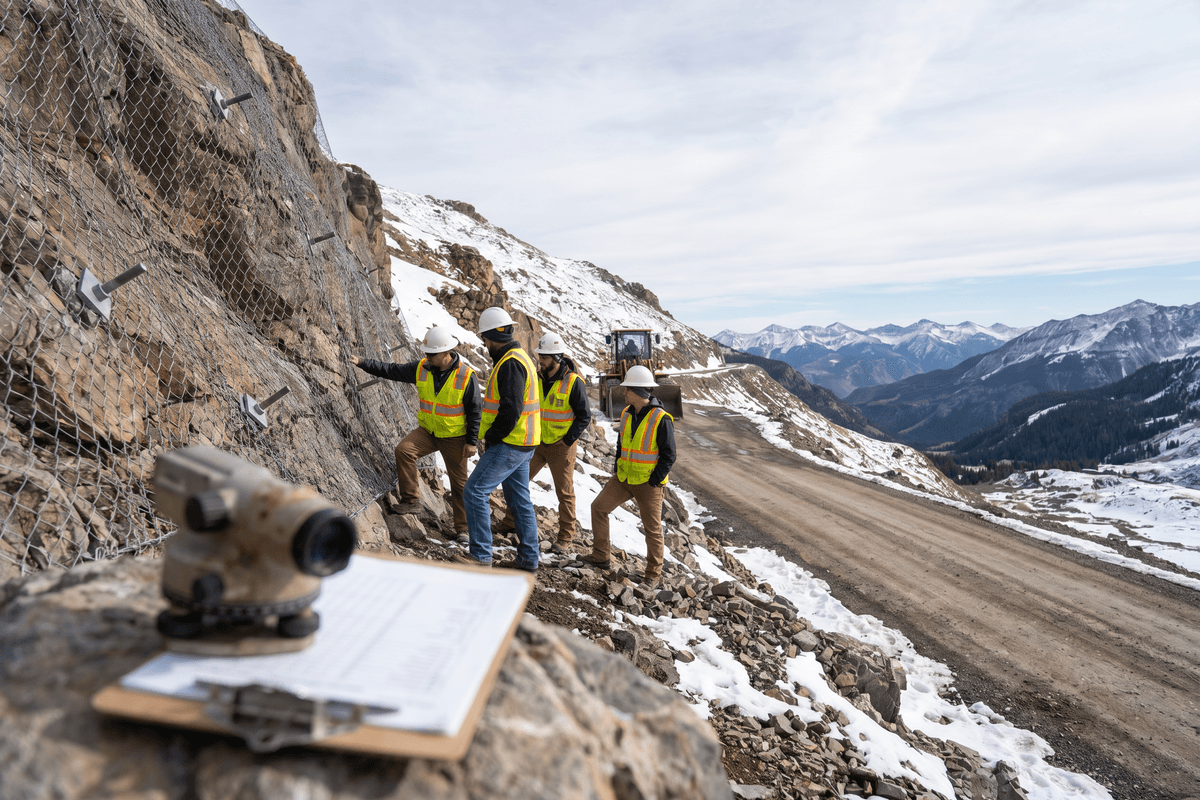



At an elevation exceeding 11,000 feet, where the air is thin, the weather is violently unpredictable, and the margins for error are virtually nonexistent, civil engineering transcends standard execution. It becomes an exercise in extreme logistics and geotechnical triage. This is the reality of the US 550 Red Mountain Pass—a treacherous, breathtaking stretch of the "Million Dollar Highway" in Colorado's San Juan Mountains. When the Colorado Department of Transportation (CDOT) and specialized contracting partner Rock & Co. scheduled road and tunnel repairs to begin on July 20, they didn't just announce a maintenance project; they initiated a masterclass in high-altitude heavy civil execution.
For engineering professionals across the United States, the US 550 project serves as a vital case study. As extreme weather events accelerate the degradation of aging rural infrastructure, the industry must look to high-stakes, constrained-environment projects like Red Mountain Pass to refine methodologies in geohazard mitigation, structural rehabilitation, and remote supply chain management. This isn't just about paving a road; it's about preserving a critical economic and social lifeline for isolated mountain communities.
The Geotechnical Reality of the San Juan Mountains
Red Mountain Pass is carved into the steep, avalanche-prone slopes of the San Juan volcanic field. The geology here is notoriously complex, characterized by highly altered, fractured, and hydrothermally weakened rock. For geotechnical engineers, this presents a continuous battle against gravity and climate.
The primary antagonist on US 550 is the aggressive freeze-thaw cycle. Water infiltrates the highly jointed rock faces and tunnel walls during the day, freezing and expanding at night. This process, known as ice jacking, exerts immense hydrostatic pressure, steadily widening fissures and triggering localized rockfalls or structural spalling within unlined or partially lined tunnel sections. Repairing these assets requires more than surface-level patching; it demands deep structural stabilization.
Tunnel Rehabilitation Under Pressure
The July 20 scope of work heavily features tunnel repairs, a particularly sensitive operation on an active highway. Rock tunnels in high-altitude environments suffer from unique degradation patterns. The engineering response typically involves a multi-phased approach:
- Kinematic Scaling: Before any structural work begins, crews must manually or mechanically scale the tunnel crown and portals to remove loose rock that poses an immediate hazard to workers and future traffic.
- Advanced Rock Bolting: To stabilize the rock mass, engineers utilize tensioned rock dowels and resin-grouted bolts, pinning unstable outer layers to deeper, competent rock.
- Shotcrete and Mesh Integration: For areas experiencing severe spalling, fiber-reinforced shotcrete is applied over welded wire mesh. In cold environments, managing shotcrete rebound and curing temperatures is a significant technical hurdle requiring specialized admixtures.
- Drainage Remediation: Capturing and redirecting water ingress is critical to preventing future ice jacking. This often involves drilling weep holes and installing insulated drainage channels that can survive sub-zero winter temperatures.
"In high-altitude rock mechanics, water is the ultimate enemy. You cannot simply seal a tunnel; you must give the mountain's hydrology a path of least resistance that doesn't intersect with your structural concrete or the traveling public."
Logistical Choreography in Constrained Corridors
While the geotechnical aspects of the US 550 project are formidable, the logistical constraints are arguably the most challenging element for contractors like Rock & Co. Red Mountain Pass is famous for its lack of shoulders, sheer drop-offs lacking guardrails (to accommodate snowplows), and narrow lane widths.
In standard highway construction, contractors rely on extensive staging areas, wide medians, and the ability to stockpile materials on-site. On US 550, the "site" is often just the 24-foot width of the asphalt itself.
The Just-In-Time Imperative
Because there is nowhere to park idle heavy equipment or stage large quantities of materials, the project relies on strict just-in-time (JIT) delivery protocols. Concrete mixer trucks, asphalt haulers, and heavy machinery must be sequenced with military precision. A delay of an hour can disrupt the entire daily pour schedule, especially considering the long, winding transport routes from batch plants in Montrose or Durango.
| Project Metric | Conventional Highway Repair | High-Altitude Pass (US 550) |
|---|---|---|
| Staging Area | Ample (shoulders, medians, ROW) | Virtually nonexistent; requires off-site staging. |
| Work Window | 8-10 months (weather dependent) | 3-4 months (strictly constrained by snow/ice). |
| Material Delivery | Standard bulk stockpiling | Precision Just-In-Time (JIT) sequencing. |
| Primary Hazard | High-speed vehicular traffic | Rockfall, extreme weather, sheer drop-offs. |
Traffic Management as an Engineering Discipline
Maintaining connectivity for the mountain communities of Silverton and Ouray is a core mandate of this CDOT project. Complete closures are economically devastating, meaning work must often proceed under single-lane, alternating traffic control. This requires sophisticated flagging operations, temporary traffic signals, and rigorous safety barriers to protect both the workers executing complex tasks inches from active traffic and the drivers navigating an active construction zone on a cliff edge.
The Broader Mandate: Rural Resilience and Economic Lifelines
From a purely quantitative perspective, projects like the Red Mountain Pass rehabilitation challenge traditional cost-benefit analyses. The Annual Average Daily Traffic (AADT) on US 550 is a fraction of what is seen on urban interstates, yet the cost per mile of maintenance is exponentially higher. Why do state DOTs and the federal government invest so heavily here?
The answer lies in systemic rural resilience. US 550 is not just a scenic byway; it is a critical commercial and emergency artery. Without it, the detour between Ouray and Silverton—towns separated by a mere 23 miles on the pass—would require a multi-hour drive spanning hundreds of miles. For these communities, the highway is the supply chain for food, fuel, medical access, and tourism revenue.
As engineering professionals, we must recognize that infrastructure equity requires us to engineer for geography, not just population density. The techniques refined by CDOT and Rock & Co. on this project—managing rockfall, executing precision concrete work in the cold, and maintaining traffic flow in impossible topographies—feed directly into the national playbook for climate-resilient infrastructure.
Looking Ahead: The Future of Extreme Execution
As the July 20 mobilization on US 550 Red Mountain Pass proceeds, it will serve as a high-visibility proving ground for modern heavy civil techniques. The successful execution of this project relies on a symbiotic relationship between advanced geotechnical engineering and hyper-disciplined construction management.
For the broader U.S. engineering sector, the lessons extracted from this high-altitude crucible will be invaluable. As we face a future where climate volatility threatens infrastructure across all topographies, the ability to execute complex repairs in constrained, hazardous environments will transition from a niche specialty to a core competency required of every major civil engineering firm.