
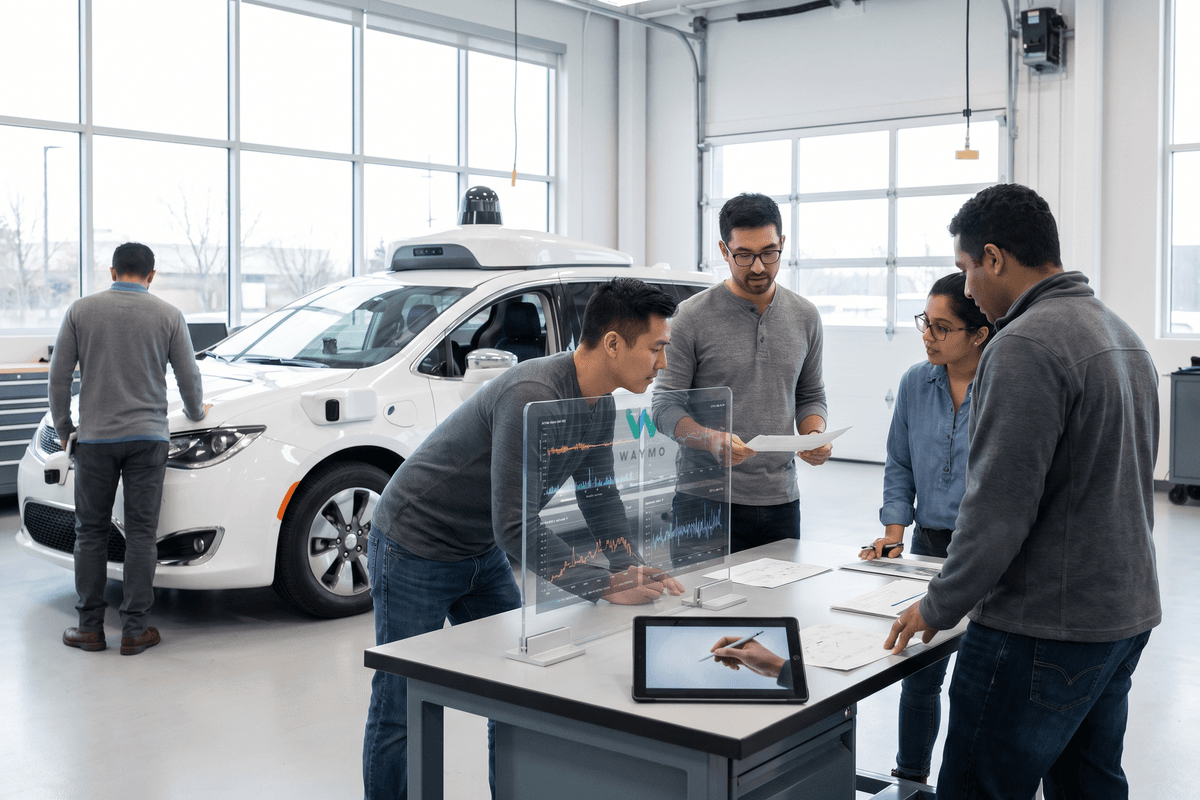



For over a decade, U.S. automotive and software engineers have chased a notoriously elusive metric: How safe is safe enough? While autonomous vehicle (AV) developers have logged millions of real-world miles and billions of simulated ones, the industry has historically lacked a standardized, universally accepted control group against which to measure machine performance. That paradigm is now shifting. With the introduction of a sophisticated behavioral model, the engineering focus is moving from simply avoiding crashes to demonstrably outperforming human intuition under extreme duress.
In a critical leap for systems validation, Waymo recently unveiled its Reference Driver (ReD), a virtual, highly detailed representation of human driver behavior. Designed to evaluate and refine the company's autonomous driving technology, ReD serves as a digital benchmark for crash avoidance. For U.S. engineering professionals—spanning systems validation, machine learning, and regulatory compliance—this development represents a fundamental rewriting of how we test, verify, and ultimately deploy autonomous infrastructure.
The Engineering Challenge of Benchmarking "Human"
Historically, the validation of autonomous systems has relied heavily on the accumulation of miles. The underlying assumption was that if an AV could drive ten million miles with fewer disengagements or collisions than the statistical human average, the system was inherently safer. However, safety engineers know that aggregate statistics are insufficient for edge-case validation.
The core problem has been the absence of a reliable "counterfactual." When an AV encounters a complex, rapidly unfolding hazard—such as a pedestrian stepping out from between parked cars on a rainy night—and successfully brakes, it is difficult to quantify exactly how much better the AV performed than a human would have. Conversely, if an unavoidable collision occurs, engineers must prove to regulators and the public that a human driver could not have prevented the outcome either.
Creating a virtual human driver is a massive systems engineering feat. Humans are erratic, subject to cognitive delays, easily distracted, yet simultaneously capable of highly intuitive predictive behavior. Translating these biological and psychological realities into a deterministic mathematical model requires an unprecedented fusion of naturalistic driving data, kinematics, and cognitive science.
"By establishing a quantifiable, virtual proxy for human behavior, the industry is transitioning autonomous safety from a statistical guessing game into a rigorous, deterministic engineering discipline."
Decoding the Reference Driver (ReD) Architecture
Waymo’s ReD is not designed to be a "perfect" driver; rather, it is engineered to be a realistic one. It models the typical reaction times, visual scanning patterns, braking profiles, and evasive maneuvering capabilities of an everyday human behind the wheel.
Key Components of the ReD Model
- Cognitive Delay Simulation: ReD incorporates realistic human perception-reaction times (PRT), accounting for the milliseconds it takes for a human to perceive a hazard, recognize the threat, decide on an action, and physically engage the brakes or steering wheel.
- Kinematic Constraints: The model understands the physical limitations of human steering inputs, preventing the virtual driver from executing mathematically perfect but physically impossible maneuvers.
- Gaze and Attention Modeling: ReD utilizes naturalistic data to simulate where a human driver is likely looking during specific traffic scenarios, accurately reflecting the human vulnerability to blind spots and distraction.
- Continuous State Evaluation: In simulation, ReD constantly evaluates the environment, providing a continuous baseline of "what the human would be doing" at any given microsecond of a simulated scenario.
By injecting ReD into their software-in-the-loop (SIL) and hardware-in-the-loop (HIL) testing environments, Waymo's engineers can run millions of permutations of a specific crash scenario. In one simulation track, the Waymo Driver (the autonomous system) navigates the hazard. In a parallel simulation track, ReD navigates the exact same hazard. The delta between the two outcomes provides a mathematically rigorous metric of safety performance.
Shifting the Validation Paradigm for U.S. Engineers
For engineering teams across the United States, the introduction of models like ReD changes the day-to-day reality of system validation. The traditional reliance on disengagement reports and aggregate crash data is giving way to Scenario-Based Counterfactual Testing.
When an autonomous system fails in simulation or the real world, root-cause analysis can now be benchmarked against human inevitability. If the ReD model also crashes in the simulated recreation of the event, engineers can categorize the incident as an "unavoidable kinematic event" rather than a failure of the autonomous perception or planning stack. If ReD avoids the crash while the AV fails, engineers have a highly specific, localized target for software refinement.
Comparing Testing Methodologies
| Validation Metric | Traditional AV Benchmarking | ReD-Enhanced Benchmarking |
|---|---|---|
| Primary Baseline | Millions of miles driven without incident | Direct comparison to human behavioral model in exact scenarios |
| Edge Case Handling | Reactive; analyze after a rare event occurs | Proactive; simulate edge cases against human baseline continuously |
| Regulatory Proof | Statistical accident rates vs. national averages | Deterministic proof of superiority to human baseline in specific hazards |
| Root Cause Analysis | Did the AV system fail its internal parameters? | Did the AV perform worse, equal to, or better than a human? |
The Regulatory and Infrastructure Ripple Effect
The implications of ReD extend far beyond Waymo's internal development cycles; they strike at the heart of U.S. regulatory frameworks. The National Highway Traffic Safety Administration (NHTSA) and the U.S. Department of Transportation (USDOT) have long struggled to define exactly what constitutes "safe enough" for Level 4 and Level 5 autonomous deployment.
By offering a standardized, virtual human baseline, the industry is providing regulators with a tangible tool for certification. In the future, we may see NHTSA adopt similar reference models as part of a national AV certification standard. Instead of proving that an AV has driven a certain number of miles safely, OEMs might be required to prove that their AV stack outperforms a federal "Standard Virtual Driver" across a battery of 10,000 highly complex, simulated crash scenarios.
Furthermore, civil and traffic engineers designing the smart cities of tomorrow can utilize these behavioral models. When designing intersections, highway on-ramps, or pedestrian crossings, urban planners can simulate traffic flows not just with perfect AVs, but with a mix of perfect AVs, flawed human drivers (modeled by ReD-like systems), and the complex interactions between the two.
Conclusion: Engineering for the Human Element
The development of Waymo's Reference Driver underscores a profound truth in modern systems engineering: to build machines that safely navigate the human world, we must first master the mathematics of human imperfection. The challenge of autonomous driving is no longer strictly a robotics problem; it is a comparative behavioral science problem.
For U.S. engineering professionals, the shift toward counterfactual, benchmarked simulation represents a maturation of the AV industry. It moves the conversation past the philosophical "Trolley Problem" and into the realm of hard, quantifiable data. As these virtual driver models become more sophisticated, they will not only accelerate the safe deployment of autonomous vehicles but will fundamentally redefine our engineering understanding of safety on American roads.