
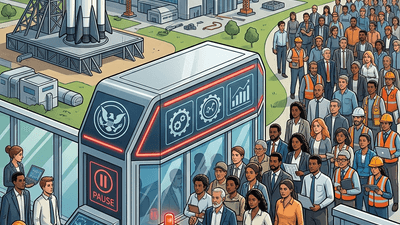



The American engineering sector is currently caught in the jaws of a profound paradox. In corporate boardrooms across the country, executives are celebrating lucrative new contracts designed to modernize domestic infrastructure and integrate cutting-edge sustainability metrics into legacy systems. Yet, down the hall in human resources, a quiet panic is setting in. The talent pipeline required to execute these highly complex, specialized projects is suddenly being choked off at the source.
This spring, a sweeping administrative pause on reviewing visa and work permit applications has sent shockwaves through the U.S. technical workforce. As millions of professionals risk losing their legal status, the engineering and STEM fields are bracing for a disproportionate impact. For an industry already grappling with acute labor shortages, this sudden regulatory bottleneck threatens to delay billions of dollars in active projects and stifle the sector's momentum just as technical demands are reaching an all-time high.
The Sudden Freeze on Intellectual Capital
The U.S. engineering ecosystem has long relied on a steady influx of international talent to fill highly specialized roles. From advanced structural modeling and computational fluid dynamics to the integration of artificial intelligence in grid management, foreign-born engineers on H-1B, OPT, and specialized work visas form the backbone of many American design and execution teams.
The current administrative pause has effectively frozen this critical supply chain of intellectual capital. Professionals already embedded in vital U.S. infrastructure projects find themselves stuck in legal limbo, unable to renew their status, while prospective hires are blocked from entering the workforce entirely.
"We are no longer just managing a tight labor market; we are facing an artificial severing of our most specialized talent pipelines. You cannot build next-generation infrastructure with a depleted bench of specialized systems engineers."
Where the Shortage Hits Hardest
The impact of this visa pause is not distributed evenly across the AEC (Architecture, Engineering, and Construction) landscape. The most severe disruptions are occurring in sectors that require a fusion of traditional engineering and advanced digital competencies:
- Energy Transition & Grid Modernization: Roles requiring expertise in high-voltage direct current (HVDC) systems and smart grid AI integration.
- Advanced Manufacturing: Industrial engineers specializing in robotics, automation, and semiconductor facility design.
- Digital Twin & Simulation: Software engineers and data scientists who build the predictive models necessary for modern mega-projects.
The Escalating Mandate: Complexity in the Face of Scarcity
What makes this talent squeeze particularly acute is the rising technical bar for engineering execution in 2026. Clients are no longer satisfied with standard design-build contracts; they are demanding verifiable, data-driven accountability, particularly in heavy industry and traditional energy sectors.
A prime example of this escalating complexity is the recent strategic push toward verifiable energy accountability. Recently, D.Energy announced a major sustainability partnership that extends deep into the industrial sector, including a strategic alliance with Howe Baker, a U.S.-based oil and gas engineering firm. This partnership is not about superficial greenwashing; it is about deploying complex, blockchain-integrated systems to track, verify, and optimize energy usage across massive industrial footprints.
Integrating digital ledgers with physical oil and gas infrastructure requires a highly specific breed of engineer—one who understands both thermodynamics and decentralized network architecture. When the visa pipeline for specialized tech and engineering talent is paused, staffing these boundary-pushing projects becomes exponentially more difficult.
The Divergence of Demand and Capacity
To understand the friction U.S. engineering firms face, we must look at how project demands are evolving precisely as workforce capacity is constrained:
| Project Requirement (2026) | Engineering Skillset Needed | Impact of Visa Pause |
|---|---|---|
| Verifiable Energy Accountability | Systems Integration, Blockchain/Data Engineering | High: Heavy reliance on international tech/STEM talent for digital integration. |
| Advanced Industrial Automation | Robotics, Mechatronics, AI Systems | High: Severe shortage of domestic graduates in specialized mechatronics. |
| Civil Infrastructure Upgrades | Structural Engineering, Geotechnical | Moderate: Stronger domestic base, but leadership and specialized modeling roles are constrained. |
Strategic Mitigation: How Firms Can Navigate the Limbo
For U.S. engineering leaders, waiting for political winds to shift is not a viable business strategy. Firms must proactively redesign their operational models to survive a prolonged talent drought while still delivering on high-complexity mandates like the Howe Baker/D.Energy initiative.
1. Accelerating Domestic Upskilling
Firms must aggressively invest in cross-training their existing domestic workforce. A traditional mechanical engineer may need to be rapidly upskilled in data analytics and sensor integration to bridge the gap left by missing international tech talent. Internal academies and partnerships with domestic universities are transitioning from "nice-to-have" HR initiatives to critical operational imperatives.
2. Leveraging AI for Capacity Multiplication
With fewer engineers available, the engineers you *do* have must be exponentially more productive. 2026 is seeing a massive acceleration in the deployment of AI-driven generative design and automated drafting tools. By automating the routine aspects of engineering design, firms can free up their limited human capital to focus on complex problem-solving and systems integration.
3. Distributed Global Workforces
If the talent cannot come to the United States, U.S. firms are increasingly taking the work to the talent. We are seeing a sharp rise in the establishment of "Centers of Excellence" in engineering hubs outside the U.S. While physical infrastructure must be built domestically, the complex digital modeling, simulation, and data architecture can be executed by specialized teams located in regions without current visa restrictions.
Looking Ahead: The Resilience Test
The U.S. engineering sector is facing a profound stress test in 2026. The mandate to modernize heavy industry and implement verifiable sustainability protocols represents a generational opportunity for growth and innovation. However, the sudden regulatory pause on international STEM talent threatens to act as a hard brake on this progress.
The firms that emerge victorious from this period of limbo will be those that view the talent shortage not merely as an HR crisis, but as a catalyst for profound operational transformation. By embracing automation, rethinking global workflows, and aggressively upskilling domestic teams, the most resilient engineering firms will find a way to meet tomorrow's complex mandates, even when the traditional talent pipeline runs dry.