
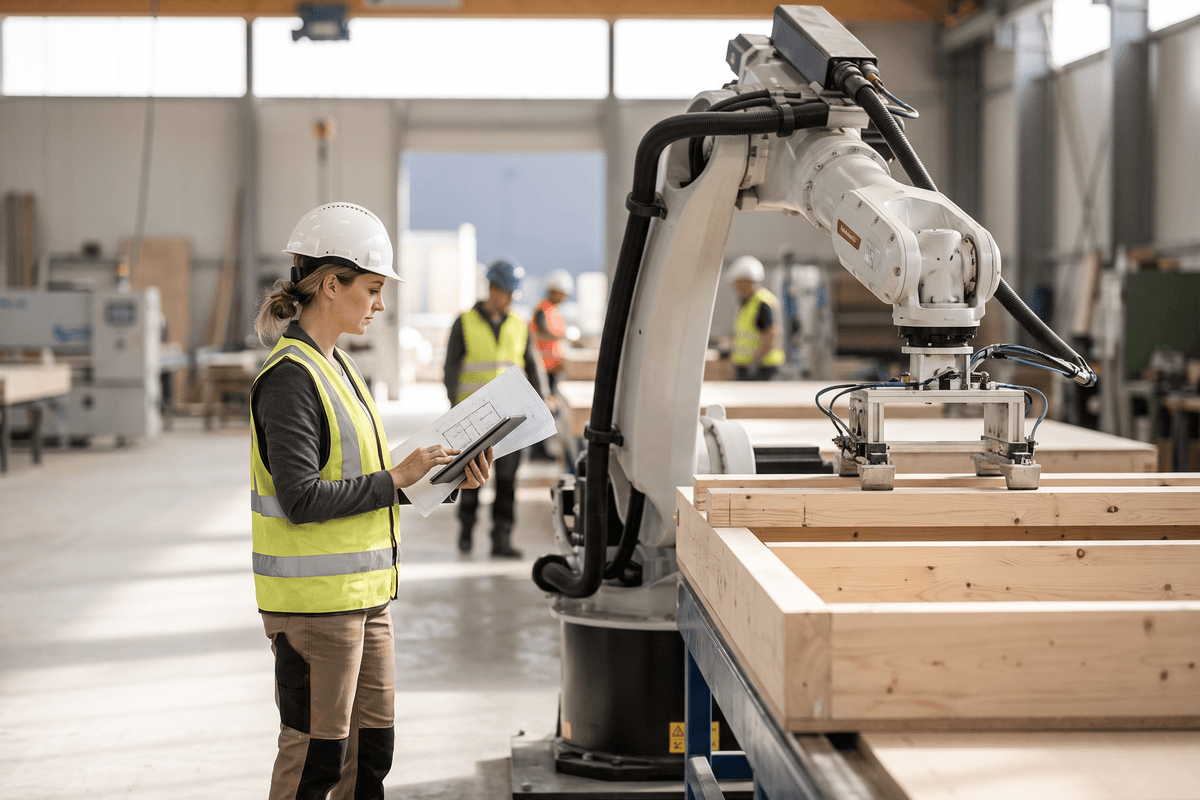



For decades, the United States construction industry has grappled with a frustrating paradox: while the manufacturing, agriculture, and aerospace sectors have seen productivity soar through automation and digitization, construction productivity has largely flatlined. Bespoke, on-site, labor-intensive processes have remained the stubborn norm. But a convergence of federal mandates, severe labor shortages, and a surge in manufacturing technology is finally forcing a structural paradigm shift. At the center of this transformation is the Department of Energy's Advanced Building Construction (ABC) Initiative, a strategic effort to close the productivity gap by dragging construction into the industrialized age.
For engineering professionals, this pivot from traditional field construction to off-site manufacturing and digitized assembly represents more than just a change in workflow—it is a fundamental rewriting of how infrastructure is designed, procured, and executed in the U.S.
Decoding the DOE’s Advanced Building Construction Initiative
The scale of the challenge is staggering. The U.S. currently houses approximately 125 million buildings that require critical energy-efficient retrofits to meet modern environmental standards and reduce operational costs. Approaching this backlog with conventional, site-built methods is mathematically impossible given current labor constraints and project timelines.
Enter the DOE’s ABC Initiative. The program is aggressively promoting a transition toward industrialized construction—specifically off-site manufacturing, modular assembly, and comprehensive digitization. By moving the bulk of the "building" process from the unpredictable environment of the job site to the controlled environment of a factory floor, the DOE aims to achieve three primary objectives:
- Accelerated Delivery: Drastically reducing project timelines by allowing site preparation and building manufacturing to occur simultaneously.
- Cost Compression: Leveraging economies of scale, reducing material waste, and optimizing supply chains to lower the per-unit cost of deep energy retrofits.
- Precision and Quality Control: Utilizing factory-grade quality assurance to ensure that energy-efficient materials and systems perform exactly as modeled in digital twins.
"We are no longer just designing buildings; we are engineering highly optimized, repeatable products. The future of U.S. construction relies on our ability to mass-produce custom solutions."
The Hardware Backbone: A Surge in Manufacturing Technology
The transition from site-built to factory-built infrastructure is only viable if the underlying manufacturing base has the capacity to support it. Recent economic indicators suggest that U.S. industry is rapidly tooling up for this reality.
According to recent market data, U.S. manufacturing technology orders climbed a remarkable 32% through the first five months of 2026, totaling $2.77 billion. While this robust demand is heavily supported by the aerospace sector, a significant driver is the urgent need for automation across all industrial sectors to combat systemic labor shortages.
For civil and structural engineers, this massive capital influx into metalworking machinery, robotics, and automated metrology translates directly into enhanced capabilities for off-site fabrication. Firms that previously struggled to source precision-engineered modular components domestically are now finding a more robust, technologically advanced supply chain capable of delivering the tight tolerances required for seamless on-site assembly.
Bridging the Human Capital Gap: Advancing Engineering Education
You cannot digitize and industrialize an industry without simultaneously upgrading the talent pool that drives it. As the lines between civil engineering, mechanical engineering, and systems manufacturing blur, the demand for cross-disciplinary engineering talent is at an all-time high.
This reality highlights the critical importance of modern engineering pedagogy. Recognizing this shift, the American Society of Civil Engineers (ASCE) Long Island Branch recently named Stony Brook University Professor Rigoberto Burgueño as the 2026 Educator of the Year. Honored for his outstanding contributions to teaching and the advancement of the civil engineering discipline, educators like Burgueño are the linchpins of this industrial transition.
To execute the DOE’s vision of industrialized construction, the next generation of civil engineers must be fluent not just in concrete and steel, but in advanced materials, digital twin modeling, robotics, and supply chain logistics. Academic proving grounds and visionary educators are essential for producing the talent required to engineer these complex, modular ecosystems.
Strategic Realignments for AEC Firms
For Architecture, Engineering, and Construction (AEC) firms, adapting to the industrialized construction model requires a fundamental restructuring of project delivery. The traditional linear progression of design-bid-build is being replaced by integrated, concurrent engineering.
| Project Phase | Traditional Paradigm | Industrialized Paradigm (ABC Initiative) |
|---|---|---|
| Design & Engineering | Bespoke, site-specific designs with high tolerance for field modifications. | Design for Manufacturing and Assembly (DfMA); standardized, repeatable components with zero-tolerance precision. |
| Procurement | Fragmented, localized sourcing of raw materials to the job site. | Centralized procurement of manufactured modules; heavily reliant on advanced manufacturing tech and logistics. |
| Labor Allocation | Heavy reliance on specialized trades executing work in uncontrolled field conditions. | Shift toward factory-based automation and technical assembly crews on-site; mitigating trade shortages. |
The Rise of DfMA
Design for Manufacturing and Assembly (DfMA) is rapidly becoming the gold standard for U.S. engineering firms tackling large-scale retrofits or new builds. By shifting the engineering focus toward how a building will be manufactured and assembled rather than just how it will look and function, firms can drastically reduce waste and accelerate timelines. This requires engineers to work closely with manufacturing technology providers early in the conceptual phase, ensuring that designs are optimized for the robotic fabrication and automated metrology systems currently flooding the U.S. market.
The Road Ahead
The U.S. engineering and construction sector is standing at a critical inflection point. The DOE's push to retrofit 125 million buildings is not just an environmental mandate; it is a catalyst for industrial modernization. Supported by a multi-billion-dollar surge in manufacturing technology and guided by forward-thinking engineering educators, the industry is finally equipped to close its decades-long productivity gap.
For engineering professionals, the mandate is clear: the future belongs to those who can bridge the gap between civil design and advanced manufacturing. By embracing digitization, off-site fabrication, and cross-disciplinary talent development, U.S. engineering firms can not only meet the massive infrastructure demands of the next decade but fundamentally redefine what it means to build in America.