
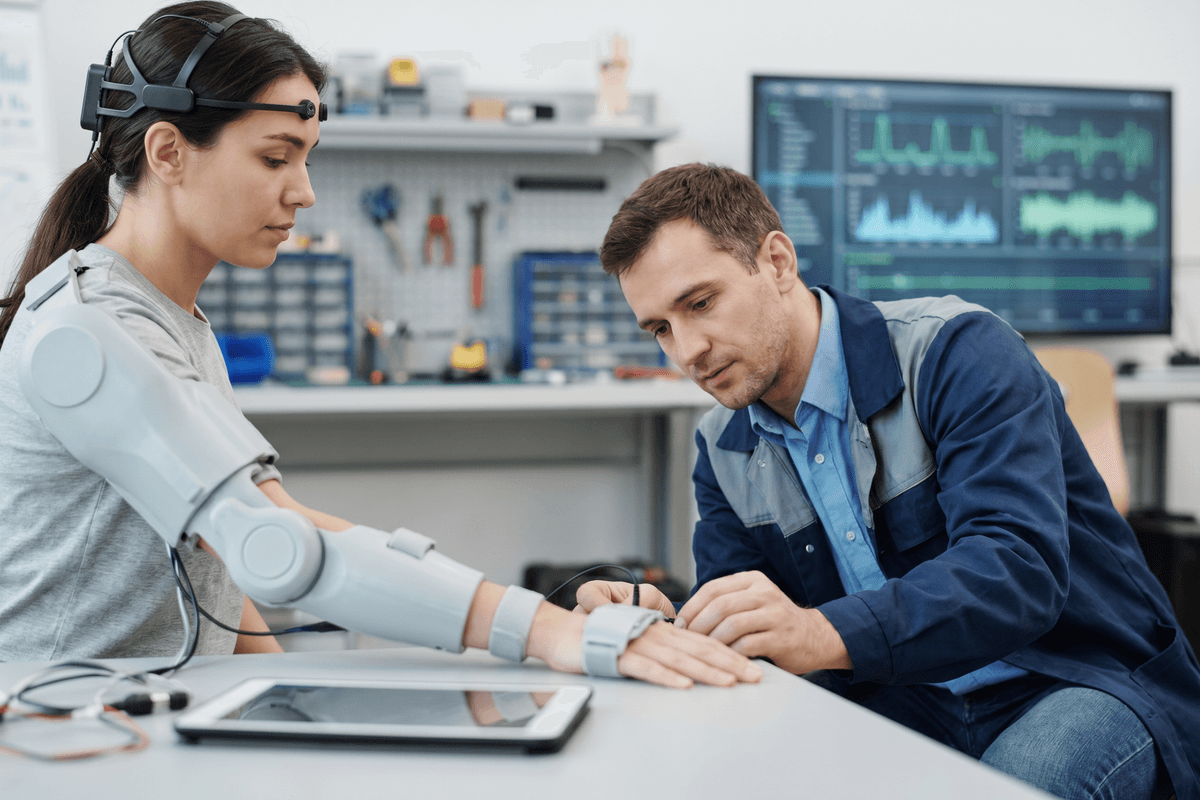



The human nervous system operates with a latency and precision that mechanical systems have spent decades trying to mimic. For years, the barrier between human intent and robotic actuation has been a physical interface—a joystick, a pressure sensor, or a motion tracker. But as highlighted in a groundbreaking National Science Foundation (NSF) podcast, the successful integration of a brain-computer interface (BCI) with a robotic exoskeleton is tearing down that barrier. For U.S. engineering professionals, this is not merely a medical marvel; it is a watershed moment in systems integration, signal processing, and biomechanical design.
The transition from reading cortical signals to driving heavy, load-bearing machinery in real-time represents one of the most complex multidisciplinary challenges in modern engineering. It requires bridging the "wetware" of the human brain with the rigid hardware of advanced robotics. As this technology moves from university laboratories into commercial and industrial viability, it is forcing engineers to rethink everything from material selection and actuator design to edge computing and safety protocols.
Decoding the Neural-Mechanical Bridge
At its core, a BCI-controlled exoskeleton is an exercise in extreme data translation. The brain produces electrical signals that are inherently noisy, low-amplitude, and highly variable between individuals. Capturing these signals—whether through non-invasive electroencephalography (EEG) caps or surgically implanted microelectrode arrays—is only the first step.
The engineering bottleneck has historically been the translation of these chaotic biological signals into clean, actionable digital commands. The recent advancements championed by the NSF demonstrate a leap forward in real-time decoding algorithms. By leveraging machine learning models directly at the edge, systems can now filter out biological artifacts (like heartbeats or muscle twitches) and isolate the specific neural patterns associated with the intent to move.
"We are no longer just building machines that humans operate; we are engineering extensions of the human nervous system. The mathematical challenge of filtering neural noise in real-time to drive a 50-pound mechanical leg without perceptible latency is the new frontier of control theory."
Solving the Latency Equation
In traditional robotics, a command is issued, processed, and executed within milliseconds. In a BCI-exoskeleton system, the "command" is a thought. If the latency between the user's intent to step forward and the exoskeleton's actuation exceeds 100 to 200 milliseconds, the user experiences cognitive dissonance, leading to loss of balance and system rejection.
To solve this, U.S. bioengineers and software architects are deploying sophisticated edge computing architectures. Rather than sending neural data to a centralized processor, lightweight, high-performance computing modules are integrated directly into the exoskeleton's chassis. These modules utilize advanced digital signal processing (DSP) and field-programmable gate arrays (FPGAs) to decode neural intent locally, drastically cutting down transmission latency.
Hardware Evolution: From Rigid to Responsive
Translating a thought into a digital command is useless if the physical hardware cannot respond with equal agility. The mechanical engineering required for BCI exoskeletons demands a radical departure from traditional industrial robotics.
Because the system is driven by human intent, the actuation must be fluid, variable, and capable of instantaneous micro-adjustments. This has accelerated the development of series elastic actuators (SEAs) and quasi-direct drive motors. Unlike rigid industrial servos, SEAs incorporate a spring element between the motor and the load, providing intrinsic compliance. This means if the user's neural signal is slightly erratic, the mechanical joint absorbs the jitter rather than violently jerking the user's limb.
Comparative System Requirements
The shift from traditional joystick or pressure-based exoskeletons to neural-controlled systems requires a fundamental upgrade in hardware specifications:
| Engineering Parameter | Traditional Exoskeleton | BCI-Integrated Exoskeleton |
|---|---|---|
| Control Latency | < 500 ms (Acceptable for manual triggers) | < 100 ms (Critical for neuro-motor synchronization) |
| Actuation Type | Rigid servos, high gear ratios | Series Elastic Actuators (SEAs), high back-drivability |
| Data Processing | Basic microcontrollers (Kinematic loops) | Edge AI/FPGAs (Real-time neural decoding) |
| Safety Fail-safes | Mechanical hard-stops, manual kill switches | Algorithmic anomaly detection, predictive intent overrides |
Beyond Rehabilitation: Industrial and Civil Applications
While the NSF highlights the profound medical and rehabilitative impacts of this technology—giving mobility back to those with spinal cord injuries—the commercial engineering sector is looking at the broader industrial applications. The U.S. construction, manufacturing, and defense sectors are actively exploring how neural-mechanical augmentation can redefine human labor in hazardous environments.
Consider a heavy civil construction site. Currently, industrial exoskeletons are passive (using springs to assist lifting) or rely on physical force sensors to trigger motors. A BCI-controlled industrial exoskeleton would allow an ironworker to manipulate heavy structural components seamlessly, with the exoskeleton acting as a true extension of their body. The machine anticipates the lift based on neural intent before the physical muscle even strains.
Navigating the Regulatory and Safety Matrix
Deploying brain-controlled heavy machinery introduces unprecedented safety and regulatory challenges. U.S. engineers must navigate a complex Venn diagram of FDA regulations (for the medical/neural interface) and OSHA standards (for occupational use of robotic machinery).
How do you engineer a fail-safe for a thought? If a user operating a BCI-exoskeleton is startled, their brain may produce a sudden, erratic spike in neural activity. Engineers are developing "intent-filtering" safety layers. These software protocols utilize predictive kinematics to evaluate whether a neurally decoded command is physically safe and logically sound within the user's current environment. If the BCI decodes a command to step forward, but onboard LiDAR sensors detect a sheer drop, the system's local safety architecture must override the neural command in milliseconds.
The Road Ahead: Building the Augmented Workforce
The breakthroughs discussed by the NSF are not the finish line; they are the starting gun for a new discipline of engineering. Over the next decade, we will see the convergence of neurotechnology, advanced materials, and edge computing solidify into a standardized engineering practice.
For U.S. engineering professionals, staying ahead of this curve requires a multidisciplinary mindset. Mechanical engineers must understand neural latency; software developers must grasp biomechanical kinematics; and systems integrators must weave it all together into a chassis that is light enough to wear but strong enough to work. The brain-computer interface has proven that the human mind can directly command machines. Now, it is up to the engineering sector to build the infrastructure, hardware, and safety protocols to bring that capability out of the lab and into the physical world.