
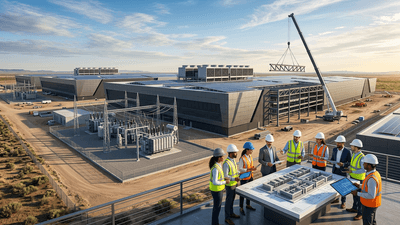



While Silicon Valley obsesses over the parameters of the latest large language models, the true beneficiaries of the 2026 artificial intelligence boom are wearing hard hats and drafting blueprints. For the United States engineering and design sector, the artificial intelligence revolution is no longer just a software phenomenon—it is the most significant catalyst for physical infrastructure development in a generation.
According to the newly released Engineering News-Record (ENR) 2026 Top 500 Design Firms list, AI-related infrastructure spending has become a dominant revenue engine buoying the broader architecture, engineering, and construction (AEC) industry. As hyperscalers and colocation providers race to build the massive facilities required to train and run next-generation AI, top U.S. design firms are reaping the financial rewards of this unprecedented capital expenditure supercycle.
The End of the Traditional Data Center
To understand why AI is generating such massive revenue for design firms, one must look at the fundamental physics of AI computing. The facilities being designed in 2026 bear little resemblance to the data centers of the 2010s. They are exponentially denser, hotter, and heavier.
Mechanical and Electrical Complexities
Traditional cloud computing data centers were designed to handle power densities of roughly 5 to 10 kilowatts (kW) per rack. Today, racks packed with specialized AI accelerators routinely demand 50 to 100 kW, with some customized liquid-cooled setups pushing beyond 120 kW. This tenfold increase in power density has rendered legacy Mechanical, Electrical, and Plumbing (MEP) designs obsolete.
For MEP engineering firms, this transition has created a windfall of high-margin design work. Engineers are being tasked with designing highly complex, closed-loop direct-to-chip liquid cooling systems and immersion cooling environments. These systems require intricate piping, advanced leak detection, and heat rejection mechanisms that demand a level of precision previously reserved for industrial chemical plants or nuclear facilities.
"We are no longer designing data storage warehouses; we are engineering high-performance thermal management plants that happen to house computers. The complexity of the MEP scope has easily tripled compared to five years ago."
Structural and Civil Engineering Demands
The weight of liquid cooling infrastructure, combined with the sheer density of AI servers, has fundamentally altered the structural engineering requirements of these facilities. Floor load capacities have had to increase dramatically, requiring more robust steel and concrete designs. Furthermore, as developers seek out larger plots of land to accommodate these mega-campuses—often in secondary markets with cheaper power—civil engineers are seeing a surge in site preparation, geotechnical surveying, and stormwater management contracts.
The Energy Infrastructure Ripple Effect
The ENR Top 500 data reveals that the AI boom's revenue impact extends far beyond the four walls of the data center. The most pressing bottleneck for AI expansion in the U.S. is not silicon; it is electricity.
A modern gigawatt-scale AI campus requires as much power as a mid-sized American city. Consequently, power and transmission engineering has become a critical growth vector for top design firms.
- Substation Design and Grid Interconnection: Firms specializing in high-voltage transmission and utility-scale substation design are reporting record backlogs. Hyperscalers are increasingly funding their own grid upgrades to expedite interconnection queues.
- Behind-the-Meter Generation: Because the traditional grid cannot always support these massive loads, design firms are being commissioned to engineer microgrids, battery energy storage systems (BESS), and on-site natural gas generation to bridge the gap.
- Advanced Nuclear and Geothermal Integration: As tech giants commit to "24/7 carbon-free energy" mandates, specialized engineering firms are actively designing integrations for Small Modular Reactors (SMRs) and advanced geothermal plants to power future AI campuses.
The Retrofit Challenge: Upgrading Legacy Assets
While greenfield mega-projects capture the headlines, a significant portion of the revenue growth highlighted in the ENR report stems from complex retrofits. Because building a new facility can take three to five years from site selection to commissioning, hyperscalers are aggressively retrofitting existing enterprise data centers to accommodate AI workloads.
Retrofitting is arguably a more complex engineering challenge than greenfield development. Engineers must figure out how to weave liquid cooling infrastructure into facilities designed only for air cooling, and how to reinforce structural slabs to handle heavier racks—often while the facility remains partially operational. This highly specialized, risk-intensive work commands premium billing rates, further driving up design firm revenues.
Comparing the Design Paradigms
The shift in engineering requirements is stark when comparing traditional facilities to modern AI infrastructure:
| Engineering Discipline | Traditional Cloud Data Center (Pre-2023) | AI-Optimized Facility (2026) |
|---|---|---|
| Electrical | 5-10 kW/rack; standard UPS systems | 50-120+ kW/rack; integrated microgrid & BESS |
| Mechanical | CRAC/CRAH units; raised floor air cooling | Direct-to-chip liquid cooling; rear-door heat exchangers |
| Structural | Standard commercial floor loading (150-250 psf) | Heavy industrial floor loading (300-500+ psf) |
| Civil/Water | Standard municipal water hookups for cooling towers | Closed-loop water recycling; zero-water depletion designs |
Navigating Resource Constraints in the AEC Sector
While the revenue surge is a boon for the industry, it is not without its challenges. The rapid acceleration of AI infrastructure projects has exacerbated an already tight labor market for specialized engineers.
To capitalize on the boom without burning out their workforce, top firms on the ENR list are deploying strategic resource management tactics:
- Cross-Training Talent: Firms are actively cross-training traditional industrial and commercial MEP engineers in mission-critical design standards to expand their capacity.
- Standardization and Modularization: To speed up deployment and reduce custom design hours, leading firms are developing standardized, modular "blocks" of AI infrastructure that can be replicated across different sites with minimal bespoke engineering.
- Leveraging AI for AI: In an ironic twist, engineering firms are heavily utilizing AI-assisted generative design and automated clash detection to accelerate the drafting process for these massive facilities, allowing them to take on more volume.
Conclusion: A Foundational Shift, Not a Passing Trend
The revenue growth highlighted in the ENR 2026 Top 500 Design Firms list is not indicative of a short-term bubble. The physical infrastructure required to support artificial intelligence represents a foundational shift in the built environment, akin to the build-out of the interstate highway system or the original telecommunications fiber networks.
For U.S. engineering and design professionals, the mandate is clear. The convergence of mission-critical facility design, advanced thermal management, and utility-scale power generation is the new frontier of the AEC industry. Firms that can seamlessly bridge the gap between the digital ambitions of Silicon Valley and the physical realities of power, thermodynamics, and concrete will dominate the revenue rankings for the next decade.