
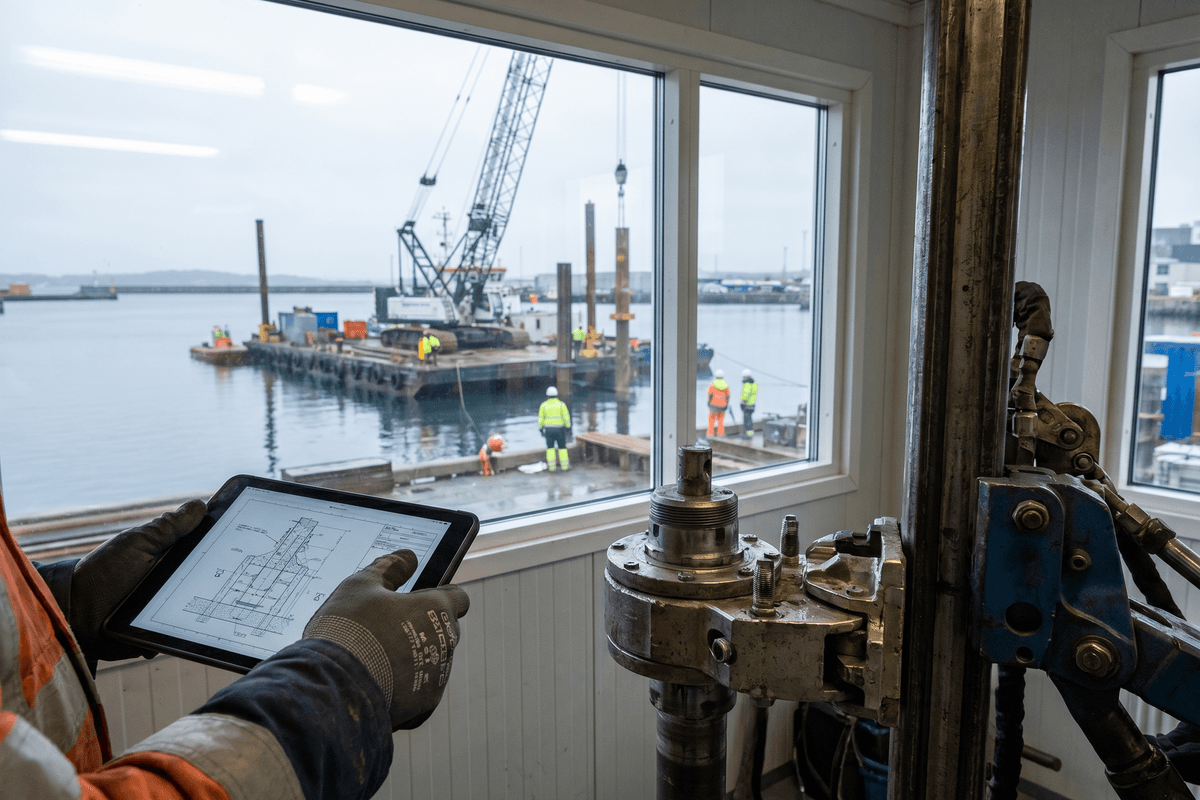



In the modern era of United States infrastructure renewal, engineering precision is being tested at two radically different extremes. On one end of the spectrum, contractors are moving literal mountains of concrete in plain sight, battling gravity and hydrology. On the other, specialized crews are operating completely out of view, navigating complex subterranean labyrinths with surgical accuracy. As federal funding and municipal demands accelerate, the engineering firms poised to dominate the next decade are those mastering these zero-tolerance environments.
This bipolar demand for precision is currently driving intense strategic maneuvering across the U.S. engineering landscape. We are witnessing a clear trend: firms are actively consolidating niche capabilities to meet the growing mandate for infrastructure upgrades that require either massive heavy-civil execution or invisible, zero-disruption subsurface installations.
The Subsurface Land Grab: DEVCO and the Trenchless Boom
The subsurface infrastructure market, particularly in the American Southwest, is undergoing a quiet but aggressive consolidation. A prime indicator of this shift is DEVCO Development & Engineering's recent integration of Directional Boring CA into its operational family. This move significantly expands DEVCO’s underground utility construction services across the highly competitive California and Arizona markets.
Why is directional boring becoming such a highly valued asset in the M&A space? The answer lies in the evolving requirements of urban utility owners. As the U.S. pushes for rapid broadband expansion, grid modernization, and water system overhauls, the traditional "open-cut" trenching method is increasingly viewed as a liability. Open-cut methods disrupt traffic, damage existing surface infrastructure, and carry heavy environmental and public relations costs.
The Strategic Value of Directional Boring
Horizontal Directional Drilling (HDD) and trenchless technologies offer a low-impact alternative, but they require a highly specialized skill set and expensive equipment. By bringing Directional Boring CA under its umbrella, DEVCO is securing several strategic advantages:
- End-to-End Control: Relying on subcontractors for critical path trenchless work introduces scheduling risks. In-house capabilities allow for tighter project management and better margin control.
- Regulatory Compliance: California's stringent environmental regulations heavily favor construction methods that minimize soil displacement and surface disruption.
- Risk Mitigation: Navigating the "spaghetti" of existing underground utilities in legacy urban centers requires specialized geomatics and highly experienced operators to prevent catastrophic utility strikes.
"The integration of specialized trenchless teams into broader development firms isn't just about expanding service lines; it's about controlling the most volatile risk vector in urban infrastructure—what lies beneath the surface."
The Macro Contrast: Heavy Civil's Zero-Margin Execution
While trenchless crews navigate inches of clearance around live utilities in the dark, heavy civil teams are operating with similar margins of error in broad daylight, but at an exponentially larger scale. To understand the full spectrum of precision demanded by modern U.S. engineering, we must look at the opposite end of the scale: legacy infrastructure replacement.
A benchmark for this macro-precision was recently achieved by the U.S. Army Corps of Engineers and its contracting partners. In a monumental feat of heavy marine civil engineering, crews successfully completed the placement of 420-ton concrete beams at the Chickamauga Lock Replacement Project on the Tennessee River.
While we have previously analyzed the broader supply chain and logistical implications of the Chickamauga project, this specific milestone serves as a perfect foil to the DEVCO acquisition. Placing a 420-ton concrete beam for an upstream approach wall over an active waterway requires millimeter-level accuracy. The environmental forces—river currents, wind, and the sheer inertia of a massive suspended load—create a dynamic engineering challenge that leaves absolutely no room for error.
The Common Thread: Spatial Intelligence and De-Risking
At first glance, steering a 4-inch drill bit through urban bedrock and hoisting a 420-ton concrete beam over a river seem like entirely different disciplines. However, from a project management and systems engineering perspective, they share a critical common thread: advanced spatial intelligence.
Both disciplines rely on the same foundational technologies to de-risk their execution phases:
- Digital Twinning and 3D Modeling: Whether mapping the subterranean utility grid of Los Angeles or modeling the stress points of a concrete beam during a complex crane lift, digital rehearsals are now mandatory.
- Real-Time Telemetry: HDD operators rely on real-time locators and gyroscopic steering tools to track the drill head's pitch and roll. Similarly, heavy lift coordinators use real-time sensor data to monitor load distribution and wind speeds during critical crane operations.
- Specialized Talent Retention: The equipment is useless without the operators. Both DEVCO's acquisition of an established boring team and the Army Corps' reliance on veteran crane operators highlight that human expertise remains the ultimate bottleneck in high-precision engineering.
Comparing the Extremes of Engineering Precision
To better understand how firms are allocating capital and building capabilities, it is helpful to contrast the operational profiles of these two critical infrastructure sectors:
| Operational Parameter | Subsurface / Trenchless (e.g., DEVCO) | Heavy Marine Civil (e.g., Chickamauga Lock) |
|---|---|---|
| Primary Challenge | Navigating unseen obstacles; preventing utility strikes. | Managing massive dynamic loads; counteracting environmental forces. |
| Precision Metric | Inches (maintaining bore path and grade). | Millimeters (aligning massive structural joints). |
| Market Drivers | Broadband expansion, grid modernization, urban density. | Legacy infrastructure decay, federal waterway funding. |
| Risk Profile | High frequency, moderate-to-high consequence (gas line strikes). | Low frequency, catastrophic consequence (structural collapse/drop). |
Strategic Implications for U.S. Firms
For engineering and construction executives, the lessons from these two extremes are clear. The era of the pure "generalist" contractor is waning, particularly in complex civil infrastructure. Clients—whether they are telecom giants laying fiber in California or federal agencies maintaining navigable waterways—are demanding specialized, de-risked execution.
Firms must decide where they play on the precision spectrum. If a firm is operating in urban utility markets, acquiring trenchless capabilities (as DEVCO has done) is no longer just a growth strategy; it is a defensive necessity to protect market share against vertically integrated competitors. Conversely, firms competing in the heavy civil space must continue to invest heavily in the specialized lifting equipment and geomatics talent required to execute macro-projects safely.
Ultimately, the future of U.S. infrastructure will not be built by brute force alone. It will be built by firms that can thread the needle—whether that needle is a drill bit navigating a crowded city street, or a 420-ton beam suspended over a rushing river.