
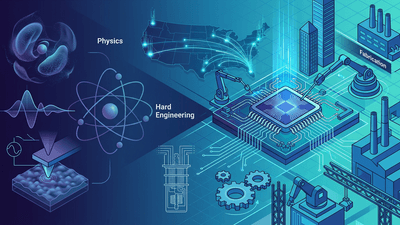



For the past decade, the race for quantum supremacy has been largely characterized as a domain of theoretical physicists and computer scientists. But as the industry attempts to scale from fragile, lab-bound prototypes to commercially viable systems, the narrative has abruptly shifted. In 2026, quantum computing is no longer just a physics problem—it is arguably the most complex mechanical, materials, and infrastructure engineering challenge of our time.
This reality was cemented this week when the Department of Commerce announced Letters of Intent with nine companies, unlocking $2 billion in CHIPS incentives. The explicit goal? To help these organizations solve the "hardest engineering challenges" and secure U.S. leadership in quantum computing technology. For American engineering professionals—from MEP designers to materials scientists—this federal mandate signals the birth of a highly lucrative, hyper-specialized infrastructure sector.
Decoding the "Hardest Engineering Challenges"
When the Department of Commerce allocates $2 billion under the CHIPS and Science Act toward quantum, it is an acknowledgment that quantum bits (qubits) are fundamentally a semiconductor and fabrication issue. Maintaining quantum coherence—the state in which qubits can perform complex calculations without degrading—requires environments that push the absolute limits of modern engineering.
The $2 billion injection targets several critical engineering bottlenecks that currently prevent quantum scaling:
- Extreme Cryogenics: Superconducting qubits must be kept at temperatures near absolute zero (roughly 15 millikelvins), which is colder than deep space. Designing and manufacturing the dilution refrigerators capable of maintaining these temperatures at a commercial scale is a monumental thermodynamic engineering challenge.
- Vibration and Acoustic Isolation: Qubits are extraordinarily sensitive to environmental noise. A microscopic vibration from a passing truck or a subtle acoustic wave can cause decoherence. Structural engineers are now tasked with designing facilities with unprecedented seismic and acoustic isolation baselines.
- Electromagnetic Shielding: Stray electromagnetic fields can instantly corrupt quantum data. The materials engineering required to build scalable, cost-effective shielding for large quantum data centers goes far beyond traditional Faraday cage designs.
- Sub-Atomic Fabrication: Manufacturing quantum chips requires atomic-level precision. Yield rates for quantum processors are notoriously low, demanding entirely new fabrication architectures and ultra-pure material supply chains.
"The transition from quantum theory to quantum utility is entirely dependent on our ability to engineer physical environments that isolate, control, and scale these delicate systems. This $2 billion investment is a recognition that hardware engineering is the true frontier of the quantum race."
The Academic-Industrial Bridge: Fueling the Talent Pipeline
Capital alone cannot solve these bottlenecks; the U.S. requires a deep bench of elite engineering talent to execute this vision. Fortunately, the alignment between federal funding and academic excellence is strengthening. This synergy was highlighted recently when several MIT affiliates were elected to the National Academy of Sciences for 2026.
Among the newly elected members are pioneers in mechanical engineering and materials science. Their outstanding research contributions are exactly the type of foundational science required to overcome the thermal and structural hurdles of quantum scaling. When institutions like the National Academy of Sciences elevate mechanical engineering researchers alongside traditional physicists, it underscores a critical industry shift: applied engineering is now the primary vehicle for scientific advancement.
For the nine companies receiving the Department of Commerce funding, this academic brain trust is vital. The talent pipeline flowing from top-tier research institutions into the private sector will be responsible for translating $2 billion of federal intent into functional, scalable quantum hardware.
The Infrastructure Shift: What This Means for U.S. Design Firms
For the broader U.S. engineering and construction sector, the commercialization of quantum computing is creating a new asset class: the Quantum Data Center. Just as the artificial intelligence boom drove record revenues for firms designing hyperscale data centers, the quantum push will demand a new tier of specialized facility design.
Traditional data centers are built to dissipate massive amounts of heat. Quantum data centers, conversely, are built to maintain extreme cold and absolute stillness. The fundamental engineering parameters are entirely inverted.
Comparing Infrastructure Baselines
| Engineering Parameter | Traditional Hyperscale Data Center | Next-Gen Quantum Facility |
|---|---|---|
| Thermal Management | Massive heat rejection (HVAC, liquid cooling) | Extreme cryogenics (Dilution refrigeration to 15mK) |
| Vibration Tolerance | Standard commercial seismic baselines | Near-zero tolerance; isolated monolithic foundation slabs |
| Electromagnetic Environment | Standard shielding for server racks | Multi-layered, active and passive EM shielding |
| Material Purity | Standard industrial construction materials | Ultra-pure, non-magnetic structural materials |
Engineering firms that can master these stringent requirements will find themselves at the forefront of a highly uncrowded, high-margin market. The CHIPS funding will accelerate the timeline for these facilities, moving them from niche university laboratories to commercial real estate developments sooner than the market previously anticipated.
Looking Ahead: The Next Decade of Quantum Engineering
The Department of Commerce's Letters of Intent represent more than just a financial boost; they are a strategic declaration that the United States intends to engineer its way to quantum supremacy. By aggressively funding the companies tackling the hardest hardware challenges, the U.S. is laying the groundwork for the next generation of technological infrastructure.
For engineering professionals, the mandate is clear. The physics of quantum computing have been proven. The task now is to build the machines, the facilities, and the supply chains that can sustain it. As elite academic research merges with robust federal backing, the American engineering sector is uniquely positioned to turn the quantum theoretical into the profoundly physical.