
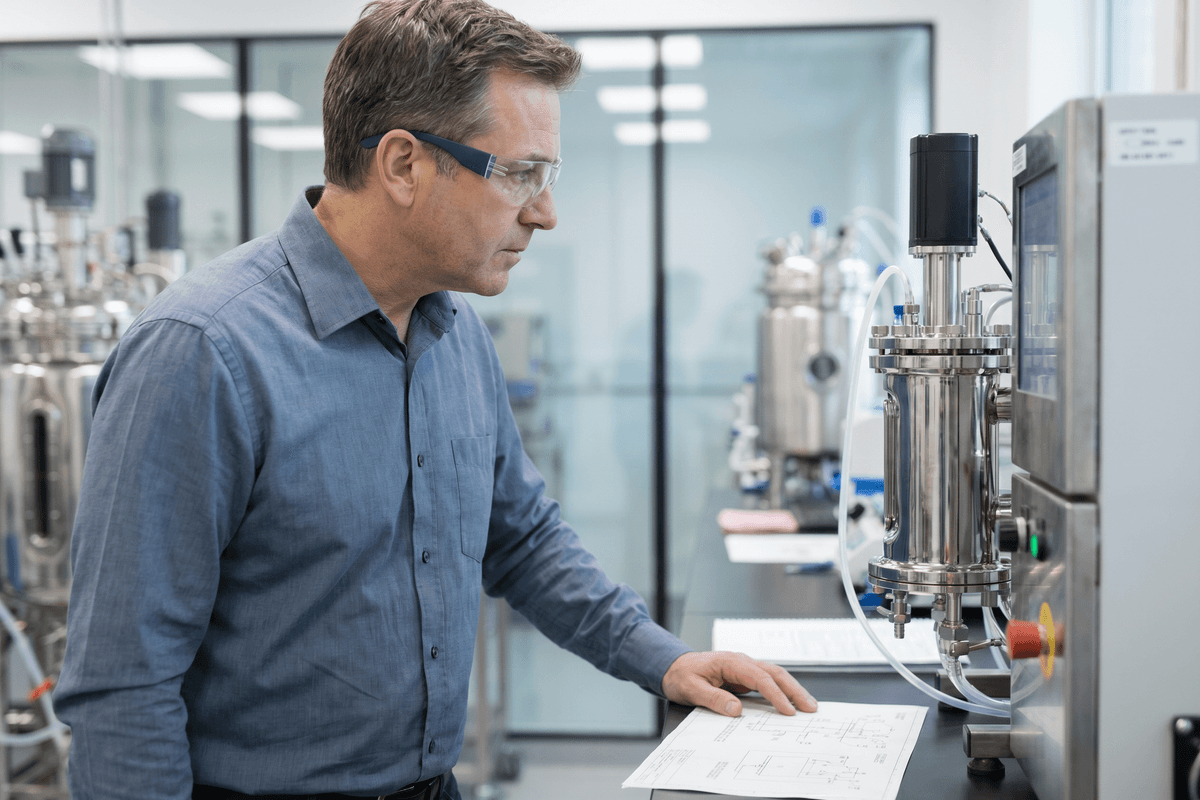



For decades, the American engineering sector has operated on a foundational bedrock of standardized measurements. Whether calculating the tensile strength of structural steel or the fluid dynamics within an industrial HVAC system, universal standards have been the silent engine of U.S. infrastructure scaling. Today, however, the definition of "infrastructure" is undergoing a profound biological shift, and the engineering frameworks required to support it are scrambling to catch up. As biomanufacturing transitions from boutique laboratory science to industrial-scale engineering, the lack of unified standards has emerged as the sector's primary bottleneck.
This week, the legislative landscape shifted to address this exact friction point. The introduction of the SCALE Biology Act marks a watershed moment, aiming to establish a dedicated federal program at the National Institute of Standards and Technology (NIST) to develop standards and measurements specifically for engineering biology. For structural, mechanical, and civil engineers, this is not merely a niche scientific development—it is the opening bell for the next massive wave of specialized U.S. industrial construction and facility retrofitting.
The SCALE Biology Act: Industrializing the Microscopic
Engineering biology—the application of engineering principles to design and build biological systems—has massive implications for healthcare, agriculture, and sustainable materials. However, scaling these innovations domestically requires physical infrastructure: bioreactors, specialized cleanrooms, and advanced mechanical, electrical, and plumbing (MEP) systems capable of maintaining precise environmental controls.
The bipartisan SCALE Biology Act is designed to support domestic biomanufacturing by giving NIST the mandate to create the "rulers and scales" of the bio-economy. Without these standards, every new biomanufacturing facility is effectively a custom, one-off project, driving up engineering costs and delaying time-to-market. By standardizing the measurements, the federal government is laying the groundwork for modular, repeatable, and scalable facility design.
"Standardization is the bridge between a scientific breakthrough and a viable industrial sector. By empowering NIST to define the metrics of engineering biology, we are giving architectural and engineering firms the blueprints they need to build the next generation of American manufacturing facilities."
Comparing Engineering Paradigms
| Engineering Domain | Standardization Body | Primary Focus | Current Industry Challenge |
|---|---|---|---|
| Traditional Civil/Mechanical | ASCE, IBC, ASHRAE | Load-bearing, safety, thermodynamics | Retrofitting legacy structures for modern MEP systems |
| Engineering Biology | NIST (Pending SCALE Act) | Biomanufacturing, genomic scaling | Lack of unified measurement and scaling protocols |
Academic and Federal Realignments
The push for federal standardization is triggering a fascinating realignment of engineering leadership at the highest levels. The intersection of academic research and federal policy has never been more critical, as evidenced by recent leadership shifts at top-tier U.S. institutions.
Purdue University recently announced that Arvind Raman has been confirmed as the U.S. undersecretary of commerce for standards and technology—the exact federal post that oversees NIST. To fill the vacancy, Purdue appointed Mark Lundstrom as the new dean of the College of Engineering. This pipeline from elite engineering academia directly into the Department of Commerce highlights how seriously the federal government is taking the standardization of emerging technologies, from semiconductors to synthetic biology.
For engineering firms, these leadership moves signal a clear directive: the standards being developed in the labs of Purdue, MIT, and Stanford today are rapidly becoming the federal building codes of tomorrow. Firms that stay aligned with NIST's evolving frameworks will be best positioned to win the lucrative federal and private contracts associated with the U.S. biomanufacturing boom.
The Physical Reality: Retrofitting for Next-Gen Systems
While federal agencies and academic deans debate standards, mechanical and civil engineers are left to solve the physical realities of housing these advanced systems. Often, this means retrofitting historic, aging infrastructure to support technologies that simply did not exist when the buildings were poured.
A prime example of this complex integration is the ongoing work by U.S. Engineering at the University of Colorado Boulder. The renovation of the historic Hellems Building perfectly encapsulates the tension between legacy architecture and modern engineering demands. Upgrading a building "not built for modern systems" requires innovative structural solutions to route advanced HVAC, electrical, and data infrastructure without compromising the building's historic integrity.
As universities and private enterprises race to build out their advanced research and biomanufacturing capabilities, they frequently encounter these exact constraints. The engineering solutions developed for projects like the Hellems Building—such as 3D laser scanning for spatial routing and modular MEP prefabrication—are the exact tactics that will be required to retrofit legacy industrial parks into NIST-compliant biomanufacturing hubs.
Baseline Execution and Workforce Readiness
However, the execution of these advanced, standardized facilities relies entirely on a workforce capable of building and maintaining them. As the technological ceiling of U.S. engineering rises, the baseline readiness of the workforce must rise with it.
This reality is starkly visible in both the private sector and the military. At Holloman Air Force Base, the 49th Civil Engineer Squadron recently conducted multi-discipline Prime BEEF training. This rigorous readiness program ensures that military civil engineers can maintain critical infrastructure and execute mission-essential tasks in highly austere environments. The discipline required to maintain operational readiness downrange mirrors the exact operational rigor needed to maintain "zero-fail" environments in domestic biomanufacturing and semiconductor facilities.
Simultaneously, private firms are recognizing that their future success hinges on community connection and talent development. In their recent May 2026 operational update, U.S. Engineering highlighted their ongoing investments in future engineering talent and community partnerships. As the complexity of engineering projects increases—driven by new biological standards and intricate historic retrofits—the competition for highly skilled, adaptable engineering talent is becoming the defining constraint for firm growth.
Strategic Priorities for Engineering Leaders in 2026
- Monitor NIST Developments: Assign internal teams to track the progress of the SCALE Biology Act and emerging NIST frameworks to anticipate new MEP and facility design requirements.
- Invest in Retrofit Capabilities: As urban space remains constrained, the ability to seamlessly integrate advanced, highly-regulated systems into legacy structures will command premium margins.
- Bridge the Talent Gap: Look to military transition programs (like former Prime BEEF engineers) to source talent accustomed to high-stakes, zero-fail infrastructure maintenance.
Conclusion: Engineering the Biological Century
The introduction of the SCALE Biology Act is more than just a regulatory update; it is an acknowledgment that biology is the next great frontier of American industrial engineering. As leaders like Arvind Raman take the helm at NIST, the gap between academic research and federal standardization is closing rapidly.
For the U.S. engineering sector, the mandate is clear. The firms that will dominate the late 2020s will be those capable of speaking the language of biological standards, executing hyper-complex retrofits in legacy structures, and maintaining a workforce disciplined enough to operate in zero-fail environments. The "rulers and scales" of the next industrial revolution are currently being drafted—it is up to the engineering community to build what comes next.