
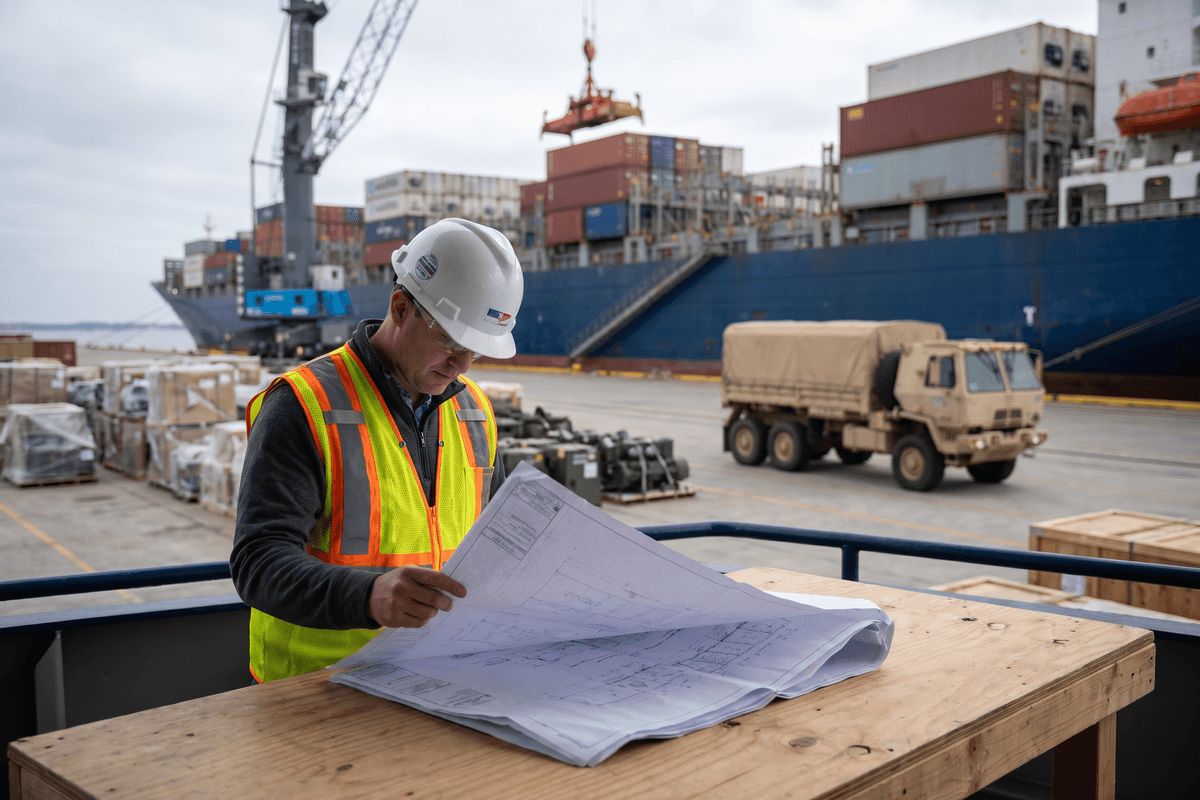



Across the Indo-Pacific and mainland United States, the boundary between national defense readiness, commercial supply chain hardening, and advanced industrial infrastructure is evaporating. The U.S. Air Force’s recent award of a $400 million indefinite-delivery/indefinite-quantity (IDIQ) contract to three engineering consortia for Pacific theater civil engineering support marks a decisive shift in how military engineers approach expeditionary resilience and dispersed basing. Far from an isolated procurement, this massive Pacific allocation coincides with major civil engineering capital commitments domestically—including the Port of Oakland’s $642 million harbor deepening agreement with the U.S. Army Corps of Engineers and SK hynix’s groundbreaking on a $4 billion advanced packaging hub in Indiana.
For civil, structural, and geotechnical engineers, these parallel developments illustrate a unified structural reality: modern infrastructure engineering is no longer simply about pouring concrete or dredging silt. It has become the foundational enabler of geopolitical deterrence, maritime throughput capacity, and technological sovereignty.
The Pacific Theater: Engineering at the Edge of Logistics
The U.S. Air Force’s $400 million IDIQ vehicle directs top-tier advisory, civil engineering, and infrastructure program support across allied and forward-operating installations in the Pacific. Under the doctrine of Agile Combat Employment (ACE)—which demands that air operations disperse rapidly from centralized mega-bases to austere, decentralized airfields—civil engineering firms face unprecedented technical constraints.
Engineers operating in the Pacific theater must reconcile harsh maritime-tropical climates, seismic volatility, and constrained supply chains with the need for rapid pavement repair, hardened utility systems, and modular fuel distribution networks. Unlike standard municipal design contracts, theater-wide infrastructure support necessitates:
- Expeditionary Airfield Pavement Engineering: Designing high-durability, rapid-curing concrete and aggregate matrices capable of supporting sustained heavy airlift under austere field conditions.
- Decentralized Utility Microgrids: Developing resilient, islanded power and water purification systems that withstand severe weather events and cyber-physical disruptions.
- Contested Geotechnical Modeling: Executing site characterization and foundation engineering across remote coral atolls and volcanic strata with limited baseline survey data.
"Executing complex civil infrastructure thousands of miles from traditional supply chains requires engineering solutions that are modular by design and nearly impervious to material degradation," explains the operational mandate behind Pacific theater engineering task orders.
Domestic Gateways: Upgrading Maritime Scale at the Port of Oakland
While the Department of Defense hardens its forward posture, domestic port authorities are racing to adapt their physical geometry to an evolving global merchant fleet. The Port of Oakland and the U.S. Army Corps of Engineers (USACE) have officially finalized their design agreement for the $642 million harbor deepening and turning basin expansion project.
The engineering challenge is driven by naval architecture: modern container shipping is dominated by 19,000+ TEU (Twenty-foot Equivalent Unit) vessels exceeding 1,300 feet in length. Oakland’s existing turning basins, engineered for previous generations of 6,000-to-8,000 TEU ships, create operational chokepoints and navigation safety risks.
| Engineering Parameter | Baseline / Existing Condition | Design Expansion Objective | Primary Technical Constraint |
|---|---|---|---|
| Vessel Capacity | Up to 14,000 TEU comfortably | 19,000+ TEU Ultra-Large Vessels | Beam clearance and maneuverability envelopes |
| Turning Basin Width | ~1,500 feet | Widened to accommodate 1,300+ ft LOA ships | Adjacent industrial shoreline and berth setbacks |
| Navigation Depth | -50 feet Mean Lower Low Water (MLLW) | Expanded deep-water draft profile | Sediment disposal, dredging plumes, and marine ecology |
| Environmental Mitigation | Standard maintenance dredge protocol | Electrified dredging & habitat beneficial reuse | San Francisco Bay water quality compliance |
The design phase requires complex hydrodynamic computational fluid dynamics (CFD) modeling, geotechnical analysis of Bay mud sediment stability, and structural engineering to retrofit existing wharf bulkheads and crane rails against amplified scour and hydrodynamic pressure.
The High-Tech Reshoring Nexus: Semiconductor Packaging at Purdue
The civil engineering demand curve is equally steep in the high-tech manufacturing sector. SK hynix’s ground-breaking on its $4 billion advanced packaging and AI memory research facility at the Purdue Research Park in West Lafayette, Indiana, illustrates the immense structural requirements of next-generation microelectronics plants.
Unlike standard industrial warehouses, advanced semiconductor packaging facilities require ultra-tight structural tolerances. Engineering teams must resolve:
- Vibration Mitigation (VC Criteria): Designing deep deep-foundation systems, massive isolated mat slabs, and structural damping to eliminate ambient micro-vibrations that disrupt nanometer-scale lithography and advanced packaging equipment.
- Complex MEP Coordination: Integrating high-purity gas loops, industrial deionized water recycling plants, and ultra-redundant HVAC systems operating cleanrooms under strict particulate specifications.
- Substation and Grid Interconnect Engineering: Engineering high-voltage substations capable of delivering uninterrupted, dual-feed power to continuously operating fabrication bays.
These industrial megaprojects reinforce the findings of the latest Q3 2026 Engineering Business Sentiment Study from the ACEC Research Institute, which highlights durable project backlogs and strong financial optimism among nearly 600 U.S. engineering firm executives, driven predominantly by defense, industrial manufacturing, and public-works investments.
Market Bifurcation: High-Spec Megaprojects vs. General Commercial
Despite robust aggregate sentiment, the engineering and construction market is experiencing sharp sectoral polarization. Data from the Associated Builders and Contractors (ABC) regarding recent nonresidential momentum shows that hiring and backlog gains are heavily concentrated in specialized verticals—such as AI data centers, defense, and high-tech manufacturing—while traditional light commercial and office engineering encounter headwinds from material volatility and capital costs.
The Talent and Technology Shift
To deliver this high-complexity backlog amid labor constraints, engineering firms are turning toward digital transformation and early-career talent. As detailed in the American Society of Civil Engineers (ASCE) report on young civil engineers, the incoming generation of practitioners is accelerating the adoption of:
- Generative Computational Design: Automating repetitive grading, storm-water runoff, and structural framing calculations.
- Digital Twins & BIM 360: Linking real-time IoT field sensor data to USACE and industrial digital models for predictive lifecycle maintenance.
- Integrated Project Delivery (IPD): Replacing adversarial design-bid-build silos with joint contractor-engineer risk-sharing frameworks on megaprojects.
Strategic Blueprint for Engineering Leadership
As the second half of the decade unfolds, civil and structural engineering leaders must realign their operational models to succeed across defense, maritime, and advanced industrial portfolios:
- Cultivate IDIQ and Federal Program Expertise: Build specialized teams versed in Federal Acquisition Regulations (FAR), Department of Defense Unified Facilities Criteria (UFC), and environmental NEPA/USACE permitting frameworks.
- Invest in Cleanroom and Extreme-Environment Engineering: Expand internal bench strength in micro-vibration mitigation, industrial wastewater containment, and modular expeditionary structures.
- Empower Digital-Native Engineers: Remove organizational barriers that prevent early-career engineers from deploying automated modeling, parametric structural design, and field robotics across active task orders.
The convergence of the Air Force's Pacific buildup, major maritime navigation expansions, and the domestic semiconductor manufacturing buildout highlights an enduring truth: engineering excellence is America’s most vital strategic asset. The firms positioned to execute at the intersection of extreme logistics and technological precision will define the next decade of infrastructure delivery.