
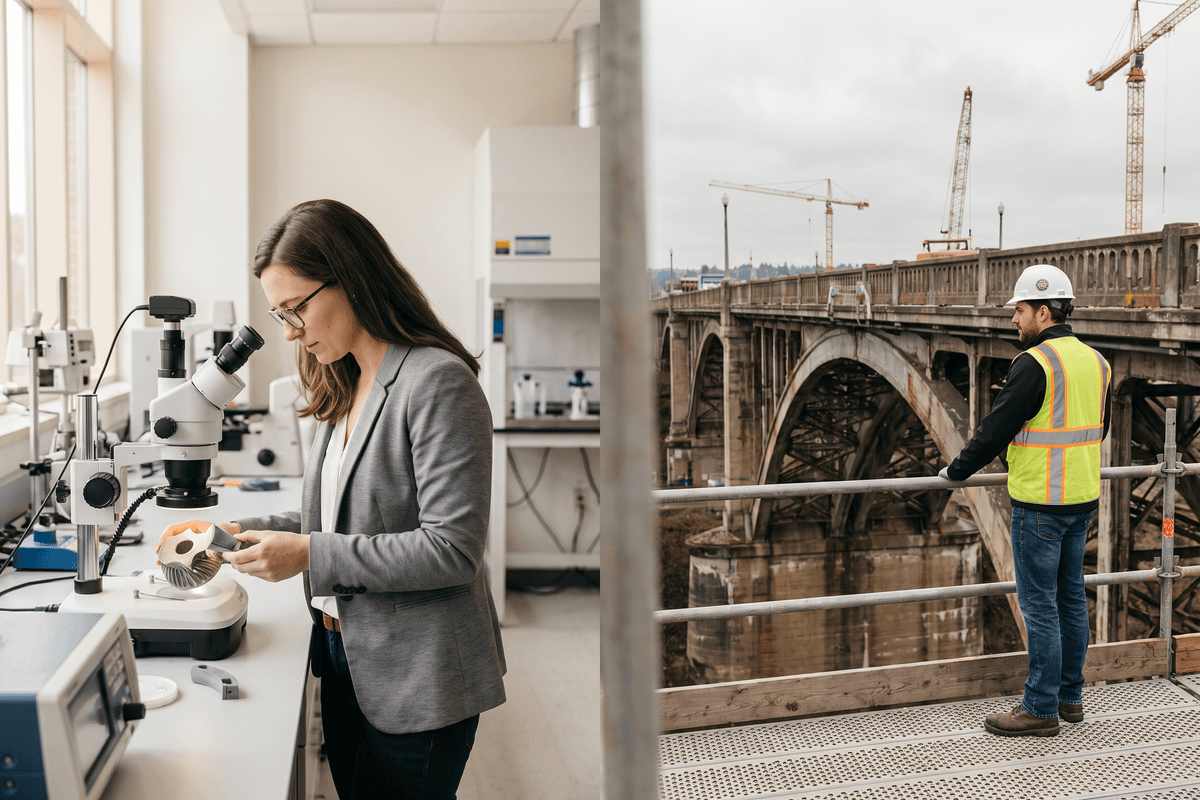



Walk into the engineering laboratories of America's top universities today, and you will find a breathtaking glimpse of tomorrow. You will see artificial intelligence redefining fluid dynamics, and advanced materials being forged for deep-space deployment. Yet, walk into the human resources department of any major U.S. civil engineering firm, and you will find a distinctly different reality: a desperate, grinding search for baseline talent just to keep the lights on and the bridges standing. This is the defining paradox of the American engineering sector in 2026.
As the United States races to maintain its global competitiveness, the engineering industry is fracturing into two distinct realities. On one side, mechanical and aerospace programs are pushing the absolute boundaries of applied science. On the other, the foundational civil engineering sector is facing a severe, structural manpower deficit. For engineering leaders, managing this divergence—and finding ways to let high-tech R&D solve baseline execution shortages—is no longer just a strategic advantage; it is a matter of survival.
The Vanguard of Mechanical and Aerospace R&D
The sheer velocity of innovation emerging from university mechanical engineering departments is staggering, fueled heavily by federal grants and a mandate to dominate next-generation technologies.
Take, for instance, the recent 2025-26 accomplishments at Binghamton University's Department of Mechanical Engineering. The department is aggressively expanding its capabilities, highlighted by a substantial $569,573 National Science Foundation (NSF) CAREER Award and the establishment of a brand-new Artificial Intelligence research center. This isn't theoretical postulating; this is the deployment of heavy capital into machine learning frameworks that will eventually dictate how robotic systems, autonomous manufacturing, and smart infrastructure operate.
Solving the Extraterrestrial Premium
Simultaneously, specialized undergraduate and graduate programs are tackling hyper-niche challenges that have massive commercial implications. At Alfred University, mechanical engineering seniors are actively solving satellite thermal management challenges. By utilizing low melting point alloys, these students are engineering passive cooling systems essential for the next generation of low-Earth orbit (LEO) constellations.
These breakthroughs in thermal management and AI represent the "Innovation Track" of U.S. engineering. They are highly funded, highly specialized, and incredibly attractive to young engineering minds who want to work on spacecraft, robotics, and artificial intelligence.
The Great Unicorn Hunt: America's Civil Deficit
While mechanical and aerospace engineers design the future of orbital networks, the terrestrial infrastructure required to support the U.S. economy is facing a demographic cliff.
According to recent industry analysis detailing the "Great Unicorn Hunt" in civil engineering, the numbers are stark and unforgiving. The United States is projected to see roughly 23,600 civil engineering openings each year over the next decade. However, U.S. universities are only producing between 16,000 and 18,000 civil engineering graduates annually.
"We are mathematically incapable of building our way out of the infrastructure backlog using traditional hiring methods. The talent simply does not exist in the numbers required."
This creates an annual deficit of roughly 5,600 to 7,600 engineers. Over a decade, that is a shortfall of over 60,000 professionals. Firms are exhausting themselves looking for "unicorns"—mid-level civil engineers with 5-10 years of experience who can manage projects, mentor juniors, and handle client relations. Because these professionals entered the workforce during a period of lower enrollment, they are virtually non-existent, driving salaries up and compressing firm margins.
The Intersection: How R&D Must Solve the Talent Gap
The juxtaposition of Binghamton's AI center and Alfred's aerospace innovations against the civil engineering talent drought highlights a critical strategic pivot for U.S. firms. We cannot hire our way out of the civil engineering shortage; we must engineer our way out of it.
Here is how forward-thinking engineering conglomerates are bridging the gap between high-tech mechanical R&D and baseline civil execution:
- Generative Civil Design: The AI frameworks being developed at institutions like Binghamton are being adapted by civil firms to automate routine grading, pipe routing, and structural load calculations. If a firm is short three junior civil engineers, generative design AI can bridge that productivity gap.
- Cross-Disciplinary Integration: Firms are increasingly hiring mechanical engineers to fill civil roles. A mechanical engineer trained in thermal dynamics (like those at Alfred University) can be upskilled to manage HVAC, MEP (Mechanical, Electrical, Plumbing), and industrial structural projects, taking the pressure off the pure-civil talent pool.
- Industrialized Construction: To reduce the need for on-site civil engineering problem-solving, firms are moving toward prefabricated, modular infrastructure. This shifts the workload from the talent-starved civil sector to the mechanical and manufacturing engineering sectors, where automation can be more easily leveraged.
Comparing the Two Realities
To understand the strategic landscape, executives must recognize the differing dynamics of these two engineering tracks:
| Metric | The Innovation Track (Mechanical/Aerospace/AI) | The Execution Track (Civil/Structural) |
|---|---|---|
| Primary Driver | Global tech supremacy, space race, defense | Infrastructure bills, urbanization, grid updates |
| Talent Dynamic | Hyper-competitive for top 1%, but deep pipelines | Severe, structural baseline shortage (7k/year deficit) |
| Capital Allocation | Federal grants (NSF), VC funding, tech partnerships | Municipal bonds, federal infrastructure spending, private equity |
| Future Outlook | Exponential capability growth via AI | Margin compression unless automated |
The Path Forward for Engineering Leaders
For executives leading U.S. design and engineering firms, the roadmap for 2026 and beyond is clear. Continuing to rely on traditional recruiting pipelines to staff civil infrastructure projects is a losing battle. The math simply does not support it.
Instead, the industry must look to the laboratories of Binghamton, Alfred, and their peers. The $569,000 NSF grants and satellite thermal projects are not just academic exercises; they are the proving grounds for the methodologies that will save the broader engineering sector. By aggressively adopting AI-driven design tools, investing in mechanical automation, and embracing cross-disciplinary talent, the U.S. engineering sector can overcome its demographic cliff. The firms that recognize this—that use the innovations of the mechanical vanguard to solve the deficits of the civil foundation—will be the ones that dominate the next decade of American infrastructure.