
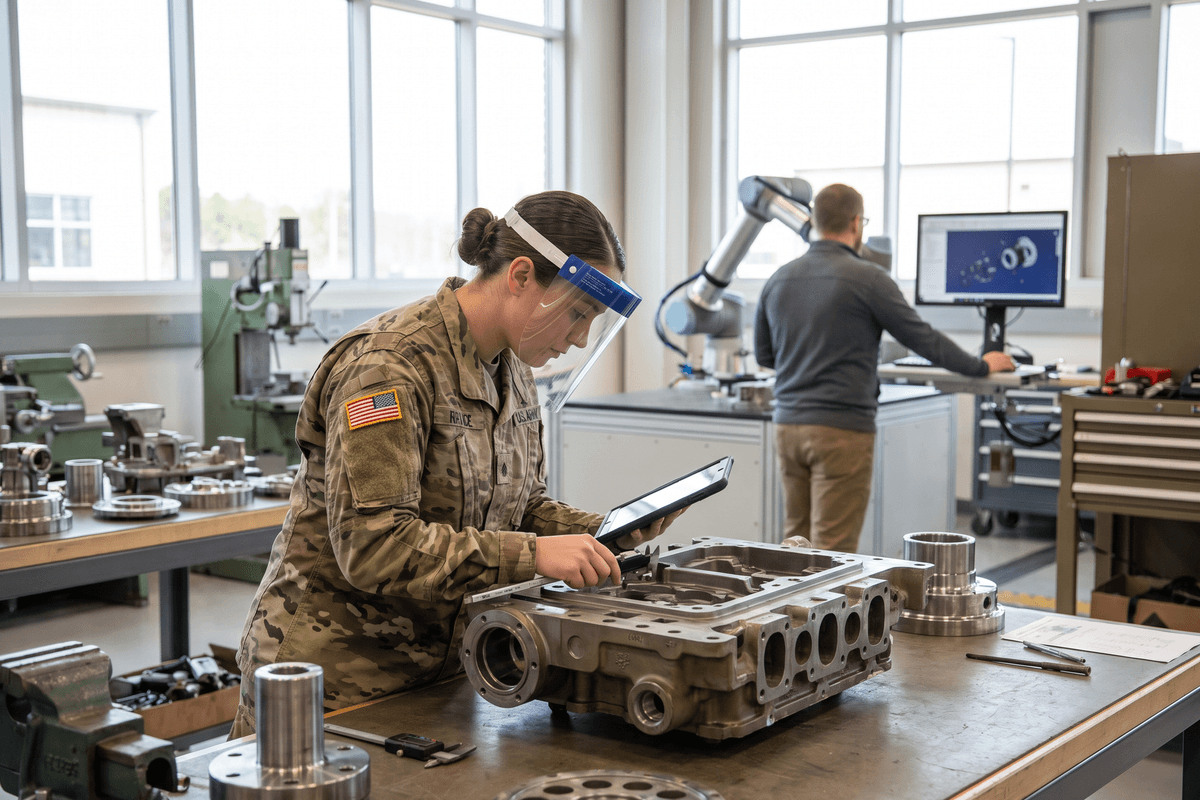



For decades, the standard playbook for qualifying mission-critical defense hardware was defined by agonizing timelines. Sourcing cast, forged, or high-tolerance structural components across the Department of Defense (DoD) often meant navigating an 18-to-36-month gauntlet of legacy supply chains, manual tooling setups, and bureaucratic test regimes. However, the operational reality of modern contested logistics has rendered those lead times untenable. A structural shift is now underway across the American defense industrial base: the military is actively replacing slow-moving legacy procurement mechanisms with high-velocity commercial engineering pipelines.
That transition reached a pivotal milestone with Amca’s award from U.S. Army Materiel Command under the Advanced Manufacturing Commercial Solutions Opening (CSO). Tasked with rapidly engineering, qualifying, and manufacturing critical defense components, the partnership underscores how advanced manufacturing is evolving from experimental field prototypes into full-rate, certified production capacity. When viewed alongside the massive influx of private capital into next-generation digital engineering tools—exemplified by Vinci securing a $250 million Series B at a $1.5 billion valuation to build continuous physics reasoning infrastructure—the engineering discipline is witnessing an unprecedented convergence of virtual design intelligence and physical manufacturing agility.
The Qualification Chokepoint: Why Legacy Sourcing Broke Down
The core bottleneck facing American industrial preparedness has rarely been a lack of raw conceptual design capacity; it has been the mechanical and metallurgical qualification chokepoint. In conventional defense logistics, producing replacement parts for legacy platforms or novel components for next-generation combat systems requires rigid tooling, dedicated casting dies, and extended first-article inspection (FAI) protocols. When a single tier-three foundry closes or a specialized forging press suffers downtime, entire platform readiness rates plummet.
The U.S. Army Materiel Command (AMC) recognized that maintaining strategic superiority requires decentralized, agile manufacturing solutions capable of reverse-engineering, redesigning, and certifying parts on demand. Through the Advanced Manufacturing CSO vehicle, the Army is bypassing traditional, cumbersome Federal Acquisition Regulation (FAR) pathways to engage innovative commercial firms that possess both computational engineering prowess and flexible manufacturing floors.
"The modern defense supply chain cannot rely on single-point-of-failure foundries with two-year backlogs. Agile qualification and on-demand precision manufacturing are no longer nice-to-have capabilities—they are fundamental requirements for national resilience."
Bridging the Gap Between Prototype and Production
For systems and materials engineers, the mandate issued to Amca represents a technical inflection point. Early military additive and advanced manufacturing programs often stalled at the "technology demonstration" phase, producing non-structural brackets or training aids. The current AMC push targets high-stress, mission-critical components operating under extreme thermal, vibrational, and fatigue environments.
- Digital Thread Integration: Ingesting legacy 2D technical data packages (TDPs) and translating them into high-fidelity 3D parametric models optimized for hybrid manufacturing.
- In-Situ Quality Verification: Employing sensor-driven process monitoring to detect porosity, microcracking, and residual stress gradients during the build cycle rather than relying solely on post-process destructive testing.
- Metallurgical Equivalence: Demonstrating that modern direct energy deposition (DED), laser powder bed fusion (LPBF), or multi-axis subtractive techniques match or exceed the yield strength and fracture toughness of legacy forged alloys.
The Hardware Intelligence Layer: How Physics AI Accelerates Deployment
Rapid physical production cannot succeed in isolation without a commensurate acceleration in simulation and stress analysis. In traditional workflows, finite element analysis (FEA) and computational fluid dynamics (CFD) remain iterative bottlenecks, requiring days of compute time and extensive manual meshing for complex geometry variants.
This dynamic explains the rapid institutional backing behind intelligence infrastructure platforms. The $250 million capital injection into Vinci signals that the engineering software stack is undergoing its most radical transformation since the advent of 3D CAD. By embedding AI-native continuous physics reasoning directly into the hardware development loop, engineering teams can evaluate structural compliance, thermal dissipation, and manufacturability in real time.
| Workflow Dimension | Legacy Defense Engineering Workflow | Agile AI & Advanced Manufacturing Framework |
|---|---|---|
| Procurement & Contracting | FAR Part 15 Cost-Plus/Fixed-Price (6–18 months) | Commercial Solutions Opening (CSO) / OTA (4–12 weeks) |
| Design & Physics Simulation | Static FEA/CFD iterations (Weeks per revision) | AI continuous physics reasoning (Near real-time feedback) |
| Tooling & Setup | Dedicated hard tooling & foundry dies (12–24 weeks) | Tool-less additive & 5-axis hybrid CAM (Days) |
| Part Qualification | Post-fabrication Destructive & FAI Testing (6–12 months) | In-situ monitoring + digital twin certification (2–4 weeks) |
| Supply Chain Architecture | Centralized, fragile tier-based dependency | Distributed, digitally synchronized manufacturing nodes |
Practical Implications for U.S. Systems and Manufacturing Engineers
The convergence of commercial defense partnerships like Amca's and foundational software advances like Vinci's offers concrete operational lessons for engineering leaders across the United States. Organizations seeking to participate in this modernized defense-industrial ecosystem must recalibrate their internal development infrastructure.
1. Standardize on Open Digital Data Architectures
Proprietary CAD and simulation silos prevent rapid handoffs between design teams and manufacturing floors. Engineering organizations must adopt unified digital twin architectures that preserve parametric intent, GD&T (Geometric Dimensioning and Tolerancing), and material behavior models across the entire lifecycle.
2. Embed Regulatory and Military Standard Compliance Upstream
Qualifying parts for Army Materiel Command requires strict adherence to military standards (such as MIL-STD-810 for environmental testing and MIL-STD-3049 for additive manufacturing). By incorporating compliance rules into early computational geometry generation, engineering teams eliminate costly late-stage redesigns.
3. Transition to Continuous Physical Validation
The traditional "design-build-break" cycle is being supplanted by hybrid validation models. Physical testing remains essential for flight-critical and armor components, but the scope of required empirical testing shrinks drastically when designs have undergone continuous physics verification prior to spindle rotation or laser exposure.
Looking Forward: The Re-Industrialization of Strategic Hardware
The U.S. Army's aggressive use of the Advanced Manufacturing Commercial Solutions Opening reflects a pragmatic recognition: national defense capability is directly tied to the velocity of the domestic engineering pipeline. By awarding contracts to agile engineering firms capable of collapsing qualification barriers, the military is stimulating a broader domestic renaissance in precision hardware manufacturing.
For the American engineering workforce, this shift creates tremendous opportunity. The next decade of mechanical, systems, and materials engineering will not be defined by static drawings or offshore procurement dependencies. Instead, it will be shaped by engineers who master the synthesis of continuous computational intelligence, advanced metallurgy, and agile manufacturing execution—delivering critical hardware exactly when and where it is needed.