
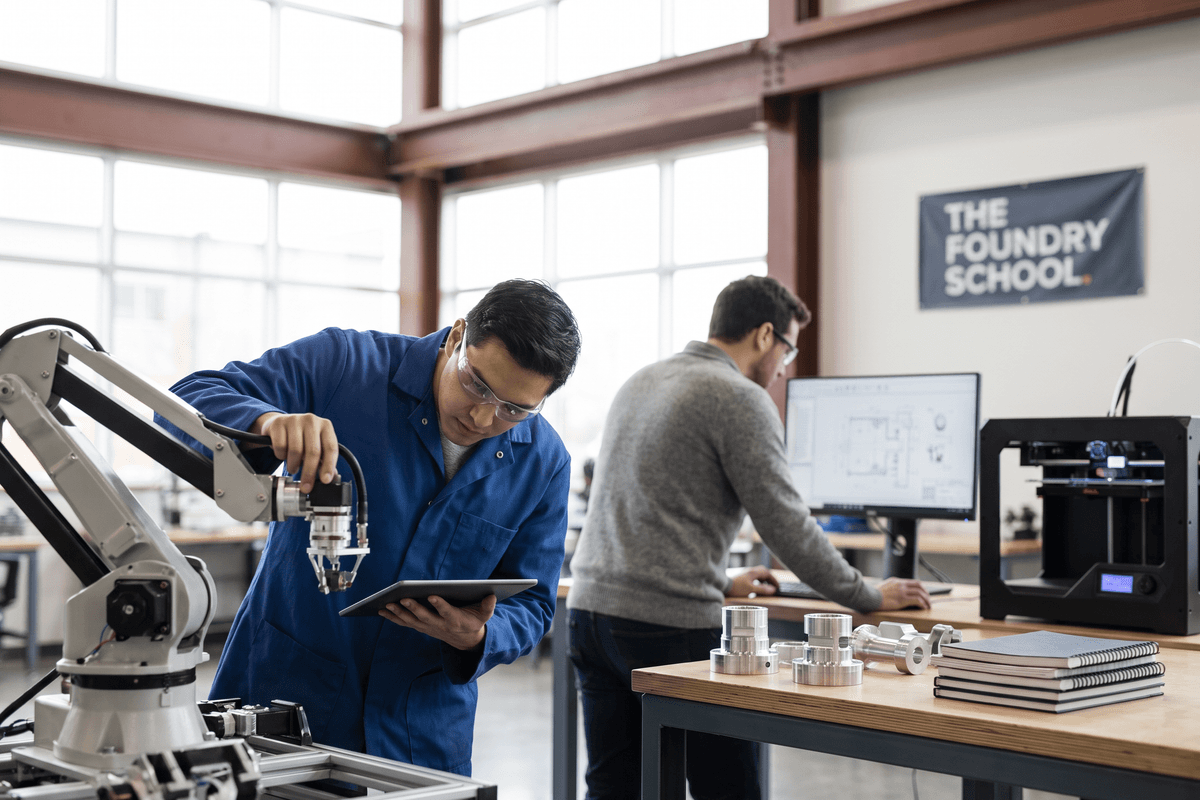

The United States is currently executing the most aggressive industrial recapitalization since the post-World War II era, but the engineering sector faces a severe structural dilemma: capital is pouring into advanced facilities faster than the engineering workforce can be trained to design, tool, and commission them. Between semiconductor fabrication facilities, advanced hardware hubs, and the explosive nationwide buildout of AI compute infrastructure, the traditional demarcation between academic research, plant engineering, and heavy construction is disintegrating. To close this execution chasm, a major federal initiative has launched The Foundry School across eight major U.S. institutions, establishing a unified educational pipeline to equip engineers and industrial leaders with the precise skills needed to scale domestic advanced manufacturing.
This academic mobilization arrives at a pivotal inflection point. According to Engineering News-Record's analysis of the Top 400 contractors, the concurrent AI data center surge is aggressively competing for elite mechanical, electrical, and plumbing (MEP) talent, structural engineering bandwidth, and critical equipment procurement. For engineering executives, managing this dual-front demand requires a profound rethink of how multidisciplinary teams are trained, deployed, and retained.
The Hardware Execution Deficit: Why The Foundry School Matters
For three decades, American engineering curricula tilted heavily toward digital systems, software architecture, and computational simulations, leaving physical tooling, foundry workflows, and industrial process scaling underserved. The abrupt reshoring of advanced manufacturing—spanning advanced packaging, clean-tech hardware, precision machining, and microelectronics—has exposed critical operational blind spots on plant floors.
The Foundry School model seeks to reverse this atrophy by embedding factory-floor reality directly into engineering pedagogy. By partnering across eight leading engineering universities, the initiative is standardizing training in:
- Precision Tooling and Metrology: Bridging the tolerance gap between laboratory prototypes and high-yield, high-throughput manufacturing lines.
- Design for Manufacturability (DFM): Training mechanical and systems engineers to incorporate supply chain constraints, thermal dynamics, and material availability directly into early-stage CAD/CAM workflows.
- Cyber-Physical Plant Operations: Integrating industrial IoT, automated guided vehicles (AGVs), and programmable logic controllers (PLCs) with modern digital twin platforms.
- High-Velocity Pilot Scaling: Transitioning advanced material formulations and hardware prototypes into pilot production without incurring multi-million-dollar yield losses.
"Scaling domestic advanced manufacturing isn't merely a matter of capital allocation; it requires a workforce that understands the physical physics of the shop floor as intimately as the code driving the simulations."
The Megaproject Collision: Manufacturing vs. AI Data Centers
While academia begins restructuring its pipelines, industrial engineering firms are navigating severe near-term resource constraints. The massive influx of capital into advanced manufacturing is colliding head-on with an unprecedented expansion in data center construction, driven by hyperscale artificial intelligence requirements.
As documented by industry data tracking contractor capacity, the sheer scale of modern AI campus development is siphoning specialized engineering resources away from industrial projects. High-voltage substation design, chilled-water plant engineering, and structural steel detailing are seeing record lead times and fee escalation.
| Engineering Domain | Advanced Manufacturing Demands | AI Data Center Demands | Primary Chokepoint |
|---|---|---|---|
| Electrical Systems | Ultra-clean power, harmonic mitigation, variable frequency drives | Gigawatt-scale substations, redundant UPS topologies, medium-voltage distribution | High-voltage switchgear lead times (80–120 weeks) |
| Thermal & Mechanical | Process cooling, cleanroom air changes (ISO Class 1–5), hazardous exhaust | Direct-to-chip liquid cooling, immersion loops, massive heat rejection | MEP engineering design bandwidth & specialized hydronic fitters |
| Civil & Structural | Deep foundation micro-vibration isolation, heavy floor loading | Rapid modular structural framing, high-density server rack floor loads | Specialized geotechnical engineering & precast concrete availability |
| Controls & Automation | Deterministic SCADA, robotic workcells, machine vision inspection | Autonomous building management systems (BMS), dynamic cooling modulation | Systems integration engineers fluent in both IT and OT protocols |
Strategic Realignment for Engineering Leadership
To navigate this fiercely competitive environment, engineering executives, EPC contractors, and project directors must modernize their execution frameworks. Relying on conventional staffing models and traditional linear project handoffs is no longer sufficient to maintain schedule certainty.
1. Institutionalizing Industrial Apprenticeships
Firms cannot afford to wait four years for The Foundry School graduates to matriculate into senior roles. Top-tier engineering firms are embedding their senior project managers and subject matter experts directly into these eight university programs. By co-developing capstone projects centered on live plant commissioning challenges, firms establish a direct talent pipeline while accelerating the practical readiness of incoming junior engineers.
2. Early Contractor Involvement (ECI) and Progressive Design-Build
With equipment lead times exceeding typical design phases, the conventional Design-Bid-Build methodology is failing across advanced manufacturing and hyperscale facilities. Engineering teams must adopt progressive design-build contracts that lock in long-lead procurement—such as step-up transformers, custom chillers, and specialized cleanroom air handlers—at the 30% schematic design milestone.
3. Cross-Skilling the MEP and Controls Cohort
The technological convergence between AI facility cooling and advanced industrial cleanrooms creates an opportunity for engineering firms to cross-train their MEP cohorts. Engineers adept at designing high-density liquid cooling loops for AI clusters can apply those exact fluid dynamics and thermal rejection principles to precision manufacturing environments, maximizing billable efficiency across market fluctuations.
The Road Ahead: Building the Resilient Engineering Firm
The simultaneous push to restore America’s advanced manufacturing baseline and power the next generation of computational infrastructure represents both a generational test and an immense opportunity for the U.S. engineering profession. The launch of The Foundry School across eight premier universities acknowledges that software prowess alone cannot sustain an industrial economy without physical hardware competence.
For project directors and firm principals, the mandate is clear: bridge the gap between academic theory and job-site reality, embrace integrated delivery models that insulate projects from supply chain volatility, and invest aggressively in cross-disciplinary talent. The organizations that master this synthesis will define the physical foundation of the American economy for the next half-century.