
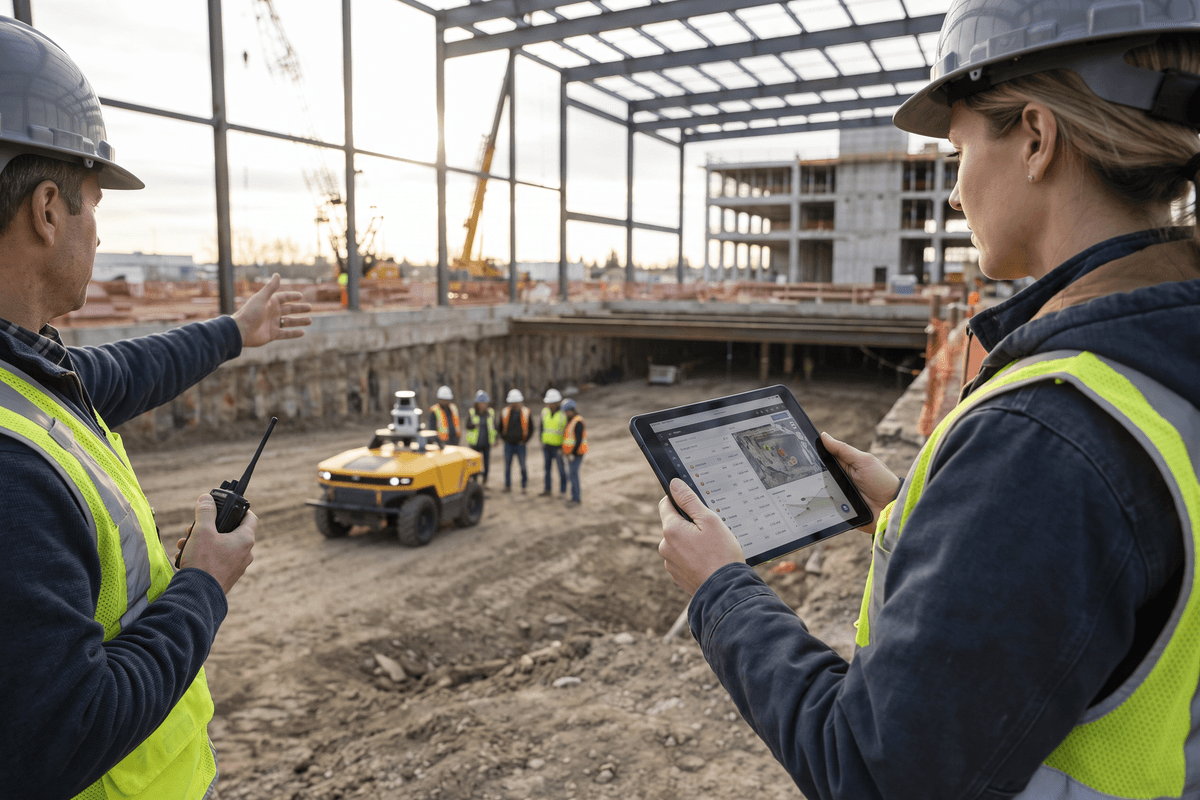



There is a profound difference between an algorithm making a mistake on a digital topographical map and an autonomous 10-ton excavator making a mistake on an active job site. As artificial intelligence continues its aggressive expansion into the U.S. civil engineering sector, the industry is rapidly approaching a bifurcation point. On one side, we have the highly successful, low-risk deployment of AI for site analysis and surveying. On the other, we face the looming, high-stakes integration of AI-enabled physical robotics—a frontier that demands an entirely new paradigm of safety and liability.
For engineering professionals, navigating this divide is no longer a theoretical exercise. The tools we use to design and build America's infrastructure are evolving faster than the regulatory frameworks that govern them. Bridging the gap between software efficiency and hardware safety will define the next decade of U.S. engineering execution.
The Digital Advantage: AI in Large-Scale Site Analysis
In the realm of pre-construction and design, AI is already delivering massive, quantifiable ROI. The sheer volume of data generated by modern surveying equipment—LiDAR, drones, ground-penetrating radar—can easily overwhelm traditional processing methods. Today, the narrative has shifted from data collection to data synthesis.
According to a recent report by the American Society of Civil Engineers (ASCE), civil engineering firms are increasingly capitalizing on the power of artificial intelligence tools to speed up surveying, site analysis, and grading. For large land parcels, what used to take weeks of manual point-cloud classification and contour mapping can now be executed in hours.
- Automated Feature Extraction: AI models can instantly differentiate between ground points, vegetation, existing utilities, and structures, stripping away noise to create highly accurate digital terrain models (DTMs).
- Generative Grading: Algorithms can now propose multiple grading options optimized for earthwork balance, stormwater runoff, and minimal environmental disruption, allowing civil engineers to evaluate dozens of scenarios before moving a single yard of dirt.
- Risk Mitigation: By analyzing historical geological data alongside current subsurface scans, AI tools flag potential geotechnical anomalies early in the design phase.
In these digital applications, the "worst-case scenario" of an AI hallucination or error is caught during the standard Quality Assurance/Quality Control (QA/QC) review by a licensed Professional Engineer (PE). The software acts as an ultra-efficient junior designer. But what happens when the AI is given physical agency?
The Physical Threat: Why AI Robotics Require a New Safety Paradigm
The transition from AI as a predictive tool to AI as an active physical agent is where the U.S. engineering sector faces its greatest hurdle. We are seeing a surge in autonomous robotics—from drone swarms conducting structural inspections to automated heavy machinery laying aggregate. However, the chaotic, unstructured environment of an active construction site is the ultimate stress test for machine learning models trained in sterile simulations.
The Penn Engineering Mandate
The core issue is that large AI models, particularly those driving physical actions, lack intrinsic common sense. A robot might optimize a path to deliver materials, but fail to recognize that the "obstacle" it is bypassing is an unstable trench edge.
Recent research underscores the urgency of this problem. Researchers at Penn Engineering have published a new paper highlighting the need to develop more thorough frameworks for ensuring that AI-enabled robots embody a fundamental 'do no harm' core principle. As these systems become more autonomous, traditional physical safeguards (like geofencing or kill switches) are no longer sufficient. The safety must be baked into the AI's foundational logic.
"We cannot bolt safety onto an autonomous system after the fact. In civil engineering applications, where heavy machinery and human workers operate in close proximity under constantly changing conditions, the AI must have a verifiable, mathematically sound framework that prevents it from taking actions that could cause physical harm, even when faced with novel edge cases."
Grounding the Tech: Regional Infrastructure and Real-World Deployment
While academic institutions wrestle with the theoretical frameworks of robotic safety, regional engineering leaders are dealing with the practical realities of putting these tools to work on the ground. The push for AI integration isn't happening in a vacuum; it's colliding with a historic boom in U.S. infrastructure spending and a persistent shortage of skilled labor.
This dynamic is highly visible in regional development hubs. For instance, recent discussions among architecture and engineering industry leaders regarding projects across the Mahoning Valley highlight how major investments and infrastructure improvements are shaping local economies. In these environments, the pressure to deliver projects on time and under budget is immense.
Regional firms are looking to AI to bridge the talent gap. When a mid-sized firm in Ohio or Pennsylvania secures a major federal infrastructure grant, their ability to execute hinges on maximizing the efficiency of their existing workforce. AI-driven site analysis allows them to punch above their weight class during the planning phases. However, these same firms are acutely aware of the liability associated with deploying bleeding-edge robotics on municipal projects. The consensus among industry leaders is clear: technology must serve the project's safety and viability first, not the other way around.
Comparing the AI Integration Phases
To understand the current landscape, engineering leaders must categorize AI deployment by risk and regulatory readiness. The table below outlines the stark differences between digital analysis and physical execution.
| Operational Phase | Primary AI Application | Risk Profile | Current Regulatory State | Human-in-the-Loop Requirement |
|---|---|---|---|---|
| Digital / Pre-Construction | Site surveying, generative grading, parcel analysis | Low (Errors caught in QA/QC) | Mature (Governed by standard PE stamping protocols) | Reviewer / Approver |
| Physical / Execution | Autonomous heavy machinery, robotic inspection | High (Immediate physical harm / structural damage) | Emerging (Lacks unified OSHA/ANSI standards for autonomous AI) | Active Supervisor / Override Ready |
The Road Ahead: Engineering Judgment in the Loop
The path forward for U.S. engineering firms is not to shy away from AI, but to aggressively compartmentalize its deployment. We must fully embrace AI for digital site analysis, surveying, and generative design, where the technology is already mature and the ROI is undeniable. Simultaneously, we must demand rigorous, transparent safety frameworks—like those being pioneered at Penn Engineering—before allowing AI to take the wheel on the physical job site.
Ultimately, the integration of AI into civil engineering is a testament to the enduring value of the human engineer. Algorithms can process billions of data points to optimize a grading plan, and eventually, robots may execute that plan with millimeter precision. But the responsibility for the safety of the workers, the structural integrity of the project, and the impact on the surrounding community will always rest on the shoulders of the licensed professional. In the age of artificial intelligence, engineering judgment is not being replaced; it is being elevated to its most critical role yet.