
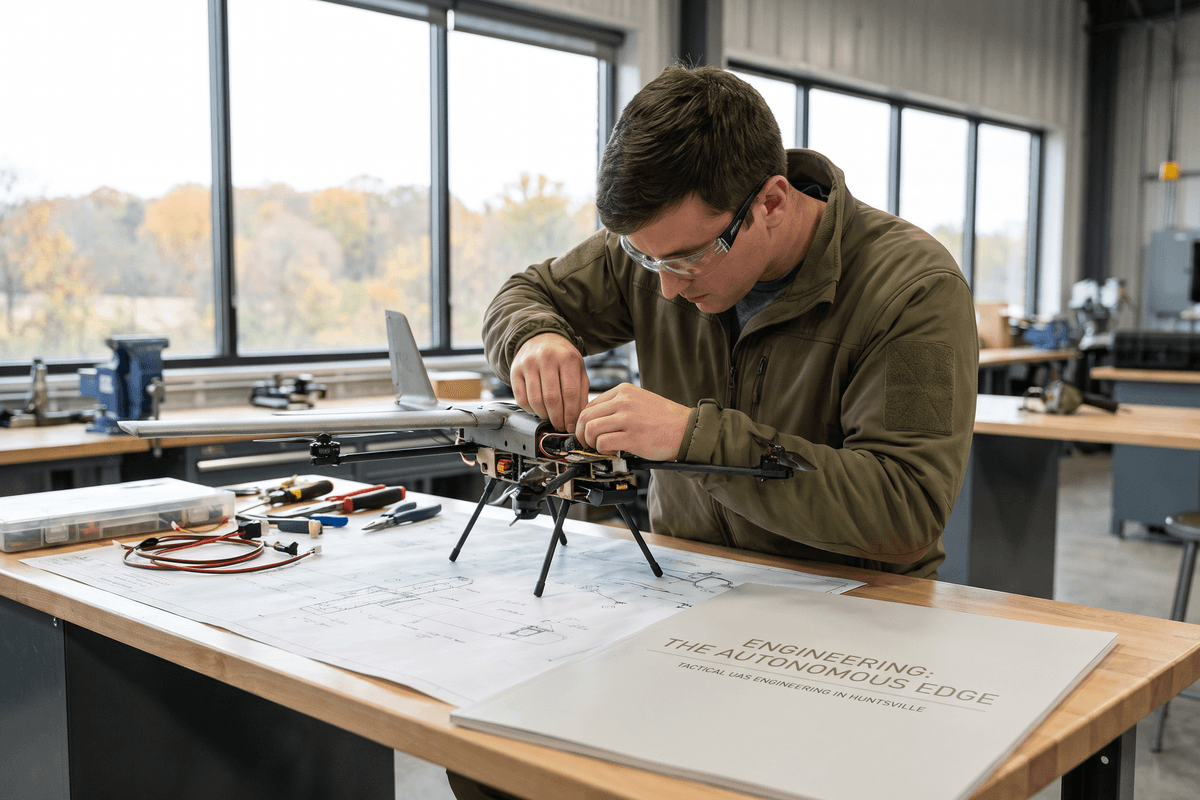



The modern contested battlespace has rendered traditional remotely piloted unmanned aerial systems (UAS) increasingly obsolete, forcing a fundamental pivot in aerospace and systems engineering toward localized, software-defined edge autonomy. As electronic warfare (EW) environments systematically disrupt radio-frequency command links and global navigation satellite systems (GNSS), flight control engineers must architect platforms capable of sub-second deterministic decision-making directly on the airframe. The recent decision by European drone manufacturer Quantum-Systems to open a dedicated 3,200-square-foot engineering and research facility in Huntsville, Alabama—as detailed by the Huntsville Business Journal—highlights a broader, critical shift: international defense-tech firms are accelerating the localization of advanced UAS flight control, computer vision, and embedded systems engineering directly within the United States defense corridor.
For systems, mechanical, and firmware engineers operating across the American aerospace landscape, this expansion signals an urgent mandate. Tactical UAS development is no longer just about composite airframes and long endurance; it is a complex cross-disciplinary discipline requiring seamless integration of edge neural processing, fail-safe sensor fusion, and Modular Open Systems Approaches (MOSA) under aggressive Size, Weight, Power, and Cost (SWaP-C) constraints.
The Flight Control Crucible: Engineering for GNSS-Denied and EW-Saturated Environments
The engineering challenge defining next-generation UAS is the reality of operating in electromagnetic spectrum (EMS) contested domains. When satellite-based positioning is jammed or spoofed, traditional autopilot loops that rely on clean GPS/INS integration quickly degrade or fail entirely. Engineering teams are actively replacing these brittle architectures with robust, multi-modal sensor fusion algorithms operating entirely on-board.
To maintain precise trajectory tracking and spatial orientation without external positioning references, flight control engineers are integrating several cutting-edge computational layers:
- Visual-Inertial Odometry (VIO): Coupling high-rate micro-electro-mechanical systems (MEMS) inertial measurement units (IMUs) with down-looking and forward-facing optical cameras to calculate relative position changes via continuous feature tracking.
- Terrain Relative Navigation (TRN): Real-time cross-referencing of optical or LiDAR digital surface models with pre-loaded on-board elevation maps to generate absolute coordinate fixes passively.
- Magnetometer-Independent Heading Estimators: Replacing vulnerable magnetic compasses—which are easily compromised by deliberate magnetic interference or onboard motor flux—with dual-antenna GNSS heading fallbacks, celestial trackers, or optical flow vectoring.
"Autonomy in tactical aviation is no longer a software layer added after the airframe is built; it dictates the thermal envelope, sensor payload placement, and flight control loop frequencies from day one of conceptual design."
Executing these sensor-fusion algorithms requires embedded neural processing units (NPUs) and field-programmable gate arrays (FPGAs) operating within milliwatt power budgets, ensuring deterministic execution of critical flight control code without throttling primary flight controllers running deterministic RTOS (Real-Time Operating Systems).
SWaP-C Optimization in Hybrid VTOL Configurations
Tactical field operations demand platforms that do not require runways or cumbersome pneumatic launchers, driving engineering teams toward hybrid eVTOL (electric Vertical Take-Off and Landing) architectures. However, marrying the hover capability of a multirotor with the cruising efficiency of a fixed-wing pusher configuration introduces complex mechanical and aerodynamic trade-offs.
Aerodynamicists and structural engineers must resolve several concurrent design tensions during the transition phase—the high-risk envelope where lift transfers from vertical rotors to fixed wings:
- Aerodynamic Drag vs. Transition Power: Fixed multirotor booms generate parasite drag during forward cruise, reducing overall range. Conversely, tilt-rotor mechanisms eliminate parasitic boom drag but introduce mechanical complexity, additional gearboxes, and single points of mechanical failure.
- Thermal Management of High-Current ESCs: Electronic Speed Controllers (ESCs) experience peak thermal loads during vertical takeoff and hover. Engineers must design carbon-fiber airframes with integrated passive heat-sinking or ducting that does not compromise laminar flow during high-speed forward cruise.
- Aeroelastic Wing Flex and Sensor Calibration: High-aspect-ratio carbon-composite wings maximize cruise endurance, but structural flex under aerodynamic load can misalign rigid sensor payloads and camera gimbals. Engineers must implement dynamic compensation algorithms within the payload control firmware.
Architectural Trade-Offs in Tactical UAS Design
Designing modern tactical unmanned aircraft requires balancing structural, propulsion, and electronic architectures. The table below outlines key engineering trade-offs faced when selecting design paradigms for mission-critical tactical platforms:
| Engineering Parameter | Pure Multirotor Platform | Pure Fixed-Wing (Launched) | Hybrid eVTOL (Fixed-Wing + VTOL) |
|---|---|---|---|
| Aerodynamic Efficiency (L/D Ratio) | Low (~2 to 4) | High (~15 to 22) | Moderate-to-High (~12 to 18) |
| Launch & Recovery Complexity | Zero infrastructure required; spot landing | High (Requires catapult, runway, or net recovery) | Zero infrastructure; automated spot landing |
| On-Board Computing & Payload SWaP | High payload weight, severely limited endurance | High efficiency, constrained sensor positioning | Optimized payload bays; high power envelope |
| Flight Control Complexity | Low to Moderate (Standard quad/hex mix) | Moderate (Control surfaces & throttle) | High (Non-linear transition aerodynamics & blending) |
| Contested EW Survivability | Vulnerable due to low speed and altitude | Moderate (High altitude, faster glide speeds) | High (Low-altitude transit, VIO terrain-following) |
The Huntsville Engineering Gravity: Proximity to the Defense Procurement Pipeline
The placement of specialized UAS R&D centers in Huntsville is not merely a real-estate decision; it reflects a strategic alignment with the epicenter of U.S. Army aviation and missile systems engineering. Huntsville houses Redstone Arsenal, the U.S. Army Combat Capabilities Development Command (DEVCOM), the Program Executive Office (PEO) Aviation, and the rapid prototyping hubs of the Army Futures Command.
For systems engineers developing tactical drones, proximity to these institutions dramatically compresses the iteration cycle for defense-grade systems:
- MOSA and FACE Compliance: Integrating Modular Open Systems Approaches (MOSA) and Future Airborne Capability Environment (FACE) technical standards directly into platform software stacks ensures rapid payload interoperability with existing defense network nodes.
- Direct Feedback Loops on Tactical Cyber Vulnerabilities: Close collaboration with military evaluation teams enables rapid firmware hardening against emerging cyber and RF electronic counter-countermeasures (ECCM).
- Supply Chain and NDAA Compliance: Rapidly engineering out non-compliant foreign components (such as unvetted microcontrollers, battery management systems, and optical sensors) in favor of NDAA-compliant domestic or allied-nation alternatives.
Actionable Takeaways for Aerospace and Systems Engineers
As defense modernization initiatives accelerate investment in autonomous platforms, engineering professionals must adapt their skills and workflows to meet these rigorous requirements:
- Master Hardware-Software Co-Design: Aerodynamic design can no longer occur in a silo separated from embedded compute constraints. Computational fluid dynamics (CFD) engineers must work alongside embedded firmware teams to optimize airframe layouts for sensor cooling, antenna separation, and avionics placement.
- Adopt Open Architecture Frameworks: Monolithic, proprietary flight stacks are rapidly losing favor. Systems engineers must architect platforms around standardized interfaces (such as ROS 2, PX4 Autopilot frameworks, and OMS/MOSA standards) to allow plug-and-play integration of third-party tactical AI models.
- Design for Graceful Degradation: Build robust state-machine architectures capable of handling catastrophic subsystem loss—such as primary GPS denial, total telemetry severing, or vertical rotor failure—without catastrophic loss of the airframe.
The Horizon: Software-Defined Tactical Aerospace
The establishment of specialized R&D footprints like Quantum-Systems' Huntsville office underscores that the future of aerospace engineering is intrinsically software-defined and tactically localized. The engineering teams that master deterministic edge processing, agile transition flight dynamics, and rapid modular prototyping will define the standard for tactical aviation over the next two decades. As the line between hardware capabilities and software intelligence continues to blur, American aerospace engineers stand at the center of this vital technological transformation.