



For decades, the engineering consensus around industrial carbon emissions has been dominated by a single, defensive strategy: capture and bury. Carbon Capture and Storage (CCS) projects have required massive geotechnical engineering feats, complex pipeline networks, and deep subsurface injection wells. But for process and chemical engineers, treating carbon dioxide purely as a waste product has always felt like a missed thermodynamic opportunity. Now, a newly funded initiative is flipping that paradigm from disposal to chemical synthesis, signaling a profound shift in how the United States will engineer its industrial future.
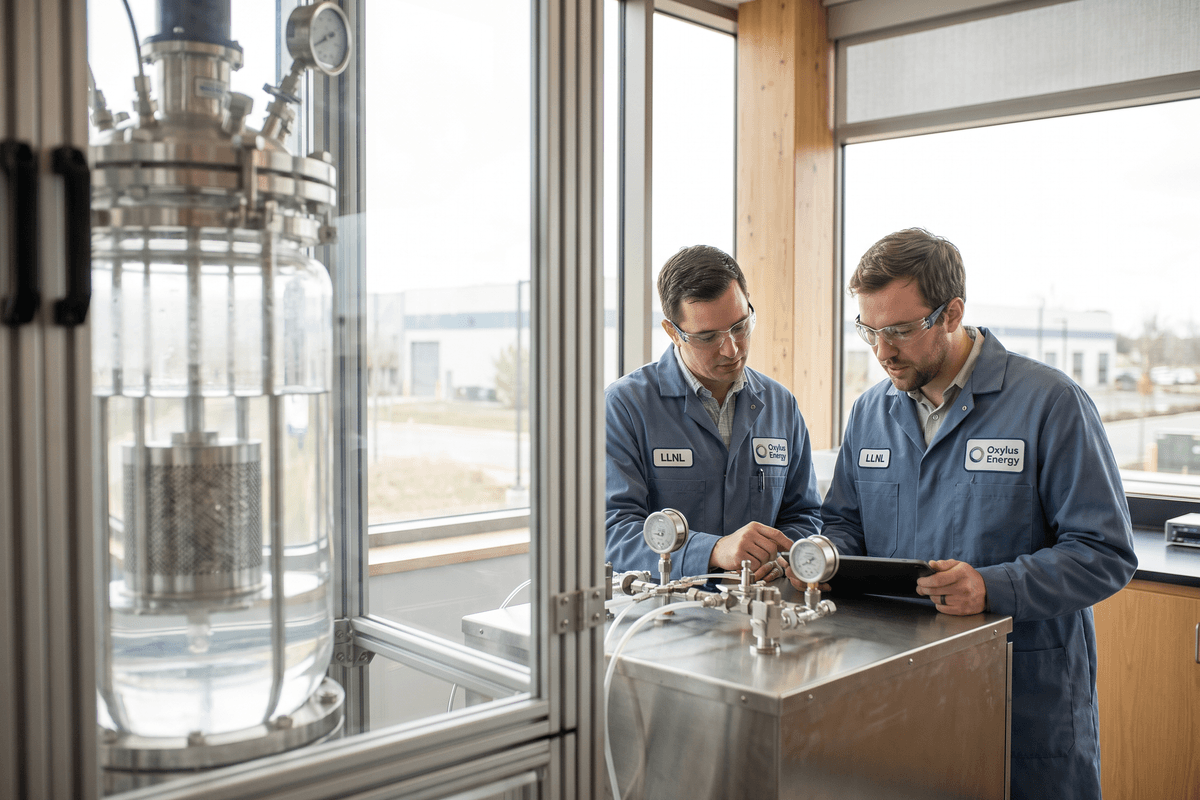
Researchers at the Lawrence Livermore National Laboratory (LLNL), in partnership with Oxylus Energy, have recently secured a highly coveted commercialization grant to scale an innovative reactor designed to convert carbon waste directly into methanol. This is not merely an academic breakthrough; it is a critical milestone in Carbon Capture and Utilization (CCU) that moves direct-to-chemical conversion out of the laboratory and into the commercial engineering pipeline.
The Engineering Mechanics of the LLNL-Oxylus Reactor
Traditional pathways for producing methanol from carbon dioxide typically involve high-temperature, high-pressure catalytic hydrogenation. This conventional approach requires massive energy inputs and complex thermal management systems, making it difficult to retrofit into existing emission point sources without completely overhauling the facility's balance of plant (BOP). The breakthrough from LLNL and Oxylus Energy targets the core of this thermodynamic bottleneck.
Electrochemical Conversion at Ambient Conditions
While proprietary details of the commercialization phase remain closely guarded, the foundational technology relies on advanced electrochemical reduction. By utilizing novel catalysts and optimized reactor geometries, the system facilitates the conversion of CO2 into methanol at or near ambient temperatures and pressures. For systems engineers, this changes the entire calculus of industrial retrofitting.
"The transition from high-pressure thermochemical synthesis to ambient electrochemical reduction is the holy grail of carbon utilization. It transforms a heavy industrial process into a modular, scalable technology that can be deployed directly at the emission source."
The engineering implications of this reactor design are multifaceted:
- Reduced Thermal Load: Without the need for extreme heat, the supporting infrastructure (heat exchangers, specialized high-temperature metallurgy) is drastically minimized.
- Modular Scalability: Electrochemical reactors can be designed in modular stacks, similar to hydrogen fuel cells, allowing EPC (Engineering, Procurement, and Construction) firms to scale the system linearly based on the specific output of a cement plant, steel mill, or power facility.
- Renewable Integration: Because the primary input is electricity rather than thermal energy, these reactors can be directly coupled with intermittent renewable energy sources (wind and solar), functioning effectively as chemical batteries that store renewable energy in the form of liquid methanol.
From Storage to Utilization: The Methanol Economy
To understand why this commercialization grant is making waves across the U.S. engineering sector, one must understand the unique value proposition of methanol. Unlike storing compressed CO2 underground—a process that generates zero downstream revenue and carries long-term liability and monitoring costs—converting CO2 to methanol creates a highly versatile, fungible commodity.
The Versatility of Green Methanol
Methanol (CH3OH) is a foundational building block in the global chemical industry. It is used to produce formaldehyde, acetic acid, and a vast array of plastics, resins, and synthetic fibers. Furthermore, "e-methanol" (methanol produced from captured carbon and renewable energy) is rapidly emerging as the preferred alternative fuel for the hard-to-decarbonize heavy marine shipping sector.
For U.S. chemical and industrial engineers, the shift from CCS to CCU redefines project economics. We are looking at a transition from cost-center engineering to profit-center engineering.
| Engineering Metric | Traditional CCS (Storage) | Electrochemical CCU (Direct-to-Methanol) |
|---|---|---|
| Primary Infrastructure | Pipelines, compression stations, injection wells | Modular electrochemical reactors, liquid storage tanks |
| Geographic Constraints | Requires specific geological formations (saline aquifers) | Agnostic; can be deployed anywhere with power and CO2 |
| Economic Output | Tax credits (45Q), carbon offsets | Direct commodity sale (Methanol), plus potential tax credits |
| Process Complexity | High-pressure fluid dynamics, subsurface geomechanics | Electrochemistry, catalytic degradation management, fluid handling |
Commercialization Hurdles for EPC Firms
While the LLNL and Oxylus Energy grant provides the necessary capital to bridge the "valley of death" between lab-scale proof of concept and commercial deployment, the burden of execution will ultimately fall on U.S. engineering firms. Scaling this technology presents several distinct challenges that process, mechanical, and systems engineers must solve over the next decade.
1. Catalyst Durability and Poisoning
In a controlled laboratory environment, feeding pure CO2 into an electrolyzer yields predictable, highly efficient results. However, industrial flue gas is rarely pure. Exhaust streams from cement kilns and natural gas plants contain NOx, SOx, particulate matter, and heavy metals. Process engineers will need to design robust pre-treatment and gas-scrubbing systems to ensure these impurities do not degrade or "poison" the sensitive catalysts within the Oxylus reactors. Balancing the cost of extensive gas conditioning against the lifespan of the reactor catalysts will be a primary focus for front-end engineering design (FEED) studies.
2. Power and Fluid Management
Electrochemical reduction requires substantial electrical input. Integrating a commercial-scale carbon-to-methanol reactor into a legacy industrial site will require significant electrical infrastructure upgrades. Electrical engineers will need to design robust microgrids and substations capable of handling the high megawatt demands of the electrolyzers. Additionally, fluid engineers must manage the continuous flow of liquid electrolytes, the separation of the synthesized methanol from aqueous solutions, and the safe storage and offloading of the final chemical product.
3. Regulatory and Safety Frameworks
Introducing chemical synthesis to facilities that previously only handled raw material processing (like cement or steel) introduces new safety paradigms. Engineers will need to implement stringent Process Safety Management (PSM) protocols, designing explosion-proof enclosures, advanced leak detection systems, and automated emergency shutdown sequences suitable for handling volatile organic compounds.
The Road Ahead: Rewriting the U.S. Industrial Base
The collaboration between national laboratories and agile energy startups like Oxylus Energy represents the tip of the spear in the next generation of American industrial engineering. The Department of Energy's willingness to fund the commercialization of this technology underscores a national strategic pivot: the United States is no longer content to simply mitigate carbon; it intends to manufacture with it.
For engineering professionals, this represents a massive, multi-decade pipeline of work. Retrofitting the thousands of point-source emitters across the U.S. Rust Belt and Gulf Coast with modular methanol reactors will require a mobilization of process, chemical, electrical, and structural engineers on a scale not seen since the mid-20th-century petrochemical boom. It will demand new cross-disciplinary skill sets, blending electrochemistry with heavy industrial construction.
The LLNL and Oxylus Energy commercialization grant is more than just a funding announcement; it is a blueprint for the future of industrial decarbonization. By proving that carbon waste can be economically transformed into a foundational chemical feedstock at ambient conditions, they are redefining the boundaries of process engineering. The challenge now passes to the broader engineering community to take this blueprint, scale it, and fundamentally rewire the carbon economy of the United States.