
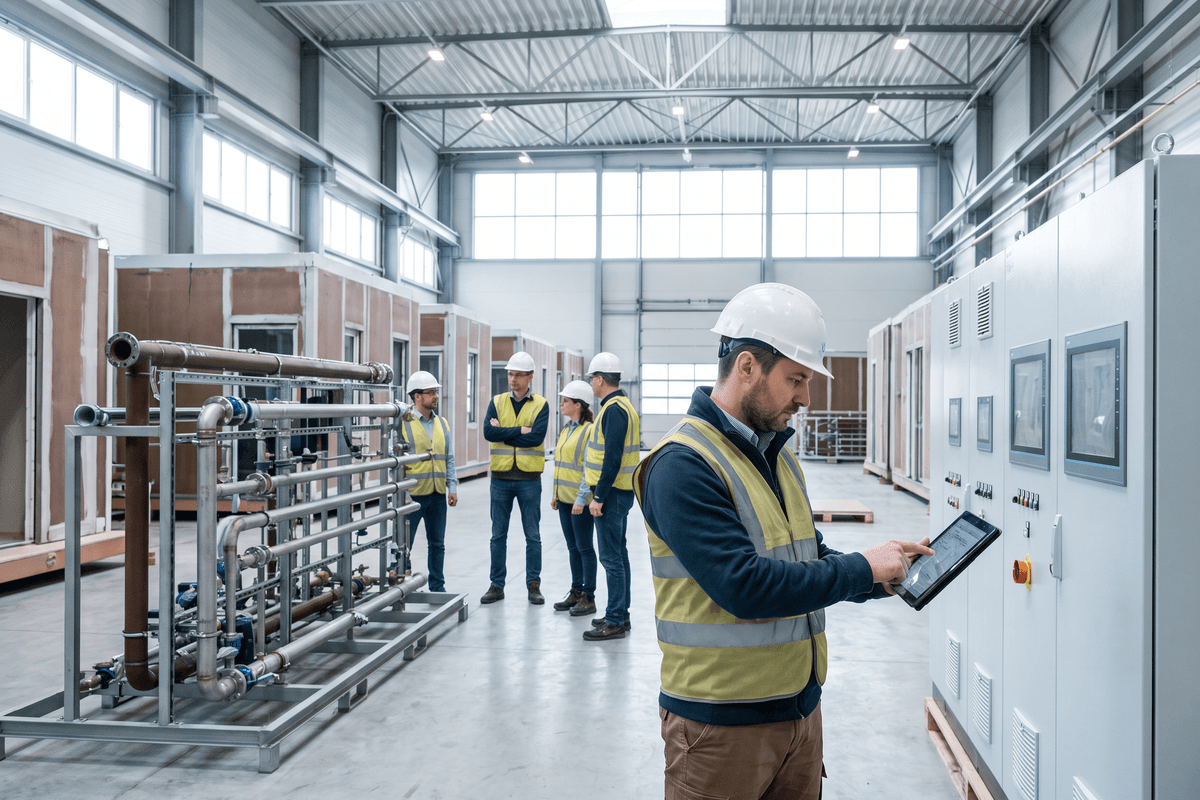



In an era where volatile material pricing and persistent labor bottlenecks threaten the viability of complex capital projects, the engineering and construction sectors are undergoing an aggressive structural realignment. The traditional paradigm of stick-built, on-site mechanical, electrical, and plumbing (MEP) execution is rapidly yielding to industrialized prefabrication. Highlighting this nationwide pivot, U.S. Engineering Metalworks has officially opened its new 110,000-square-foot manufacturing facility in Lawrence, Kansas. Representing a $25 million capital investment, the state-of-the-art operation is purpose-built to deliver modular piping, plumbing, and mechanical skids for critical infrastructure and advanced industrial facilities across the country.
The Economic Squeeze: Offsite Fabrication as a Hedge Against Inflation
The imperative for offsite manufacturing is fundamentally grounded in project economics. Recent market data shows that U.S. construction costs have risen sharply throughout 2026, driven by cumulative supply-chain friction, tariff-related raw material premiums, and climbing operational overhead. For systems engineering firms operating on fixed-price or guaranteed maximum price (GMP) contracts, field inefficiencies can rapidly eliminate profit margins.
This economic pressure is further corroborated by the latest ENR Construction Economics update on 20-city cost indexes, which documents sustained escalation in structural materials, raw alloys, and skilled trade wages across every major regional market in the United States. In response, engineering leaders are utilizing advanced shop-floor prefabrication to decouple complex assembly tasks from the unpredictable variables of the field.
"Moving labor hours from an uncontrolled jobsite into an optimized, climate-controlled fabrication plant doesn't just reduce direct field labor by 30% to 50%—it fundamentally de-risks schedule certainty, QA/QC integrity, and material scrap rates in an inflationary market."
By producing modular mechanical assemblies in high-throughput manufacturing plants like the new Lawrence facility, engineering contractors can achieve unprecedented economies of scale, standardizing welding, QA/QC testing, and pipe spool production before components ever reach the physical construction site.
Modular Industrialization: Field Assembly vs. Offsite Prefabrication
The gap in operational efficiency between traditional field installation and industrialized fabrication has widened dramatically over the past two years. Mechanical and process engineering workflows are increasingly engineered from the ground up for modular constructability.
| Operational Parameter | Traditional Field-Built MEP | Industrialized Offsite Modularization | Engineering & Business Impact |
|---|---|---|---|
| Labor Utilization & Ergonomics | Scaffolding, ladder work, weather delays, crowded trade interfaces | Stationary jigs, automated orbital welding, ground-level rigging | Up to 40% gain in labor productivity; sharp reduction in OSHA recordables |
| Material Waste & Optimization | Jobsite field cuts, scrap loss often exceeding 12-15% | Automated CNC nesting, bulk stock recycling, sub-5% scrap | Direct mitigation of raw material cost inflation and alloy supply volatility |
| Quality Assurance & Testing | Field hydrotesting, localized X-ray inspections in congested spaces | In-line non-destructive testing (NDT), automated ultrasonic inspection | Defect reduction near zero prior to site delivery and commissioning |
| Schedule Compression | Linear execution; MEP waits for core and shell readiness | Concurrent fabrication during substructure and earthwork phases | Overall project critical path compressed by 20% to 35% |
The Workforce Evolution: Automation, Controls, and High-Skill Premiums
Modern prefabrication plants bear little resemblance to the sheet metal shops of past decades. Today's fabrication infrastructure relies heavily on automated plasma cutting tables, robotic pipe-welding cells, digital twin layout projectors, and integrated ERP systems. However, scaling these high-tech plants requires a different caliber of technical talent.
According to a recent Engineering Labor Outlook report, broad hiring across general civil and structural roles has moderated, but engineering employers are paying substantial salary premiums for specialized professionals in automation, programmable logic controllers (PLC), and AI-integrated industrial tooling.
Core Competencies Driving the Modern Fabrication Floor
- Robotic Systems Integration: Mechanical engineers capable of programming multi-axis robotic welders and automated pipe-handling gantry systems.
- VDC/BIM to DfMA Translation: Designers skilled in converting Level of Development (LOD) 400 Building Information Models directly into Design for Manufacture and Assembly (DfMA) machine code.
- Smart Manufacturing Quality Controls: Technicians and systems engineers proficient in automated non-destructive evaluation and laser-scanning validation against original engineering tolerances.
Next-Gen Computational Infrastructure: From Quantum Design to Factory Floor
The industrialization of the fabrication yard is also being accelerated upstream by profound leaps in computational engineering. As modular systems grow in density—often packing critical valves, high-pressure piping, redundant electrical feeds, and chilled water networks into micro-skids—the simulation of thermal dynamics, fluid turbulence, and structural vibration becomes exponentially more complex.
Pioneering computational workflows are stepping in to solve these high-dimensional engineering challenges. In a major technology milestone, IonQ and Synopsys demonstrated that hybrid quantum algorithms can accelerate engineering simulation processing times by up to 14.6%. While currently proving its value in high-complexity aerospace and automotive systems, the integration of quantum-accelerated multiphysics solvers points toward the immediate future of industrial MEP design.
By cutting hours off complex fluid dynamic and structural stress calculations, engineering teams can iterate and optimize modular skids in virtual environments far more rapidly, ensuring that the physical spools rolling out of facilities like U.S. Engineering Metalworks' Lawrence plant are mathematically optimized for performance, weight, and fabrication cost.
Strategic Outlook: Scaling the Industrialized Delivery Model
As the United States continues to build out high-tech infrastructure—spanning semiconductor fabrication plants, data centers, advanced battery gigafactories, and biopharma facilities—the demands on mechanical engineering contractors will only intensify. These facilities require ultra-pure piping, complex process cooling, and tight spatial tolerances that are nearly impossible to achieve predictably using traditional field techniques.
Contractors and engineering executives seeking to maintain competitive advantages over the next decade must take decisive structural steps:
- Commit to Front-Loaded DfMA: Transition engineering teams from drafting passive 3D models to authoring manufacturing-ready parametric assets that interface directly with fabrication tooling.
- Invest in Regional Manufacturing Hubs: Emulate the centralized production model demonstrated in Kansas, leveraging lower land and operating costs to serve national megaproject corridors.
- Bridge the IT/OT Engineering Gap: Upskill mechanical engineering staff in industrial robotics, sensors, and automated QA/QC workflows to maximize plant-floor throughput.
The successful launch of U.S. Engineering Metalworks' Lawrence facility serves as a clear blueprint for the sector. In a market defined by high costs, tight labor, and aggressive timelines, the future of engineering delivery belongs to those who build offsite, automate with precision, and treat the construction site not as a workshop, but as the final assembly dock.