
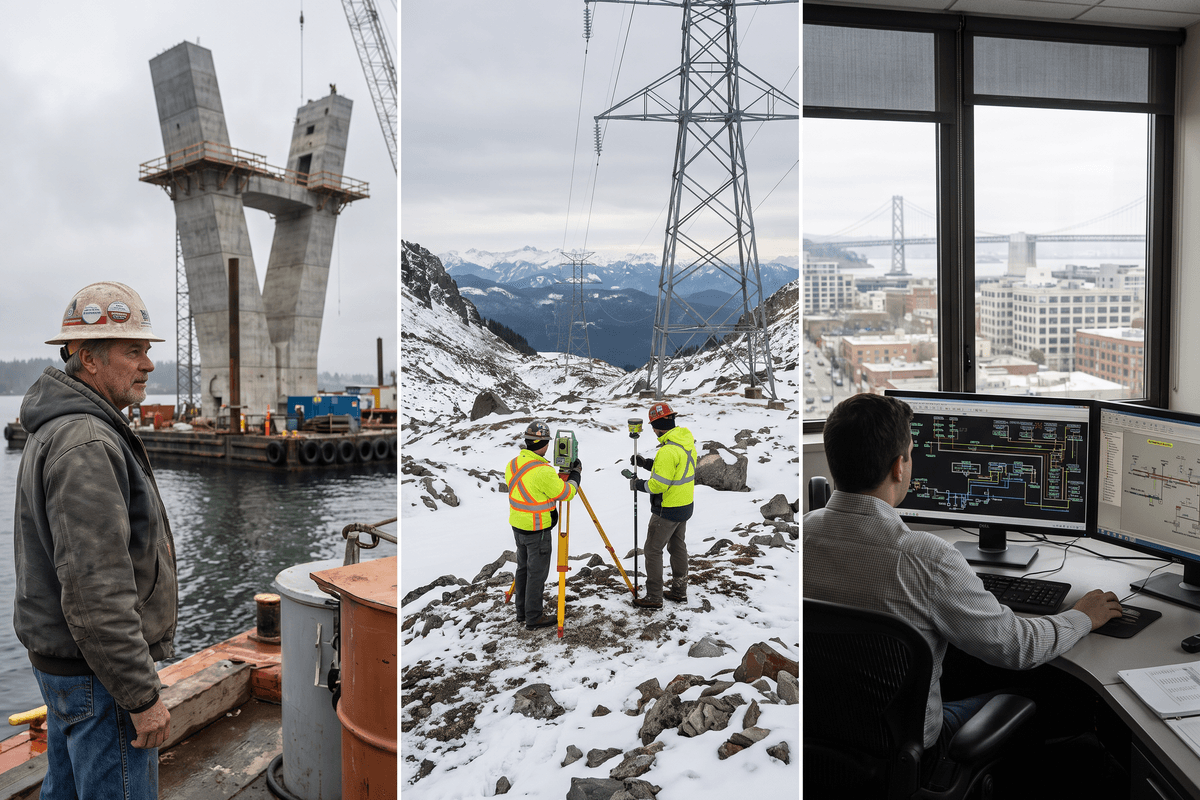



In the current era of U.S. infrastructure development, the low-hanging fruit has long been harvested. Today's engineering landscape is defined by extreme environments, unprecedented scale, and the relentless pressure of accelerated timelines. Whether securing national defense capabilities in the Pacific, untangling high-altitude transit corridors in the Rockies, or rapidly deploying utility-scale energy storage to feed the AI boom, American engineering firms are operating in a multi-front crucible. The projects defining July 2026 demonstrate a clear reality: mastering complex environmental execution is now the baseline for top-tier civil and structural engineering.
By examining concurrent milestones across marine, alpine, grid, and institutional sectors, we can extract critical lessons on how modern project delivery is evolving to meet the demands of unforgiving terrains and non-negotiable deadlines.
The Marine Megaproject: Scaling Defense at Dry Dock 5
Nowhere is the intersection of scale and environmental hostility more apparent than at Joint Base Pearl Harbor-Hickam. As of July 2026, the U.S. Navy continues to make significant headway on Dry Dock 5, officially the largest military construction project in the installation's history. Designed to accommodate the next generation of Virginia-class nuclear submarines, this project is a masterclass in heavy marine civil engineering.
Constructing a dry dock of this magnitude requires overcoming immense hydrostatic pressures, executing massive underwater concrete pours (tremie placements), and ensuring seismic resilience in a highly active tectonic region. The progress logged this month underscores the critical transition phases of marine megaprojects—moving from complex dredging and foundational anchoring to the structural build-out of the dock walls and pump infrastructure.
"Marine megaprojects like Dry Dock 5 leave zero margin for error. The structural integrity required to safely dry-dock nuclear assets demands tolerances that push the boundaries of underwater construction technology and materials science."
Key Execution Variables in Marine Civil Works:
- Hydrostatic Management: Advanced dewatering systems and continuous monitoring of cofferdam integrity.
- Material Logistics: Coordinating continuous concrete pours in a high-traffic, operational naval corridor.
- Seismic QA/QC: Integrating deep foundational piles capable of withstanding both seismic events and the dynamic loads of incoming vessels.
High-Altitude Logistics: The I-70 Floyd Hill Milestone
While marine engineers battle hydrostatic pressure in Hawaii, civil contractors in Colorado are battling gravity, hard rock, and active traffic. The I-70 Floyd Hill project recently reached its halfway mark, signaling a pivotal shift in the project's lifecycle. This critical corridor, vital for both commercial freight and mountain tourism, is transitioning from the volatile phase of heavy rock excavation to the precision phase of major bridge and roadway construction.
Alpine engineering introduces a unique set of logistical headaches. Blasting and excavating millions of tons of rock while keeping a major interstate open requires micro-phasing—breaking the project down into highly controlled, sequential windows. Now, as the project pivots to structural erection, the focus shifts to staging massive bridge girders and pouring decks in constrained, high-altitude environments where weather windows are notoriously unpredictable.
The Floyd Hill milestone is a testament to the power of modern geotechnical stabilization and phased traffic management, proving that massive infrastructure upgrades can be executed even in the most spatially constrained and geologically challenging corridors.
The Energy Backbone: Rapid Deployment of Battery Storage
While defense and transit projects are geographically bound, the U.S. energy grid is undergoing a decentralized, nationwide overhaul. Driven by the voracious power demands of artificial intelligence data centers and the continuous push to integrate intermittent renewables, battery storage construction is surging as the ultimate enabler of U.S. renewable growth.
For civil and electrical engineering firms, utility-scale Battery Energy Storage Systems (BESS) present a different kind of execution challenge: speed to market. Unlike a decade-long bridge or dry dock project, BESS facilities require rapid site preparation, rigorous thermal management infrastructure, and complex substation integration, often deployed in remote or environmentally sensitive areas.
Civil Demands of the BESS Boom:
- Thermal Containment: Designing structural firewalls and advanced HVAC/liquid cooling infrastructure to mitigate thermal runaway risks.
- Geotechnical Speed: Rapid site grading, foundational pads, and trenching for heavy electrical conduits.
- Grid Interconnection: Upgrading legacy substations to handle bi-directional power flows with minimal disruption to existing grid operations.
The Micro-Scale: Precision Craftsmanship in Institutional Mechanical Systems
Megaprojects and grid expansions dominate the headlines, but the operational success of any facility ultimately relies on internal mechanical precision. A recent update detailing July 2026 progress at U.S. Engineering highlights the vital role of mechanical craftsmanship in institutional settings, specifically showcasing work on a Colorado high school and a Missouri detention center.
These environments require highly specialized HVAC, plumbing, and building automation systems. In a detention center, mechanical systems must be tamper-proof, redundant, and highly secure. In modern educational facilities, the focus is on energy efficiency, indoor air quality (IAQ), and acoustic control. This level of craftsmanship reminds us that while heavy civil engineering shapes the macro-environment, mechanical engineering dictates the human experience within it.
Comparing the Execution Environments
To understand the breadth of current U.S. engineering demands, we can categorize these projects by their primary environmental challenges and engineering focuses:
| Project Domain | Example Project | Primary Environmental Challenge | Core Engineering Focus |
|---|---|---|---|
| Marine Defense | Dry Dock 5 (HI) | Hydrostatic pressure, seismic activity, active naval operations | Tremie concrete, deep foundations, structural resilience |
| Alpine Transit | I-70 Floyd Hill (CO) | Hard rock geology, constrained staging, active traffic flow | Geotechnical stabilization, micro-phased bridge erection |
| Grid Storage | National BESS Deployments | Decentralized sites, rapid deployment timelines | Thermal containment, rapid site prep, electrical integration |
| Institutional facilities | U.S. Engineering Projects (CO/MO) | Strict regulatory codes, specialized user requirements | Secure mechanical systems, IAQ, energy efficiency |
Conclusion: The Multidisciplinary Imperative
The progress logged in July 2026 across Pearl Harbor, the Colorado Rockies, and utility grids nationwide paints a picture of an industry operating at peak complexity. The days of siloed engineering disciplines are over. Building a dry dock requires advanced materials science; erecting an alpine bridge requires masterful traffic and logistics management; deploying battery storage requires seamless civil-electrical integration; and outfitting institutional buildings demands elite mechanical craftsmanship.
For U.S. engineering professionals, the forward-looking mandate is clear: technical expertise in a single domain is no longer sufficient. The future belongs to firms and project managers who can navigate the "terrain crucible"—synthesizing diverse engineering disciplines to execute high-stakes infrastructure in the nation's most unforgiving environments.