
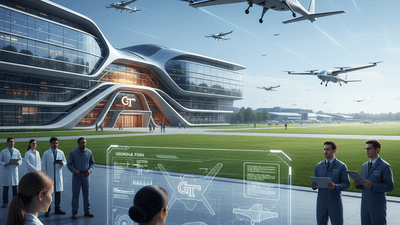



In an era where the global race for aerospace dominance is intensifying—ranging from next-generation commercial travel to autonomous defense systems—the infrastructure supporting engineering education is becoming as critical as the curriculum itself. The Georgia Institute of Technology has announced plans to construct a new aerospace engineering building, a move backed by significant state funding and a major investment from The Delta Air Lines Foundation. For engineering professionals across the United States, this development signals more than just campus expansion; it represents a strategic pivot toward integrating traditional aeronautics with emerging fields like cybersecurity, autonomy, and advanced materials.
Georgia Tech's new facility, supported by public-private partnerships, aims to solve the critical shortage of specialized aerospace engineers by merging physical testing capabilities with digital disciplines like AI and cybersecurity.
A Convergence of Hardware and Software
The aerospace sector is currently undergoing a profound transformation. The days of designing airframes in isolation from their digital control systems are over. The new facility at Georgia Tech is designed to address this convergence by expanding research capacity in five critical pillars:
- Advanced Aircraft Design: Moving beyond traditional aerodynamics to integrated digital twins.
- Propulsion: focusing on sustainable fuels and electrification.
- Materials: Developing lighter, stronger composites for extreme environments.
- Cybersecurity: Protecting connected aircraft from digital threats.
- Autonomy: Engineering the next generation of uncrewed aerial systems.
This holistic approach mirrors the demands of the modern aerospace industry, where a mechanical engineer must understand sensor integration, and a software engineer must grasp aerodynamic constraints.
Addressing the Engineering Workforce Gap
The timing of this investment is particularly notable given the shifting landscape of the U.S. engineering labor market. While the tech sector faces uncertainty regarding entry-level coding roles, the demand for engineers capable of building physical, complex systems is rising.
"As AI systems become capable of handling basic coding tasks, the engineering value chain is shifting upward. The industry needs professionals who can bridge the gap between AI algorithms and physical reality."
According to recent industry analysis, entry-level software engineering jobs could see significant disruption by 2026 due to AI automation. However, aerospace engineering remains a stronghold for human expertise. Designing a propulsion system or certifying an autonomous aircraft requires a synthesis of physics, safety compliance, and material science that current AI cannot replicate autonomously.
Georgia Tech's expansion specifically targets this "high-skill" gap, ensuring that the U.S. maintains a pipeline of talent capable of tackling problems that software alone cannot solve.
The Role of AI in Modern Aerospace Design
While the new building focuses on physical infrastructure, the research conducted within will heavily leverage artificial intelligence to accelerate development cycles. The intersection of AI and Computer-Aided Design (CAD) is becoming a focal point for university research.
For instance, researchers are already developing AI agents capable of learning CAD to create 3D objects directly from sketches. This technology, pioneered at institutions like MIT, allows engineers to move from concept to prototype much faster. By integrating such tools into the curriculum, Georgia Tech is preparing students for a future where engineers act as conductors of AI design tools rather than just operators.
Strategic Research Priorities
The new facility is expected to prioritize research areas that directly impact U.S. competitiveness. The table below outlines how these academic focus areas translate to industry applications.
| Research Focus | Academic Goal | Industry Application |
|---|---|---|
| Autonomy | Algorithm development for non-deterministic environments | Urban Air Mobility (UAM), military drones, and autonomous cargo delivery. |
| Propulsion | Thermodynamics of alternative fuels and electric drives | Decarbonizing commercial aviation (Net-Zero 2050 goals). |
| Cybersecurity | Resilient avionics architectures | Preventing hijacking or disabling of connected aircraft fleets. |
| Advanced Materials | Nanomaterial integration and composite testing | Hypersonic flight vehicles and lightweight commercial airframes. |
The Power of Public-Private Partnerships
The financing of this project highlights a critical trend in American engineering: the necessity of public-private partnerships. The backing from The Delta Air Lines Foundation alongside state funding demonstrates that industry leaders view academic infrastructure as a direct extension of their own R&D capabilities.
For Delta, headquartered in Atlanta, this is not merely philanthropy; it is supply chain management for talent. As airlines face retiring workforces and increasingly complex maintenance and operations requirements, having a premier research institution next door provides a direct feeder for top-tier engineering talent.
Conclusion: A Blueprint for Future Engineering
Georgia Tech’s new aerospace building is a microcosm of where the engineering profession is heading. It rejects the siloed approach of the past, embracing a multidisciplinary model where aerodynamics, AI, and cybersecurity coexist. For engineering professionals, the message is clear: the most valuable skill sets of the next decade will be those that can navigate the interface between the physical world and the digital systems that control it.
As construction begins, the facility stands as a tangible commitment to keeping the United States at the forefront of aerospace innovation, ensuring that the next generation of aircraft—and the engineers who build them—are ready for takeoff.