
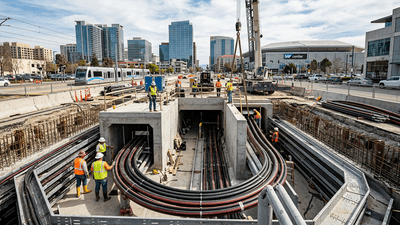



The era of easy right-of-ways is officially over. For decades, expanding the U.S. electrical grid meant a predictable sequence of land acquisition, steel monopoles, and stringing overhead lines across open terrain. But as load growth surges in densely populated technological hubs—driven by data centers, electrification, and advanced manufacturing—engineering firms are increasingly being forced to look down.
A landmark infrastructure project in California provides the clearest blueprint yet for this new reality. San Jose has inked a deal with LS Power to develop 2 gigawatts (GW) of new transmission capacity to meet critical South Bay reliability needs. The project will add 17 miles of new transmission lines. The defining engineering challenge? Twelve of those miles will be routed entirely underground.
For U.S. engineering professionals, the San Jose project is not just another utility upgrade; it is a bellwether. It signals a permanent shift toward high-complexity, high-capex urban grid modernization that will demand a radically different set of engineering disciplines, supply chain logistics, and talent pipelines over the next decade.
The Subterranean Shift: Engineering the San Jose Blueprint
Undergrounding high-voltage transmission is notoriously difficult and historically avoided due to cost multipliers that can range from five to ten times that of overhead lines. However, in dense urban corridors like the South Bay, NIMBYism, lack of physical space, and the need for wildfire resilience have made undergrounding the only viable path forward.
The Thermal and Civil Challenges
Moving 2 GW of power underground strips engineers of their greatest natural asset: air cooling. High-voltage alternating current (HVAC) or direct current (HVDC) cables generate immense heat. When buried, that heat must be managed through precise civil and materials engineering.
- Thermal Backfill Engineering: Traditional soil acts as an insulator, trapping heat and degrading cable capacity. Projects of this scale require specialized thermal backfill—engineered soils or fluidic concrete mixtures—that can rapidly dissipate heat away from the conduit.
- Joint Bay Construction: High-voltage cables can only be manufactured and transported in limited lengths. For a 12-mile underground route, engineers must design massive subterranean "joint bays" (splicing vaults) every few thousand feet. These vaults are essentially underground cleanrooms where highly specialized technicians splice cables with zero tolerance for moisture or contamination.
- Horizontal Directional Drilling (HDD): Trenching through 12 miles of urban San Jose means navigating a labyrinth of existing water, sewer, telecom, and gas lines. Extensive use of HDD and micro-tunneling will be required to bypass critical infrastructure without disrupting surface-level city operations.
"We are transitioning from an era of purely electrical grid expansion to an era of heavy civil grid integration. You can no longer design a transmission line without simultaneously designing a complex subterranean civil works project."
Overhead vs. Urban Underground Transmission
| Engineering Factor | Traditional Overhead | Urban Underground (San Jose Model) |
|---|---|---|
| Cooling Mechanism | Ambient Air (Convection) | Engineered Thermal Backfill / Conduction |
| Right-of-Way Needs | Wide corridors, clear-cutting | Narrow trenches, high subsurface conflict |
| Splicing & Maintenance | Accessible via bucket trucks | Requires massive underground joint bays |
| Primary Engineering Focus | Structural (Wind/Ice loading) | Civil, Geotechnical, and Thermal |
The Talent Pipeline Fueling the Grid Supercycle
You cannot execute 12 miles of underground high-voltage transmission with legacy skill sets. The San Jose project, and the dozens of similar urban megaprojects following in its wake, require a new breed of engineer—one who understands the intersection of heavy civil construction, advanced electrical systems, and complex supply chain management.
Fortunately, the geographic alignment of top-tier engineering programs is rising to meet this localized demand. California’s infrastructure demands are increasingly being met by its homegrown elite institutions. The University of California San Diego's Jacobs School of Engineering recently secured the #9 spot in the nation (and #6 among public schools) in the 2026 U.S. News & World Report Rankings. Programs like UCSD's, which emphasize cross-disciplinary structural and systems engineering, are exactly the talent engines required to staff complex regional projects like the South Bay transmission upgrade.
Supply Chains and Baseload: The National Picture
While the physical construction of the San Jose project is a local civil engineering feat, the broader implications for the U.S. grid stretch nationwide. Adding 2 GW of transmission capacity implies that there is 2 GW of reliable generation to transmit, and securing the materials to build these lines is currently the industry's largest bottleneck.
This is where specialized national programs are stepping in to solve the macro-level challenges of grid modernization. The University of Tennessee’s Tickle College of Engineering recently rose to 28th among public universities, driven by highly targeted specialties that directly impact infrastructure megaprojects. UT Knoxville now boasts the #3 ranked nuclear engineering program in the nation, alongside top-tier supply chain management programs.
Why does this matter for a transmission line in California? Because the high-voltage cables, specialized switchgear, and transformers required for the LS Power deal are currently facing lead times of up to 150 weeks. Engineers with advanced supply chain expertise are becoming just as critical to project delivery as the civil engineers digging the trenches. Furthermore, as states look to feed these expanded urban grids with firm, zero-carbon baseload power, the resurgence of nuclear engineering (particularly in Small Modular Reactors) is inextricably linked to transmission expansion.
Looking Ahead: The New Standard for Urban Power
The LS Power and San Jose agreement is more than a regional fix for the South Bay; it is a preview of the 2030s. As data centers proliferate and urban electrification accelerates, overhead transmission will increasingly become a non-starter in major metropolitan areas.
For U.S. engineering firms, the mandate is clear. The competitive edge will no longer belong to firms that can simply string wire the fastest. It will belong to those who can master the subterranean environment, manage highly constrained global supply chains for high-voltage components, and recruit from the top-tier academic programs that are actively rewriting the curriculum for the modern grid. The future of power is moving underground, and the engineering sector must dig deep to meet it.